Birdr

Nile Valley Sunbird vs Abyssinian Sunbird

Hedydipna metallica versus Cinnyris habessinicus

Play a quiz with Nile Valley Sunbird and Abyssinian Sunbird
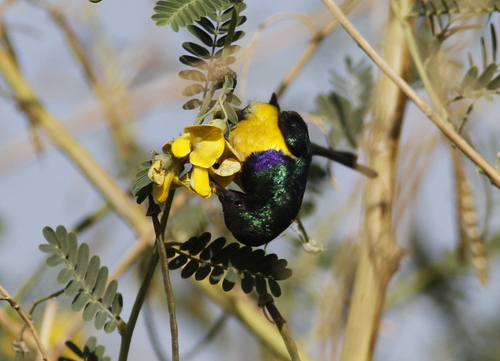
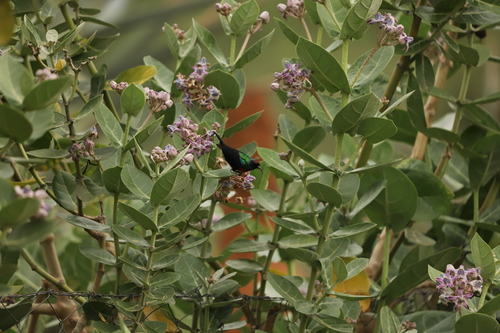
Nile Valley Sunbird (Hedydipna metallica) Nile Valley Sunbird
Abyssinian Sunbird (Cinnyris habessinicus) Abyssinian Sunbird

Media

Loading…

In short

The Nile Valley Sunbird and the Abyssinian Sunbird are both small, colorful sunbirds with overlapping ranges in northeastern Africa. Key differences include the male plumage and habitat preferences. Observing the bill shape and plumage details can help differentiate these species in the field.

Identification tips

1. Check the bill: The Abyssinian Sunbird has a longer, more decurved bill compared to the Nile Valley Sunbird. 2. Observe male plumage: Look for the metallic blue throat in male Nile Valley Sunbirds and the red breast-band in male Abyssinian Sunbirds. 3. Note habitat: Consider the habitat; Nile Valley Sunbirds are more associated with riverine areas, while Abyssinian Sunbirds prefer open woodlands and rocky areas.

Size

Both species are similar in size, typical of small sunbirds, but the Abyssinian Sunbird may appear slightly larger due to its longer, decurved bill.

Plumage

Male Nile Valley Sunbirds have metallic green upperparts and a distinctive metallic blue throat, while male Abyssinian Sunbirds have golden-green upperparts with a broad red breast-band. Female Nile Valley Sunbirds are more uniformly colored compared to the pale gray-brown females of the Abyssinian Sunbird, which have a dark tail and pale underparts.

Behaviour

Both species exhibit typical sunbird behavior, feeding on nectar and insects, but the Abyssinian Sunbird is more often found in open woodlands and rocky hillsides.

Habitat

Nile Valley Sunbirds are often found in riverine habitats and gardens, while Abyssinian Sunbirds prefer open woodlands, thornbush, and rocky hillsides below 2,000 m.

Voice

Vocalizations are not well-documented for both species, but they likely have similar calls typical of sunbirds, consisting of high-pitched, rapid notes.

Submit a better description

Use the same sections as the comparison. Your text is published immediately.

The Nile Valley Sunbird and the Abyssinian Sunbird are both small, colorful sunbirds with overlapping ranges in northeastern Africa. Key differences include the male plumage and habitat preferences. Observing the bill shape and plumage details can help differentiate these species in the field.

1. Check the bill: The Abyssinian Sunbird has a longer, more decurved bill compared to the Nile Valley Sunbird. 2. Observe male plumage: Look for the metallic blue throat in male Nile Valley Sunbirds and the red breast-band in male Abyssinian Sunbirds. 3. Note habitat: Consider the habitat; Nile Valley Sunbirds are more associated with riverine areas, while Abyssinian Sunbirds prefer open woodlands and rocky areas.

Both species are similar in size, typical of small sunbirds, but the Abyssinian Sunbird may appear slightly larger due to its longer, decurved bill.

Male Nile Valley Sunbirds have metallic green upperparts and a distinctive metallic blue throat, while male Abyssinian Sunbirds have golden-green upperparts with a broad red breast-band. Female Nile Valley Sunbirds are more uniformly colored compared to the pale gray-brown females of the Abyssinian Sunbird, which have a dark tail and pale underparts.

Both species exhibit typical sunbird behavior, feeding on nectar and insects, but the Abyssinian Sunbird is more often found in open woodlands and rocky hillsides.

Nile Valley Sunbirds are often found in riverine habitats and gardens, while Abyssinian Sunbirds prefer open woodlands, thornbush, and rocky hillsides below 2,000 m.

Vocalizations are not well-documented for both species, but they likely have similar calls typical of sunbirds, consisting of high-pitched, rapid notes.

Discard your changes?

You have unsaved edits. If you leave now, those changes will be lost.

Nile Valley Sunbird · Abyssinian Sunbird · My Tricky Birds