Northern Bald Ibis vs African Spoonbill
Geronticus eremita versus Platalea alba
Play a quiz with Northern Bald Ibis and African Spoonbill
Northern Bald Ibis
African Spoonbill
In short
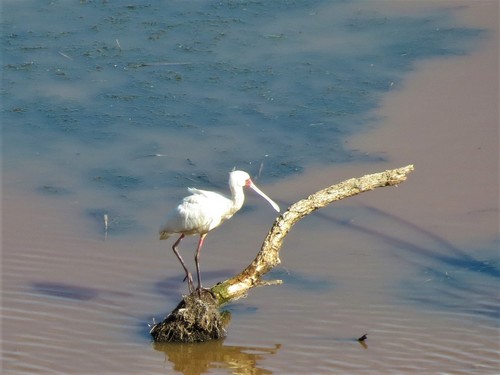
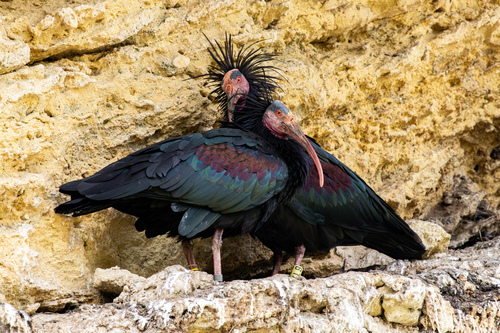
The bill shape is the most reliable field mark: the Northern Bald Ibis has a long, downward-curving bill, while the African Spoonbill has a distinctive, flat, spoon-shaped bill. These differences are easily observed with binoculars. Both species belong to the same family, but their unique bill structures make them unmistakable in the field.
Identification tips
- Bill shape: Northern Bald Ibis has a long, curved bill; African Spoonbill has a flat, spoon-shaped bill.
- Plumage: Look for the iridescent black body and bald red head of the Northern Bald Ibis versus the all-white plumage of the African Spoonbill.
- Habitat: Note the environment; Northern Bald Ibis in arid, rocky areas, African Spoonbill in wetlands.
- Behavior: Observe feeding behavior; Northern Bald Ibis may be seen in drier areas, while African Spoonbill is usually wading in water.
Size
Both species are similar in size, with the Northern Bald Ibis being slightly more robust.
Plumage
The Northern Bald Ibis has a mostly black plumage with an iridescent sheen and a bald, red face and head. In contrast, the African Spoonbill is predominantly white with a red face and legs.
Behaviour
Both species forage in wetlands but the Northern Bald Ibis is more often seen in rocky, arid habitats, while the African Spoonbill is typically found wading in water.
Habitat
Northern Bald Ibis prefers arid, rocky environments and open areas, whereas the African Spoonbill is more commonly found in wetlands, marshes, and shallow lakes.
Voice
Vocalizations are not a primary distinguishing feature; both species are relatively quiet, but the Northern Bald Ibis may produce croaking sounds.