Birdr

Northern Gannet vs European Shag

Morus bassanus versus Gulosus aristotelis

Play a quiz with Northern Gannet and European Shag

Northern Gannet (Morus bassanus) Northern Gannet
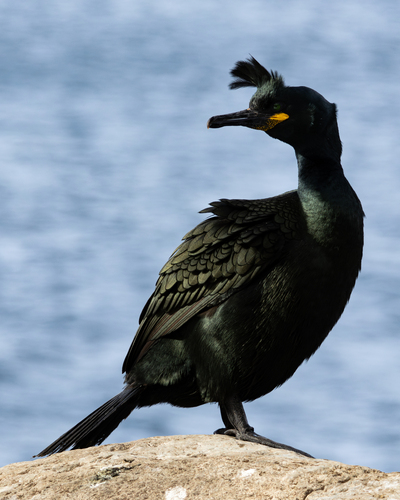
European Shag (Gulosus aristotelis) European Shag

Media

Loading…

In short

The Northern Gannet and European Shag are both seabirds but differ significantly in size and plumage. The Northern Gannet is much larger with a predominantly white body and black wingtips, while the European Shag is smaller and dark all over. Both species are plunge-divers, but their habitats and behaviors provide additional clues for identification.

Identification tips

Size

The Northern Gannet is considerably larger than the European Shag, with a wingspan reaching up to 2 meters, compared to the Shag's more modest size.

Plumage

Northern Gannets are predominantly white with distinctive black wingtips, especially noticeable in adults. In contrast, European Shags are uniformly dark, often appearing black or dark green, with a glossy sheen.

Behaviour

Both species are plunge-divers, but Northern Gannets often forage far from their colonies, while European Shags tend to stay closer to the coast. Gannets are also known for their high-altitude dives.

Habitat

Northern Gannets are typically found in large colonies on cliffs and islands in the North Atlantic, often far from shore. European Shags prefer rocky coastlines and are more commonly seen nearshore.

Voice

The Northern Gannet is generally silent at sea but can be noisy at colonies, while the European Shag has a variety of harsh calls, often heard around nesting sites.

Submit a better description

Use the same sections as the comparison. Your text is published immediately.

The Northern Gannet and European Shag are both seabirds but differ significantly in size and plumage. The Northern Gannet is much larger with a predominantly white body and black wingtips, while the European Shag is smaller and dark all over. Both species are plunge-divers, but their habitats and behaviors provide additional clues for identification.

  • Size: Look for the much larger size of the Northern Gannet.
  • Plumage: Note the white body and black wingtips of the Gannet versus the all-dark plumage of the Shag.
  • Habitat: Consider the location; Gannets are often seen far offshore, while Shags are near rocky coasts.
  • Behavior: Observe diving behavior; Gannets dive from higher altitudes.

The Northern Gannet is considerably larger than the European Shag, with a wingspan reaching up to 2 meters, compared to the Shag's more modest size.

Northern Gannets are predominantly white with distinctive black wingtips, especially noticeable in adults. In contrast, European Shags are uniformly dark, often appearing black or dark green, with a glossy sheen.

Both species are plunge-divers, but Northern Gannets often forage far from their colonies, while European Shags tend to stay closer to the coast. Gannets are also known for their high-altitude dives.

Northern Gannets are typically found in large colonies on cliffs and islands in the North Atlantic, often far from shore. European Shags prefer rocky coastlines and are more commonly seen nearshore.

The Northern Gannet is generally silent at sea but can be noisy at colonies, while the European Shag has a variety of harsh calls, often heard around nesting sites.

Discard your changes?

You have unsaved edits. If you leave now, those changes will be lost.

Northern Gannet · European Shag · My Tricky Birds