
Northern House Wren vs Pacific Wren
Troglodytes aedon versus Troglodytes pacificus
Play a quiz with Northern House Wren and Pacific Wren
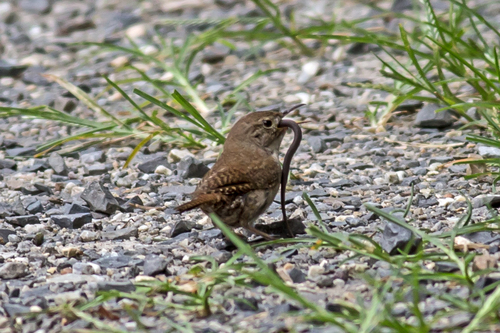 Northern House Wren
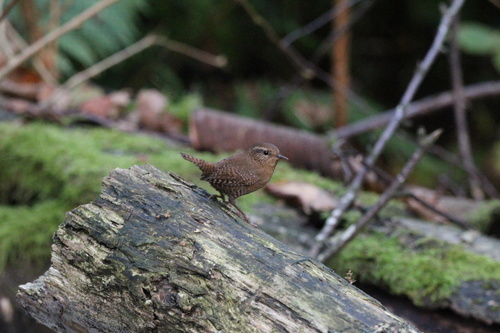 Pacific Wren
In short
The most reliable field mark between Northern House Wren and Pacific Wren is overall plumage tone and barring: Pacific Wren is a richer, more uniformly rufous-brown bird with extensive, crisp barring above and below, while Northern House Wren is paler and more variable, with less distinct barring and often paler underparts. Both are tiny, active wrens with cocked tails and similar structure, but Pacific Wren favors dense coniferous forests and sounds off with a longer, more exuberant song, whereas Northern House Wren is more likely in open or suburban areas. Juvenile and immature plumages are subtly different, but barring and overall color remain useful. Structure and behavior are similar, so careful attention to plumage and habitat is key.
Identification tips
- Overall color: Pacific Wren is a rich, warm rufous-brown above and below, while Northern House Wren is paler, greyer, or buffier, especially below. This is visible in all ages, but especially adults.
- Barring: Pacific Wren shows heavy, crisp barring on wings, tail, and flanks, even below; House Wren has barring on wings and tail, but flanks and underparts are often less distinctly barred or even plain.
- Juvenile/immature plumage: Pacific Wren juveniles are less barred than adults but still richer brown overall; House Wren juveniles can be very pale or greyish below, with weak barring.
- Bill color: House Wren has a long, thin bill with a blackish upper mandible and a pale (yellowish or grey) lower mandible tipped black; Pacific Wren's bill is uniformly dark brown. This is subtle but can help at close range.
- Underpart color: House Wren underparts can be brown, buff, pale grey, or white, often much paler than Pacific Wren, which is consistently rich brown below.
- Habitat: In dense, mossy, coniferous forests, Pacific Wren is expected; in open woods, gardens, or suburban areas, House Wren is much more likely.
- Song: Pacific Wren's song is longer, more exuberant, and continuous; House Wren's is shorter and less complex. Use this only in the breeding season.
- Eye-ring and eyebrow: Both have faint eye-rings and eyebrows; these are not reliable for separation.
- Tail posture: Both species cock their tails, so this is not useful for separation.
- Flight style: Both have short, whirring flights with rounded wings; not a separator.
- Leg color: House Wren legs are pinkish or grey; Pacific Wren's are pale brown. This is subtle and rarely diagnostic.
- Subspecies variation: House Wren varies greatly across its range, so always consider local context and compare to known local birds.
- Context: If you find a wren in a nest box or near buildings, it's almost certainly House Wren; Pacific Wren avoids such settings.
- Season: Both species are most vocal in the breeding season; in winter, Pacific Wren may roost communally in cavities, but this is not unique.
- Pitfalls: Beware of duller House Wrens in the west, which can appear darker and more rufous, approaching Pacific Wren tones; in these cases, rely on barring and habitat.
Size
Both species are extremely small wrens, and their body mass is nearly identical (Northern House Wren: 11.5 g [wikidata]). Length and wingspan are also very close, with Northern House Wren at 11–13 cm long and a 15 cm wingspan. No direct mass or measurement is given for Pacific Wren, but it is not appreciably larger or smaller in the field. Size is not a reliable separator between these two.
Plumage
-
Juvenile/immature plumage: Pacific Wren juveniles are less distinctly barred than adults, but still show a generally rich rufous-brown tone above and below. Northern House Wren juveniles and immatures are variable, but tend toward duller, greyer or paler brown above, with underparts that can be brown, buff, pale gray, or even white. Both have some barring on wings and tail, but Pacific Wren's barring is more extensive and crisp, especially on the flanks and underparts, while House Wren's is more limited and sometimes faint.
-
Adult plumage: Pacific Wren is rufous-brown above and below, with heavy, even barring on wings, tail, and flanks, and a dark brown bill. Northern House Wren is more variable: upperparts can be dull grey-brown to rich rufous-brown, underparts are often paler (sometimes nearly white), and barring is present on wings and tail but less extensive on the flanks. Both show a faint eye-ring and eyebrow, but these are not strong field marks. House Wren's bill is long and thin, with a blackish upper mandible and a paler lower mandible tipped black; Pacific Wren's bill is dark brown throughout.
Behaviour
Both species are restless, creeping and climbing through low vegetation and brush, often with cocked tails. Pacific Wren is described as incessantly moving, with short, direct flights and whirring, rounded wings. House Wren is similarly active and perky, especially in suburban settings. In flight, both appear small and round with short tails, and neither shows a strong flight pattern difference in the notes. Both may roost in cavities or old nests, especially in winter.
Habitat
Northern House Wren is common in open woodlands, suburban yards, and gardens across southern Canada, the USA, and Mexico. It readily uses nest boxes and is often found around human habitation. Pacific Wren, by contrast, is strongly tied to dense coniferous forests, especially spruce and fir, and avoids open or suburban habitats. In urban areas, Pacific Wrens tend to relocate to nearby forests rather than stay in developed settings. If you find a tiny wren in a dense, mossy, coniferous forest, Pacific Wren is far more likely; in a suburban yard or open woodland, House Wren is the default.
Voice
Both species are renowned for their complex, bubbly songs, but Pacific Wren's song is longer, more exuberant, and intricate, often described as a continuous cascade. House Wren's song is rich and bubbly but typically shorter and less elaborate. Song is most useful during the breeding season, as House Wren sings less outside this period. Both species have variable songs, but Pacific Wren's is especially complex and can be adapted in noisy environments.