
Northern Pygmy-Owl vs Burrowing Owl
Glaucidium gnoma versus Athene cunicularia
Play a quiz with Northern Pygmy-Owl and Burrowing Owl
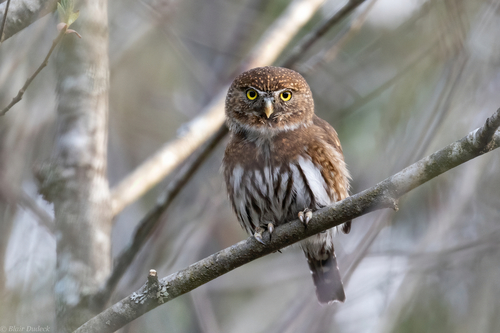 Northern Pygmy-Owl
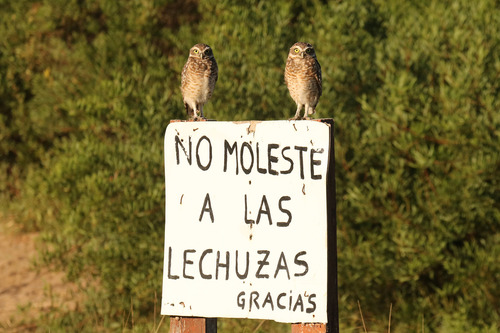 Burrowing Owl
In short
The most reliable field mark to separate Northern Pygmy-Owl from Burrowing Owl is leg length and posture: Burrowing Owl stands upright on long, exposed grayish legs, often on the ground or a low perch, while Northern Pygmy-Owl perches higher with short, feathered legs and a compact, round-bodied look. In flight or perched, Burrowing Owl shows a white 'chin' patch and prominent white eyebrows, whereas Northern Pygmy-Owl has a spotted crown and distinctive black-and-white nape 'eyes'. Juvenile Burrowing Owls lack upperpart spotting and have a buff wing bar, while all ages of Northern Pygmy-Owl show white spots on the head and wings. Habitat is a strong clue: Burrowing Owl is strictly terrestrial in open country, Northern Pygmy-Owl is arboreal in forested areas.
Identification tips
- Leg length and posture: Burrowing Owl stands tall on long, exposed grayish legs, often upright on the ground or a low perch. Northern Pygmy-Owl has short, feathered legs and sits low and horizontally on branches.
- Habitat context: Burrowing Owl is always in open country, usually near a burrow or on the ground. Northern Pygmy-Owl is in wooded or forested areas, perching high in trees.
- Nape 'eyes': Only Northern Pygmy-Owl has two black spots outlined in white on the nape, visible from behind. Burrowing Owl lacks this feature.
- Facial markings: Burrowing Owl has prominent white eyebrows and a white 'chin' patch, especially visible when agitated. Northern Pygmy-Owl has a weakly defined facial disc and lacks these strong facial contrasts.
- Head spotting: Northern Pygmy-Owl always has a round, white-spotted head. Burrowing Owl's head is brown with white spots in adults, but juveniles lack most spotting.
- Underpart pattern: Northern Pygmy-Owl shows white underparts with dark vertical streaks. Burrowing Owl adults have white underparts with brown spots or barring; juveniles have buffy, unmarked breasts.
- Wing and tail: Burrowing Owl has long wings and tail for its size, giving a lanky look, especially in flight. Northern Pygmy-Owl is compact with a relatively long tail, but overall much smaller and rounder.
- Juvenile confusion: Juvenile Burrowing Owls lack white spotting above and have a buff wing bar and breast, while juvenile Northern Pygmy-Owls retain white spots and nape 'eyes'.
- Perch choice: Northern Pygmy-Owl perches high in trees; Burrowing Owl is almost always on the ground or a low post.
- Flight style: Northern Pygmy-Owl's flight is direct and buzzing, not silent. Burrowing Owl's flight is more buoyant and low to the ground.
- Bill color: Northern Pygmy-Owl has a yellowish-green bill; Burrowing Owl's bill is dark yellow or gray, but this is rarely diagnostic in the field.
- Eye color: Both have yellow eyes, not a useful separator.
- Sex differences: Both species show little sexual dimorphism in plumage; males and females look alike.
- Size impression: Burrowing Owl is larger and more elongated; Northern Pygmy-Owl is tiny and round.
- Vocalization (when heard): Northern Pygmy-Owl's call is ventriloquistic and given from high perches; Burrowing Owl's call is not described here, so use with caution.
Size
Burrowing Owl is noticeably larger: 19–28 cm (7–11 in) long with a 50.8–61 cm (20–24 in) wingspan and 140–240 g mass [wikipedia]. Northern Pygmy-Owl is much smaller and more compact: 15–17 cm (5.9–6.7 in) long [wikipedia]. In the field, Burrowing Owl looks lanky and upright, while Northern Pygmy-Owl is stubby and round with a relatively long tail for its size.
Plumage
- Juvenile/immature birds: Juvenile Burrowing Owls lack most white spotting above and brown barring below, showing a buff bar across the upper wings and a buff (not white) breast. Juvenile Northern Pygmy-Owls retain the white spots on the head and wings, and always have the black-and-white nape 'eyes'.
- Adults: Northern Pygmy-Owl adults are gray, brownish-gray, or rufous, with a round, white-spotted head, weak facial disc, and white underparts with vertical streaking. Burrowing Owl adults are brown with white spots above, white with brown barring or spots below, and have a flat facial disc, white eyebrows, and a white 'chin' patch. Burrowing Owl lacks the nape 'eyes' of the pygmy-owl.
- Wings in flight: No unique upperwing pattern is described for either species in flight, but the Burrowing Owl's long wings and white underparts contrast with the pygmy-owl's compact, dark wings and streaked underparts.
Behaviour
Northern Pygmy-Owl is arboreal, perching high in conifer trees, often at the very top, and is rarely seen on the ground. It hunts from perches and is active by day, but is hard to spot due to its small size and cryptic color. Its flight is not silent and produces a buzzing or whirring sound. Burrowing Owl is terrestrial, spending most of its time on the ground or on low posts, often seen standing upright outside a burrow. It is tolerant of human presence, sometimes nesting in urban or agricultural settings, and is active during the day. It rarely perches in trees.
Habitat
Habitat is a strong separator: Northern Pygmy-Owl is found in western North American forests, especially coniferous woods, and nests in tree cavities. Burrowing Owl is strictly a bird of open country—grasslands, rangelands, deserts, agricultural fields, and even urban lawns—always where there is low vegetation and burrows for nesting. If you see an owl on the ground in open country, it is almost certainly a Burrowing Owl; if it is in a forest, especially perched high, it is Northern Pygmy-Owl.
Voice
Northern Pygmy-Owl males give a territorial call from high perches, described as ventriloquistic and hard to localize. No specific vocalization details are given for Burrowing Owl in the provided notes.