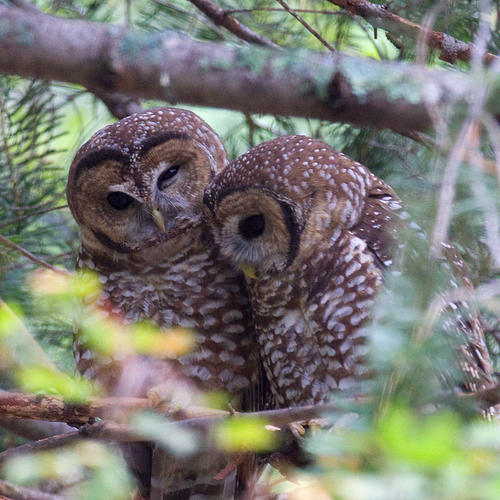
Northern Pygmy-Owl vs Spotted Owl
Glaucidium gnoma versus Strix occidentalis
Play a quiz with Northern Pygmy-Owl and Spotted Owl
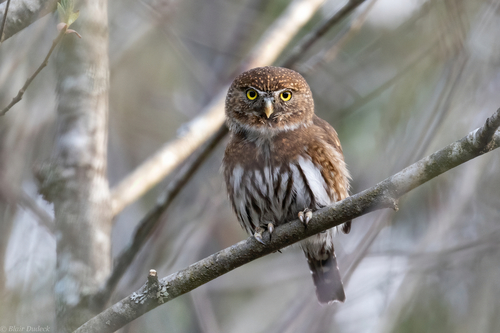
Northern Pygmy-Owl
Spotted Owl
In short
The Northern Pygmy-Owl and Spotted Owl are both forest-dwelling owls but differ significantly in size and appearance. The Northern Pygmy-Owl is much smaller and more active during the day, while the Spotted Owl is larger and primarily nocturnal.
Identification tips
Size: Look for the much smaller size of the Northern Pygmy-Owl. Activity: Note the time of day; Northern Pygmy-Owls are active during the day, while Spotted Owls are nocturnal. Plumage: Check for the lack of ear tufts and the more uniform spotting on the Northern Pygmy-Owl compared to the mottled appearance of the Spotted Owl. Vocalization: Listen for the simple, repetitive calls of the Northern Pygmy-Owl versus the more complex hoots of the Spotted Owl.
Size
The Northern Pygmy-Owl is a small owl, significantly smaller than the Spotted Owl, which is a medium to large-sized owl.
Plumage
Northern Pygmy-Owls have a compact body with a round head and lack ear tufts, featuring a brownish plumage with white spots. In contrast, Spotted Owls have a more robust body with a rounded head and dark eyes, and their plumage is brown with white spots, giving them a more mottled appearance.
Behaviour
Northern Pygmy-Owls are diurnal and often seen perched openly during the day. Spotted Owls are primarily nocturnal and more secretive, often roosting in dense canopy during the day.
Habitat
Northern Pygmy-Owls inhabit coniferous forests with open understory, while Spotted Owls prefer old-growth forests with dense canopy and are often associated with mature forest ecosystems.
Voice
The Northern Pygmy-Owl has a monotonous series of single notes, while the Spotted Owl's call is a series of hoots that are more complex and variable.