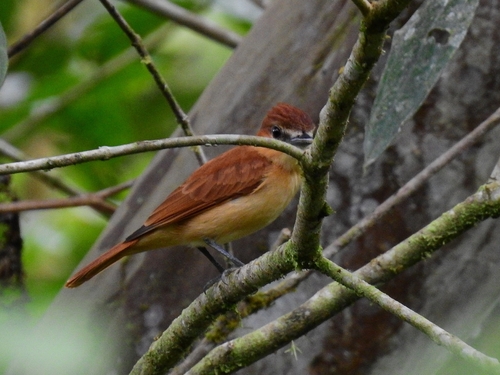
Northern Schiffornis vs Cinnamon Becard
Schiffornis veraepacis versus Pachyramphus cinnamomeus
Play a quiz with Northern Schiffornis and Cinnamon Becard
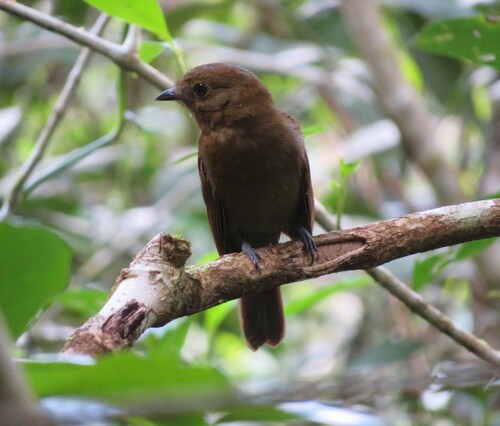
Northern Schiffornis
Cinnamon Becard
In short
The Northern Schiffornis and Cinnamon Becard can be distinguished primarily by their plumage and behavior. The Northern Schiffornis is more uniformly brown or olive-brown, while the Cinnamon Becard has a more cinnamon or rufous tone. Behaviorally, the Schiffornis is often found close to the ground, whereas the Becard is more likely to be seen higher in the canopy.
Identification tips
- Look for the uniform brown or olive-brown plumage of the Northern Schiffornis versus the cinnamon or rufous tone of the Cinnamon Becard. 2. Observe the bird's location: Schiffornis is often near the ground, while Becard is higher in the canopy. 3. Listen for the Northern Schiffornis's two-note whistle; the Cinnamon Becard's calls are less distinctive. 4. Note the habitat: Schiffornis prefers terra firme forest understory, while Becard can be in various forest types.
Size
Both species are similar in size, typical of small to medium passerines, but the Cinnamon Becard may appear slightly more robust.
Plumage
The Northern Schiffornis is primarily brown or olive-brown with paler underparts, while the Cinnamon Becard has a more cinnamon or rufous overall tone. The Becard lacks the prominent gray head sides seen in similar species, which can help in distinguishing it.
Behaviour
Northern Schiffornis typically forages within 1-2 meters of the ground and is often solitary. In contrast, the Cinnamon Becard is more likely to be seen higher in the canopy and may be more social.
Habitat
Both species inhabit forested areas, but the Northern Schiffornis is more often found in the understory of terra firme forests, while the Cinnamon Becard can be found in a wider range of forest types, often higher up.
Voice
The Northern Schiffornis has a distinctive two-note whistle, with the first note long and ending in a sharp upward inflection. The Cinnamon Becard's vocalizations are less well-documented but are generally not described as distinctive.