
Northern Wheatear vs Isabelline Wheatear
Oenanthe oenanthe versus Oenanthe isabellina
Play a quiz with Northern Wheatear and Isabelline Wheatear
 Northern Wheatear
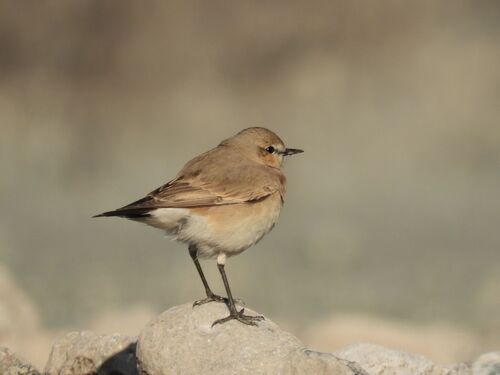 Isabelline Wheatear
In short
The most reliable field mark between Northern Wheatear and Isabelline Wheatear is the tail pattern: Northern Wheatear shows a white tail with a bold black 'inverted T' at the tip, while Isabelline Wheatear has a mostly white tail with more extensive black on the central feathers and a narrower black tip and edge. Isabelline Wheatear is also distinctly paler, larger, and more upright, with a longer bill and a sandy or parchment overall tone, compared to the greyer, more compact Northern Wheatear. Both can look similar in female or autumn plumage, but Isabelline’s pale underwing and overall sandy coloration are good clues. Structural differences and subtle plumage cues, especially in flight or at a distance, are key to separating these two.
Identification tips
- Tail pattern is key: Northern Wheatear always shows a white tail with a bold black inverted 'T' at the tip (all ages and sexes). Isabelline Wheatear has a white tail base, but the black is more extensive on the central feathers and forms a narrower edge and tip, lacking the neat 'T'.
- Underwing color: In flight, Isabelline Wheatear has white underwing coverts and axillaries, while Northern Wheatear’s are mottled with grey. This is most useful on birds in flight or when preening.
- Overall coloration: Isabelline Wheatear is always paler, sandy or parchment-colored above and below, with a creamy-white belly and buff breast. Northern Wheatear is greyer above (male) or brownish (female/autumn), with less uniform sandy tones.
- Supercilium and ear-coverts: Isabelline shows a long, creamy-white supercilium and paler ear-coverts, giving a more open-faced look. Northern’s supercilium is less contrasting, and the ear-coverts are not as pale.
- Bill and head shape: Isabelline has a longer bill and a more elongated head profile, while Northern is shorter-billed and rounder-headed.
- Posture: Isabelline stands more upright and appears longer-legged, often looking taller and more alert. Northern is more compact and horizontal.
- Size: Isabelline is slightly larger and bulkier, but this is only obvious with direct comparison or experience.
- Wing pattern in immatures: Both species lack distinctive upperwing panels or W-patterns in juvenile/first-winter plumage, so rely on tail and underwing for these ages.
- Sexual dimorphism: Male Northern Wheatear in breeding plumage is grey with a black mask and wings, unlike any Isabelline. Female and autumn Northern can look similar to Isabelline but are less sandy and have darker wings.
- Habitat context: In rocky or mountainous areas, Northern Wheatear is more likely; in open steppe or sandy plains, especially in Central Asia, Isabelline is favored.
- Behavior: Isabelline moves with longer hops and is more upright; Northern is more chat-like in movement and stance.
- Voice: Northern’s 'chack' call may help if heard, but is not always diagnostic.
- Pitfalls: Autumn and female Northern Wheatears are the most likely to be confused with Isabelline, especially in dull light or at a distance. Focus on tail pattern and overall tone.
- Flight views: Prioritize tail pattern and underwing color for birds in flight; these are the most reliable separation marks for all ages.
- When in doubt: If the bird appears very pale, upright, with a long bill and a tail lacking a neat 'T', favor Isabelline; if greyer, more compact, and with a crisp black 'T' on the tail, it is Northern.
Size
Isabelline Wheatear is the larger of the two, measuring 15–16.5 cm in length and weighing around 29 g [wikidata], while Northern Wheatear is slightly smaller at 14.5–16 cm and 17–30 g. The difference is subtle but can be noticeable in direct comparison: Isabelline appears bulkier and longer, with a more upright stance. Bill length is also greater in Isabelline, giving it a longer-headed look. Both are similar in wingspan, but Isabelline’s longer legs and bill are often more apparent in the field.
Plumage
Juvenile and first-winter birds of both species can be tricky, as both lack the crisp black-and-white contrasts of adult males. However, Northern Wheatear (all ages) shows a white rump and tail with a clear black 'T' at the tip, while Isabelline Wheatear’s tail is white at the base but has more extensive black on the central feathers and a narrower black edge and tip, lacking the neat 'T'. In flight, Isabelline’s underwing coverts and axillaries are white (not grey-mottled as in Northern), which can be a clincher if seen well. Adult male Northern Wheatear in breeding plumage is grey above with a black face mask and wings, while Isabelline is sandy or parchment throughout, with both sexes similar. Female and autumn Northern Wheatear are browner above but still less sandy than Isabelline, and their wings are darker brown rather than blackish. Isabelline always shows a pale creamy supercilium and paler ear-coverts, and its overall coloration is more uniform and pale. Both have white rumps, but the tail pattern and overall tone are the best field marks.
Behaviour
Isabelline Wheatear tends to be more upright and often stands taller, sometimes reminiscent of a small thrush or lark, and moves with long hops. Northern Wheatear is more compact and horizontal, with shorter hops and a more chat-like stance. Both species are active and restless, but Isabelline’s longer legs and bill contribute to its distinctive posture. In flight, both species show white rumps, but Isabelline’s flight is often described as more buoyant and less direct.
Habitat
Both species favor open country, but Northern Wheatear breeds in stony, rocky areas across a vast range including Europe, Asia, and even North America, while Isabelline Wheatear is more typical of steppe, arid plains, and high plateaux in southern Russia, Central Asia, and northern Pakistan. In winter, both move to open, often semi-arid areas, but Isabelline is more associated with sandy ground and less likely to be found in rocky or mountainous habitats typical of some Northern Wheatear sites.
Voice
Northern Wheatear has a whistling, crackly song and a typical 'chack' call, which is also given in flight. Isabelline Wheatear’s song is not described in detail here, but both species are generally quiet outside the breeding season. Voice is not a primary field mark for separation in most contexts, but Northern’s calls may be more familiar and distinctive if heard.