Birdr

Nutting's Flycatcher vs Brown-crested Flycatcher

Myiarchus nuttingi versus Myiarchus tyrannulus

Play a quiz with Nutting's Flycatcher and Brown-crested Flycatcher
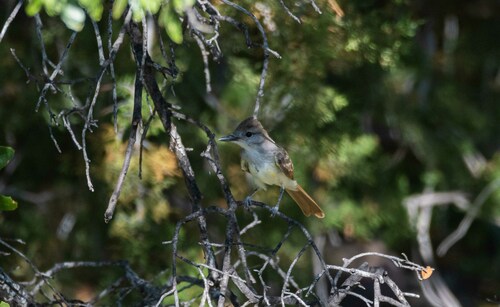
Nutting's Flycatcher (Myiarchus nuttingi) Nutting's Flycatcher
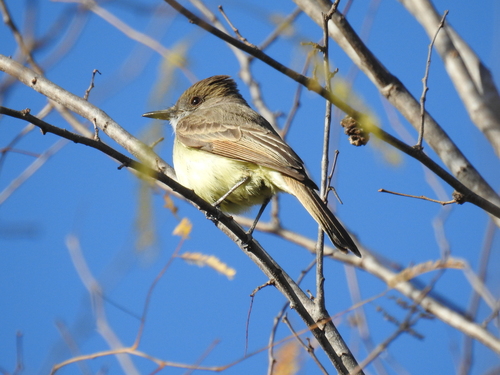
Brown-crested Flycatcher (Myiarchus tyrannulus) Brown-crested Flycatcher

Media

Loading…

In short

Nutting's Flycatcher and Brown-crested Flycatcher are both Myiarchus flycatchers with similar plumage, but they can be distinguished by their vocalizations and habitat preferences. The Nutting's Flycatcher tends to inhabit denser thorn forests, while the Brown-crested Flycatcher is found in more open areas with large trees or cacti.

Identification tips

  1. Vocalizations: Listen for the distinctive calls of the Brown-crested Flycatcher. 2. Habitat: Note the habitat; Nutting's prefers dense thorn forests, while Brown-crested is found in open areas with large trees. 3. Size: Consider the size, as Brown-crested is generally larger. 4. Plumage: Be cautious, as plumage differences are subtle and unreliable.

Size

Both species are similar in size, but the Brown-crested Flycatcher is generally larger, especially the Pacific-slope subspecies.

Plumage

Both species have similar plumage with grayish heads, olive-brown upperparts, and yellowish underparts. Differences in plumage are subtle and not reliable for identification.

Behaviour

Both species are cavity-nesters and forage by sallying for insects, but the Brown-crested Flycatcher is more often found in the canopy.

Habitat

Nutting's Flycatcher prefers dense, closed canopy thorn forests, while the Brown-crested Flycatcher favors more open habitats with large trees or cacti.

Voice

Vocalizations are a key differentiator; the Brown-crested Flycatcher has a distinctive call that is crucial for identification, as voice plays a dominant role in species recognition.

Submit a better description

Use the same sections as the comparison. Your text is published immediately.

Nutting's Flycatcher and Brown-crested Flycatcher are both Myiarchus flycatchers with similar plumage, but they can be distinguished by their vocalizations and habitat preferences. The Nutting's Flycatcher tends to inhabit denser thorn forests, while the Brown-crested Flycatcher is found in more open areas with large trees or cacti.

  1. Vocalizations: Listen for the distinctive calls of the Brown-crested Flycatcher. 2. Habitat: Note the habitat; Nutting's prefers dense thorn forests, while Brown-crested is found in open areas with large trees. 3. Size: Consider the size, as Brown-crested is generally larger. 4. Plumage: Be cautious, as plumage differences are subtle and unreliable.

Both species are similar in size, but the Brown-crested Flycatcher is generally larger, especially the Pacific-slope subspecies.

Both species have similar plumage with grayish heads, olive-brown upperparts, and yellowish underparts. Differences in plumage are subtle and not reliable for identification.

Both species are cavity-nesters and forage by sallying for insects, but the Brown-crested Flycatcher is more often found in the canopy.

Nutting's Flycatcher prefers dense, closed canopy thorn forests, while the Brown-crested Flycatcher favors more open habitats with large trees or cacti.

Vocalizations are a key differentiator; the Brown-crested Flycatcher has a distinctive call that is crucial for identification, as voice plays a dominant role in species recognition.

Discard your changes?

You have unsaved edits. If you leave now, those changes will be lost.

Nutting's Flycatcher · Brown-crested Flycatcher · My Tricky Birds