Birdr

Orange-headed Thrush vs Eyebrowed Thrush

Geokichla citrina versus Turdus obscurus

Play a quiz with Orange-headed Thrush and Eyebrowed Thrush
Orange-headed Thrush (Geokichla citrina) Orange-headed Thrush
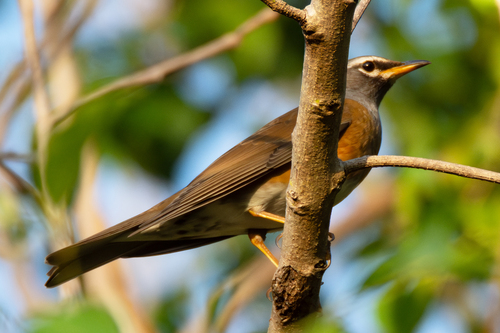
Eyebrowed Thrush (Turdus obscurus) Eyebrowed Thrush

Media

Loading…

In short

The Orange-headed Thrush (Geokichla citrina) and the Eyebrowed Thrush (Turdus obscurus) can be distinguished by their head markings and overall coloration. The Orange-headed Thrush has a distinctive bright orange head, while the Eyebrowed Thrush features a prominent white supercilium above the eye. Both species are medium-sized thrushes, but their habitats and behaviors can also aid in identification.

Identification tips

  1. Look for the bright orange head of the Orange-headed Thrush, which is absent in the Eyebrowed Thrush. 2. Check for the white supercilium in the Eyebrowed Thrush. 3. Consider the habitat: dense undergrowth suggests Orange-headed, while more open areas might indicate Eyebrowed. 4. Observe behavior: ground foraging is common in both, but habitat preference can be a clue. 5. Listen for song differences if possible, though this may be subtle.

Size

Both species are medium-sized thrushes, with similar body shapes typical of the Turdidae family.

Plumage

The Orange-headed Thrush is notable for its bright orange head and underparts, contrasting with its grayish back and wings. In contrast, the Eyebrowed Thrush has a more subdued brownish back and wings with a white supercilium and paler underparts, lacking the vibrant orange coloration.

Behaviour

Both species exhibit typical thrush behavior, foraging on the ground for insects and fruits. However, the Orange-headed Thrush is more often found in dense undergrowth, while the Eyebrowed Thrush may be seen in more open areas during migration.

Habitat

The Orange-headed Thrush prefers dense forest undergrowth, often in humid environments, while the Eyebrowed Thrush is more adaptable, found in a variety of habitats including forests, open woodlands, and gardens, especially during migration.

Voice

The vocalizations of these species are not well-documented in the provided notes, but generally, thrushes have melodious songs. Observers should note any differences in song structure or call notes when possible.

Submit a better description

Use the same sections as the comparison. Your text is published immediately.

The Orange-headed Thrush (Geokichla citrina) and the Eyebrowed Thrush (Turdus obscurus) can be distinguished by their head markings and overall coloration. The Orange-headed Thrush has a distinctive bright orange head, while the Eyebrowed Thrush features a prominent white supercilium above the eye. Both species are medium-sized thrushes, but their habitats and behaviors can also aid in identification.

  1. Look for the bright orange head of the Orange-headed Thrush, which is absent in the Eyebrowed Thrush. 2. Check for the white supercilium in the Eyebrowed Thrush. 3. Consider the habitat: dense undergrowth suggests Orange-headed, while more open areas might indicate Eyebrowed. 4. Observe behavior: ground foraging is common in both, but habitat preference can be a clue. 5. Listen for song differences if possible, though this may be subtle.

Both species are medium-sized thrushes, with similar body shapes typical of the Turdidae family.

The Orange-headed Thrush is notable for its bright orange head and underparts, contrasting with its grayish back and wings. In contrast, the Eyebrowed Thrush has a more subdued brownish back and wings with a white supercilium and paler underparts, lacking the vibrant orange coloration.

Both species exhibit typical thrush behavior, foraging on the ground for insects and fruits. However, the Orange-headed Thrush is more often found in dense undergrowth, while the Eyebrowed Thrush may be seen in more open areas during migration.

The Orange-headed Thrush prefers dense forest undergrowth, often in humid environments, while the Eyebrowed Thrush is more adaptable, found in a variety of habitats including forests, open woodlands, and gardens, especially during migration.

The vocalizations of these species are not well-documented in the provided notes, but generally, thrushes have melodious songs. Observers should note any differences in song structure or call notes when possible.

Discard your changes?

You have unsaved edits. If you leave now, those changes will be lost.

Orange-headed Thrush · Eyebrowed Thrush · My Tricky Birds