
Osprey vs Black-winged Kite
Pandion haliaetus versus Elanus caeruleus
Play a quiz with Osprey and Black-winged Kite
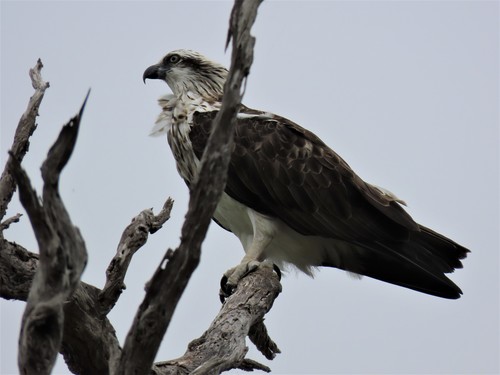 Osprey
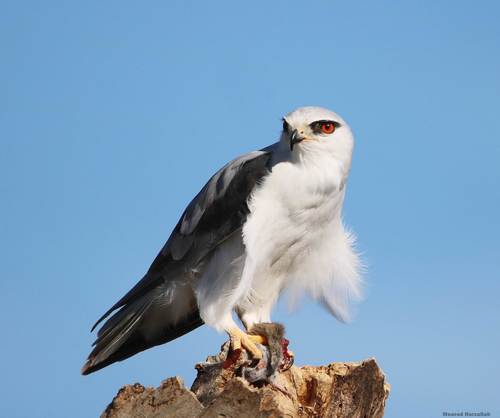 Black-winged Kite
In short
The most reliable field mark to separate Osprey from Black-winged Kite is overall size and structure: Osprey is a massive, long-winged raptor with a white underbody and bold dark wrist patches in flight, while Black-winged Kite is much smaller, compact, and strikingly pale with black shoulders and red eyes. Juvenile Ospreys show buff fringes and a streaked head, whereas young Black-winged Kites have a reddish wash on the upperparts and breast. In flight, Osprey's long, narrow wings with distinct 'fingered' tips and short tail contrast strongly with the kite's pointed wings and squared tail. Osprey is usually seen over water, often hovering or diving for fish, while Black-winged Kite prefers open grasslands and is famous for its kestrel-like hovering. If you see a large raptor with a strong dark eye-stripe and bold black wrist marks, it's an Osprey; a smaller, pale bird with black shoulders and red eyes is a Black-winged Kite.
Identification tips
- Size is the first clue: Osprey is much larger and bulkier than Black-winged Kite. If the bird looks huge and eagle-like, it's Osprey; if it's small and dainty, it's the kite.
- Wing shape in flight: Osprey has long, narrow wings with four long 'fingers' and a shorter fifth, and a short tail. Black-winged Kite has long, pointed wings and a squared tail, with no pronounced 'fingers.'
- Underwing pattern: Osprey always shows bold black wrist patches (carpal patches) on the underwing, visible at all ages. Black-winged Kite lacks these; instead, the black is on the upperwing shoulder.
- Head pattern: Osprey has a white head with a strong dark eye-stripe (mask) running through the eye. Black-winged Kite has a white face with no dark mask, but striking red eyes.
- Upperwing pattern: In Osprey, upperwing is dark brown with pale coverts in juveniles (buff fringes). Black-winged Kite shows black shoulders (upperwing coverts) contrasting with pale grey wings.
- Juvenile marks: Young Osprey has buffy fringes and a streaked head; young Black-winged Kite has a reddish-brown wash on upperparts and breast, never seen in Osprey.
- Breast band: Female Osprey may show a strong brown breast band; males have a weaker or absent band. Black-winged Kite has clean white underparts with no band.
- Eye color: Osprey's eyes are golden to brown; Black-winged Kite's are bright red and forward-facing, giving an 'owl-like' look.
- Bill and feet: Osprey has a heavy, black bill and blue cere; feet are white with black talons. Black-winged Kite has a finer bill and less robust feet.
- Flight style: Osprey flies with slow, deep wingbeats and soars over water; Black-winged Kite hovers like a kestrel over fields and glides with buoyant, tern-like flight.
- Perched posture: Osprey perches upright, often on snags near water. Black-winged Kite perches more delicately on wires or exposed branches in open country.
- Habitat context: Osprey is almost always near water; Black-winged Kite is found in open grasslands and agricultural areas, rarely near large water bodies.
- Sex differences: In Osprey, females have a stronger breast band and bulkier build; in Black-winged Kite, sexes are similar in the field.
- Seasonal movement: Osprey may be migratory or wintering depending on region; Black-winged Kite is non-migratory but nomadic, following rodent booms.
- Common pitfalls: Distant Osprey can look pale below and be mistaken for a kite, especially in strong light; check for size, black wrist patches, and head mask. Black-winged Kite's hovering and black shoulder patches are unique among small raptors.
Size
Osprey is dramatically larger: it weighs around 1400 g and measures 50–66 cm in length with a wingspan up to 180 cm. Black-winged Kite is much smaller and lighter (no precise mass here, but it is a small raptor), with a more compact build and shorter wingspan. In the field, Osprey appears as a big, heavy raptor with long, narrow wings and a short tail, while Black-winged Kite looks slim, dainty, and noticeably smaller, more akin to a large dove or small crow in size.
Plumage
- Juvenile/immature Osprey: Shows buff fringes on upperparts, a buffy tone below, and a streaked head. In spring, look for barring on underwings and flight feathers due to feather wear. The underwing always shows bold black 'wrists' (carpal patches) and a dark eye-stripe on a white head.
- Juvenile Black-winged Kite: Has a reddish-brown wash on upperparts and breast, not seen in Osprey. This color is from porphyrins and provides camouflage. Young kites molt into adult plumage after two years, sometimes showing a mix of old and new feathers.
- Adult Osprey: Deep brown upperparts, white underparts, white head with a strong dark mask, and black wrist patches on the underwing. Short tail, long, narrow wings with four long 'fingers' and a shorter fifth. Breast band can be weak or absent in males, stronger in females.
- Adult Black-winged Kite: White, grey, and black plumage. Striking black patches on the shoulders (upperwing coverts), white face and underparts, and red eyes. No dark eye-stripe like Osprey. Wings are long and pointed, tail is squared. No black wrist patch; instead, the black is on the shoulder.
Behaviour
Osprey is almost always seen near water, flying with slow, deep wingbeats, hovering briefly before plunging feet-first to catch fish. It rarely hovers for long periods. Black-winged Kite is famous for its kestrel-like hovering over open grasslands, often holding position for extended periods while hunting small mammals and insects. Osprey perches upright on snags or posts, often with a fish, while Black-winged Kite perches on wires or exposed branches, appearing more delicate and upright. Osprey's flight is powerful and direct; Black-winged Kite is buoyant, agile, and can appear almost tern-like in lightness.
Habitat
Osprey is tied to water: lakes, rivers, reservoirs, and coasts, rarely venturing far from fish-rich habitats. Black-winged Kite favors open grasslands, agricultural fields, and savannas, often far from large bodies of water. If you see a raptor hovering over a field or grassy plain, it's likely a Black-winged Kite; if it's over water, especially diving, it's almost certainly an Osprey.