
Osprey vs European Honey-buzzard
Pandion haliaetus versus Pernis apivorus
Play a quiz with Osprey and European Honey-buzzard
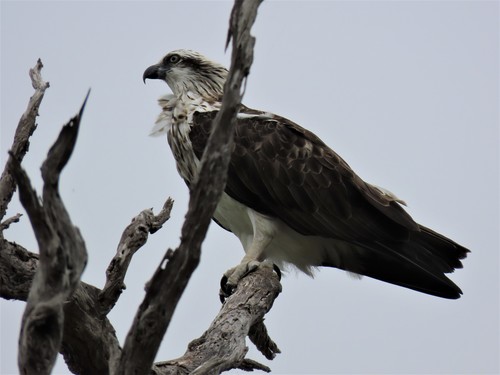 Osprey
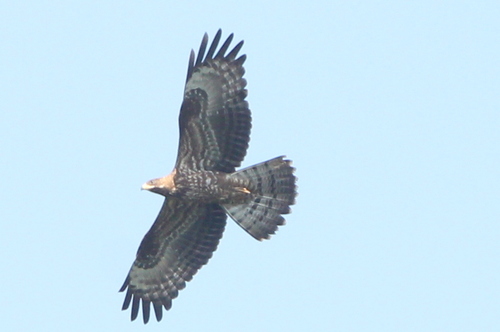 European Honey-buzzard
In short
The most reliable field mark between Osprey and European Honey-buzzard is the Osprey’s striking underwing pattern: bold black carpal (wrist) patches and mostly white underparts, visible on all ages in flight. Juvenile Ospreys show buff fringes and a pale, clean look below, while Honey-buzzards (especially juveniles) have more variable, often barred underwings and a longer, banded tail. Structurally, Ospreys are heavier, with long, narrow wings and a short tail, whereas Honey-buzzards are slimmer, long-necked, and have a longer tail with fewer, broader bars. Both can appear brown above and pale below, but the Osprey’s dark eye-stripe and distinctive flight silhouette are key. Use these differences in flight, as perched birds can be trickier, especially at a distance.
Identification tips
- Underwing pattern in flight (all ages): Osprey shows bold black carpal (wrist) patches and otherwise white underwing coverts, with a clean, pale look; Honey-buzzard lacks these patches and has more evenly barred or mottled underwings.
- Tail shape and pattern: Osprey has a short, squarish tail with fine barring; Honey-buzzard has a longer tail with two narrow dark bars and a broad subterminal bar, often fanned in flight.
- Head pattern: Osprey’s white head with a strong dark eye-stripe (mask) is visible even at distance; Honey-buzzard’s head is smaller, blue-grey in males, brown in females, and lacks a bold mask.
- Flight silhouette: Osprey’s wings are long, narrow, and angled with four long fingered primaries; Honey-buzzard’s wings are broader at the base, held flat or slightly drooped, and the head projects forward with a kinked neck.
- Body structure: Osprey is bulkier and heavier-bodied; Honey-buzzard is slimmer, long-necked, and appears almost pigeon-headed.
- Juvenile confusion: Juvenile Ospreys have buff fringes on upperparts and a pale, unstreaked belly; juvenile Honey-buzzards can mimic Common Buzzards, with more barring and a less clean look below.
- Perched birds: Ospreys perch upright, often on exposed snags near water, with a strong, direct posture; Honey-buzzards perch more secretively in woodland, often partially hidden.
- Behavior: Osprey often hovers or dives for fish; Honey-buzzard never hovers and is more likely to be seen soaring or gliding over woodland.
- Habitat context: Osprey is almost always near water; Honey-buzzard is tied to woodland and forest edges, rarely seen over open water.
- Sex differences: Osprey sexes are similar, but females have a stronger breast band; Honey-buzzard males have a blue-grey head, females brown, but this is subtle at distance.
- Size impression: Osprey is noticeably larger and heavier; Honey-buzzard is longer-tailed and slimmer.
- Voice: Honey-buzzard’s 'peee-lu' call is clear during display; Osprey’s calls are higher-pitched whistles, but not often heard in migration or at a distance.
- Legs and feet: Osprey’s feet are large, white, with reversible outer toes for grasping fish; Honey-buzzard’s toes are long and adapted for digging, but this is rarely visible in the field.
- Seasonal context: In Europe, Osprey is a migrant or summer visitor near water; Honey-buzzard is a summer breeder in woodland, with migration peaks in spring and autumn.
- Pitfalls: Juvenile Honey-buzzards can mimic Common Buzzard and may be mistaken for Osprey at a distance, but lack the Osprey’s bold underwing carpal patches and mask.
Size
Osprey is the larger, heavier raptor: body mass averages 1400g, with a length of 50–66 cm and a wingspan of 127–180 cm. European Honey-buzzard is lighter (440–1050g), slightly shorter (52–60 cm), and has a wingspan of 130–150 cm. Osprey’s bulk is apparent in flight and perched, with a robust body and broad wings, while Honey-buzzard looks slimmer, more elongated, and less muscular. The Osprey’s size is closer to the largest Buteos or small eagles, while Honey-buzzard is closer to a Common Buzzard in mass but with longer wings and tail.
Plumage
Juvenile Ospreys are distinctive with buff fringes on upperparts, a buffy wash below, and a clean white underbody; their underwings show bold black carpal patches and mostly white coverts, with some barring on flight feathers. Juvenile Honey-buzzards, in contrast, often mimic Common Buzzards, showing more barring on underwings and tail, but with fewer, broader tail bands (usually two narrow and one broad subterminal). Adult Ospreys always show a white head with a dark eye-stripe (mask), white underparts, and dark brown upperparts; their underwing pattern (black carpal patches, white coverts) is diagnostic. Adult Honey-buzzards have a small, pigeon-like head, blue-grey (male) or brown (female) head, and variable underparts with barring and a longer, banded tail. In flight, Osprey’s wings are long, narrow, and angled, with four long fingered primaries and a short tail; Honey-buzzard’s wings are held flat, with a longer tail and a slight downward kink at the wrist.
Behaviour
Osprey is almost always seen near water, often hovering or diving for fish, and perches upright with a strong, direct posture. In flight, it soars on angled wings, often with a distinct bend at the carpal. Honey-buzzard is more secretive, usually seen soaring on flat wings with slightly drooped tips, and rarely hovers. It spends much time in woodland, sometimes seen flying high on migration or displaying with wing-clapping. On the ground, Honey-buzzard may be seen digging for wasp nests, a behavior never shown by Osprey.
Habitat
Osprey is tied to open water: lakes, rivers, estuaries, and coasts, rarely straying far from fish-rich habitats. Honey-buzzard prefers woodland and forest edges, especially during breeding, and is rarely found in open aquatic habitats. If you see a large raptor over dense woodland or forest, especially away from water, Honey-buzzard is more likely; if it’s over a lake, river, or coast, Osprey is favored.
Voice
Honey-buzzard gives a clear, whistled 'peee-lu' call, especially during display. Osprey’s call is a series of high-pitched whistles, but vocalizations are rarely diagnostic at a distance or in migration.