
Osprey vs Hen Harrier
Pandion haliaetus versus Circus cyaneus
Play a quiz with Osprey and Hen Harrier
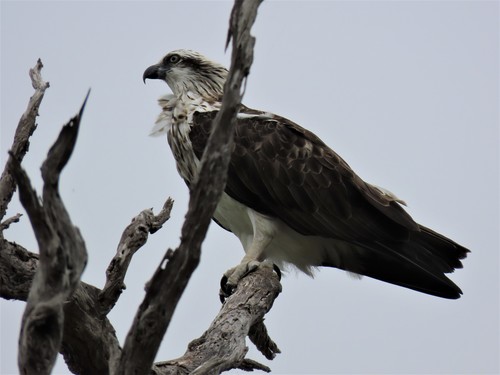 Osprey
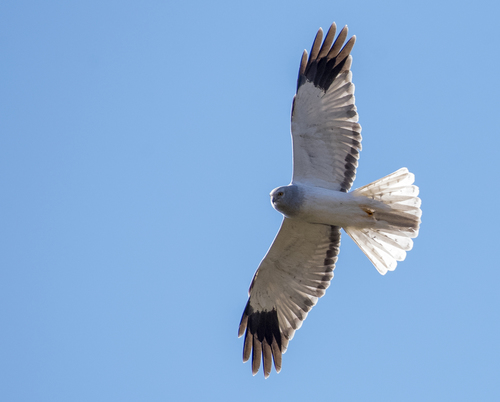 Hen Harrier
In short
The most reliable way to separate Osprey from Hen Harrier in the field is by overall size and structure: Osprey is much larger, with long, narrow wings and a short tail, while Hen Harrier is slimmer, with a long tail and a more buoyant, low-to-the-ground flight. For immatures, note that juvenile Ospreys show buff fringes above and a pale, streaked head, while juvenile Hen Harriers (especially females and 'ringtails') are brown above with a white rump and buff, barred underparts. Osprey in flight shows a distinctive dark carpal patch (wrist) on otherwise pale underwings and long, fingered primaries, while Hen Harrier (especially females/juveniles) shows a white rump and less contrast on the underwing. Habitat and hunting style also differ: Osprey is almost always seen near water, hovering or diving for fish, while Hen Harrier quarters low over open fields and marshes. Size, wing shape, and context are your best quick checks.
Identification tips
- Size is a primary clue: Osprey is much larger and bulkier than Hen Harrier—look for a deep chest and large head, especially when perched or seen with other birds for scale.
- Wing shape in flight: Osprey has long, narrow wings with four long, fingered primaries and a short tail; Hen Harrier has long, fairly narrow wings but a much longer, rounded tail and often holds its wings in a shallow V (dihedral) when gliding.
- Underwing pattern (all ages): Osprey shows a bold, dark carpal (wrist) patch on otherwise pale underwings, visible at all ages; Hen Harrier lacks this, with more uniform underwings and, in males, black wingtips.
- Juvenile plumage: Juvenile Osprey has buff fringes above, a pale streaked head, and a buffy wash below; juvenile Hen Harrier is brown above with a white rump and buff underparts with brown barring.
- White rump: Hen Harrier (especially females and juveniles) shows a conspicuous white rump in flight, a classic harrier mark; Osprey lacks this feature.
- Head pattern: Osprey has a striking white head with a dark eye-stripe (mask); Hen Harrier has a less contrasting head, with females and juveniles showing a more uniform brown or buffy face.
- Tail shape: Osprey's tail is short and squared; Hen Harrier's tail is long and rounded, often fanned in flight.
- Flight style: Osprey flies with deep, powerful wingbeats and often hovers before diving; Hen Harrier quarters low over the ground with buoyant, gliding flight and rarely hovers.
- Perched posture: Osprey perches upright on exposed posts or snags near water, looking large and heavy; Hen Harrier perches low, often on the ground or low posts, appearing slimmer and longer-tailed.
- Habitat context: Osprey is almost always near water, rarely over fields or marshes; Hen Harrier is found in open country, moorland, and marshes, often far from water.
- Sexual dimorphism: Osprey sexes are similar, with females slightly bulkier and a more marked breast band; Hen Harrier sexes differ strongly—males are grey and white with black wingtips, females and juveniles are brown with a white rump.
- Bill and feet: Osprey has a heavy, hooked bill and strong, pale feet with black talons (adapted for fishing); Hen Harrier has a finer bill and less robust feet, suited for small mammals and birds.
- Behavior around prey: Osprey dives into water to catch fish; Hen Harrier hunts by surprise, gliding low over land.
- Voice: Not usually diagnostic, but Osprey gives high-pitched whistles near the nest; Hen Harrier is more vocal on breeding grounds with whistled and chattering calls, rarely heard in migration.
- Seasonal context: In winter, Osprey is a rare visitor in some areas, usually near water; Hen Harrier is more likely in open country in winter, especially away from water.
Size
Osprey is dramatically larger and bulkier than Hen Harrier. Osprey averages 1400 g in mass, with a length of 50–66 cm and a wingspan of 127–180 cm. Hen Harrier is much lighter (average 436.5 g), shorter (41–52 cm), and has a smaller wingspan (97–122 cm). Even the largest female Hen Harrier is less than half the mass of an average Osprey. Osprey has a heavier build, deeper chest, and a more robust head and bill, while Hen Harrier is slim, long-tailed, and noticeably lighter in flight.
Plumage
-
Juvenile/immature birds: Juvenile Ospreys have buff fringes to the upperparts, a buffy wash below, and a pale, streaked head; their underwings show a strong dark carpal (wrist) patch and otherwise pale coverts. Juvenile Hen Harriers (especially females, often called 'ringtails') are brown above with a distinct white rump, buff underparts with brown barring, and less distinct barring than adults. Their underwings are not as strongly marked as Osprey's and lack the bold carpal patch.
-
Adult males: Osprey is brown above, white below, with a white head and dark eye-stripe; underwings are pale with a strong black wrist mark and long, fingered primaries. Adult male Hen Harrier is pale grey above, white below, with black wingtips and a white rump; wings are long and narrow, but lack the Osprey's strong wrist patch and show more uniform grey and black.
-
Adult females: Female Osprey is similar to male but bulkier, with a more marked brown breast band and slightly darker underwing coverts. Female Hen Harrier is brown above, white-rumped, and buff below with brown barring; underwings are less contrasting than Osprey and lack the dark carpal patch.
-
Key in flight: Osprey shows a short tail and long, narrow wings with four long 'fingers' and a dark carpal patch; Hen Harrier shows a long, rounded tail, wings held in a shallow V, and a white rump, especially obvious from behind.
Behaviour
Osprey is almost always seen near water, where it hunts by hovering and then plunging feet-first to catch fish. Its flight is powerful, with deep, steady wingbeats and occasional hovering. Hen Harrier hunts by flying low and buoyantly over open ground, holding its wings in a shallow V and gliding close to the contours of the land. It rarely hovers, instead quartering fields and marshes for small mammals and birds. Osprey perches on exposed snags or posts near water, while Hen Harrier is more often seen in continuous flight over open country or perched low on the ground.
Habitat
Osprey is strongly associated with water—lakes, rivers, estuaries, and coasts—where it can fish. It is rarely seen far from water. Hen Harrier prefers open habitats such as moorland, marshes, grasslands, and farmland, often far from large bodies of water. If you see a large raptor hunting over open fields or moors, especially away from water, Hen Harrier is much more likely. Osprey is almost never seen quartering fields or marshes in the harrier style.
Voice
Vocalizations are not usually diagnostic in the field for these species, especially at a distance. Hen Harrier is a more vocal bird on the breeding grounds, with whistled and chattering calls, but these are rarely heard in migration or winter. Osprey is generally silent except near the nest, where it gives high-pitched whistles. Voice is not a reliable field mark for separating these species in most situations.