
Osprey vs Peregrine Falcon
Pandion haliaetus versus Falco peregrinus
Play a quiz with Osprey and Peregrine Falcon
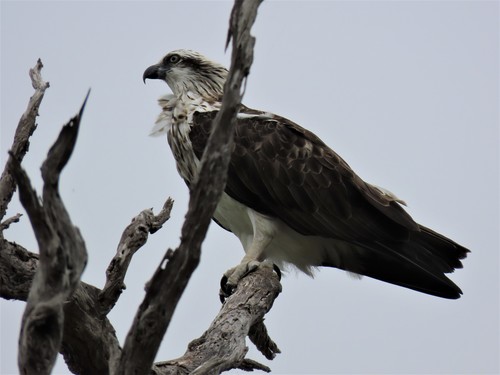 Osprey
 Peregrine Falcon
In short
The most reliable field mark to separate Osprey from Peregrine Falcon is the Osprey's distinctive underwing pattern: in all ages, Osprey shows prominent black 'wrists' (carpal patches) and long, narrow wings with four long, fingered primaries, creating a unique silhouette in flight. Juvenile Ospreys have buff fringes on upperparts and a buffy wash below, while Peregrines never show this. Peregrine Falcons are more compact, with pointed wings and a shorter tail, and adults have a bold dark hood and heavily barred underparts. Both species are large raptors, but Osprey is bulkier and longer-winged, often seen over water, while Peregrine is more streamlined and typically hunts over open land or urban areas. Sex differences are subtle in the field for both, but size dimorphism is more pronounced in Peregrine.
Identification tips
- Underwing pattern in flight (all ages): Osprey shows bold black carpal patches ('wrists') and long, fingered primaries; Peregrine never does. This is the single most reliable mark at a distance.
- Wing shape: Osprey's wings are long, narrow, and held with a slight crook at the carpal; Peregrine's wings are shorter, pointed, and more triangular.
- Tail shape: Osprey has a relatively short, slightly rounded tail; Peregrine's tail is shorter and more squared-off.
- Flight style: Osprey has deep, elastic wingbeats and often hovers; Peregrine is fast, direct, and rarely hovers, often seen in a high-speed stoop.
- Size and bulk: Osprey is much larger and bulkier, with a longer wingspan and heavier build. Even large female Peregrines are smaller and more compact than Ospreys.
- Head pattern: Osprey has a white head with a dark eye-stripe (mask); Peregrine has a bold black hood and mustache, with no white crown.
- Underparts: Osprey is mostly white below, sometimes with a faint brown breast band (stronger in females); Peregrine is heavily barred or streaked below, never pure white.
- Upperparts: Osprey is deep brown above; Peregrine is blue-grey (adults) or brownish (juveniles).
- Juvenile marks: Young Osprey shows buff fringes on upperparts and a buffy wash below, with streaked head; Peregrine juveniles are browner above and streaked below, but lack buff tones and have no pale underwing with black wrists.
- Habitat context: Osprey is almost always near water; Peregrine can be found in cities, cliffs, or open country, often away from water.
- Perched posture: Osprey appears long-legged and upright, with a slim, elongated look; Peregrine is more compact, with a horizontal, hunched posture.
- Prey handling: Osprey carries fish head-forward in its talons; Peregrine carries prey in talons, often in mid-air, and usually bird prey.
- Sex differences: Osprey males are slimmer and have less breast band, but this is subtle; Peregrine females are larger, but plumage is similar.
- Contextual clues: If seen hovering or plunging into water, it's Osprey; if seen stooping at high speed or perching on urban structures, it's Peregrine.
- Pitfalls: At long range, both can appear dark above and pale below; always look for the Osprey's black wrist patches and fingered wings versus Peregrine's pointed wings and barred underparts.
Size
Osprey is the larger and heavier of the two, with a body mass around 1400 g and a wingspan up to 180 cm, giving it a lanky, long-winged look. Peregrine Falcon is crow-sized, noticeably smaller and more compact than Osprey, with shorter, more pointed wings and a shorter tail. In direct comparison, Osprey appears much bulkier and longer-winged, especially in flight. Female Peregrines are larger than males, but even the largest Peregrine is still smaller and more compact than an Osprey.
Plumage
- Juvenile Osprey: Shows buff fringes on upperparts and a buffy tone to the underparts, with streaked head feathers. In flight, note the strong black carpal patches ('wrists') and overall pale underwing with dark flight feathers. Barring on underwings and flight feathers is more pronounced in young birds, especially in spring.
- Adult Osprey: Upperparts are glossy brown, underparts pure white (sometimes with a weak brown breast band), head white with a dark eye mask. Underwings always show black carpal patches and long, fingered primaries.
- Peregrine Falcon (all ages): Never shows the Osprey's black 'wrists' or fingered wing silhouette. Adults have blue-grey upperparts, a bold black hood, and heavily barred white underparts. Juveniles are browner above and streaked below, but still lack the Osprey's pale underparts and distinctive wing pattern. In all ages, Peregrine's wings are pointed, and the underwing is barred, not pale with black patches.
- Sex differences: Osprey sexes are similar, with males slimmer and less marked on the breast; Peregrine females are larger but plumage is similar.
Behaviour
Osprey is almost always seen near water, hovering or circling before plunging feet-first to catch fish. Its flight is buoyant and elastic, with deep, flexible wingbeats and frequent glides. Peregrine Falcon hunts by high-speed stoop, often from a perch or high in the air, striking prey in mid-air with a clenched foot. Peregrines are agile, fast, and direct in flight, rarely hovering. Osprey often carries fish with feet forward; Peregrine carries prey in talons, usually mid-air or to a perch.
Habitat
Osprey is strongly tied to water—lakes, rivers, coasts—and is rarely seen far from aquatic habitats. Peregrine Falcon is more versatile, found in open landscapes, cliffs, and increasingly in urban areas, often far from water. If seen over city buildings or dry open country, Peregrine is more likely; Osprey is almost always over or near water.