
Osprey vs Western Marsh Harrier
Pandion haliaetus versus Circus aeruginosus
Play a quiz with Osprey and Western Marsh Harrier
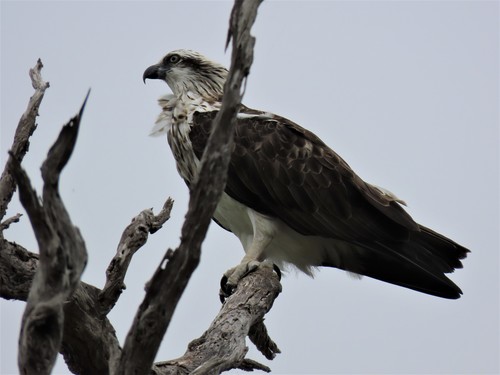 Osprey
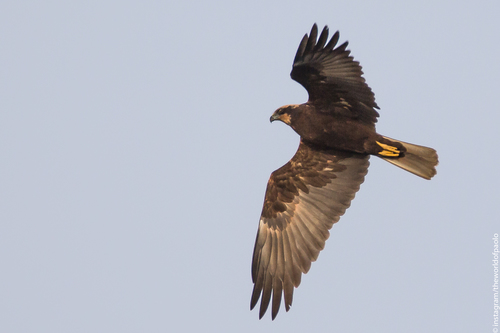 Western Marsh Harrier
In short
The most reliable field mark between Osprey and Western Marsh Harrier is the Osprey’s striking white underparts and dark carpal ('wrist') patches, creating a bold, high-contrast look in flight, versus the Marsh Harrier’s more uniformly brown or tricolored underwings and body. Juvenile Ospreys show buff fringes and a pale, streaked head, while juvenile Marsh Harriers are darker and lack the Osprey’s crisp underwing pattern. Structurally, Ospreys are bulkier, with long, narrow wings and a short tail, while Marsh Harriers have broader wings and a longer tail, often held in a shallow V when gliding. Both species can be seen over wetlands, but Ospreys are almost always associated with open water, and their flight style is more powerful and direct compared to the harrier’s buoyant, low, gliding hunt.
Identification tips
- Underwing pattern in flight (all ages): Osprey shows striking white underwings with bold black carpal ('wrist') patches and long, fingered primaries; Marsh Harrier’s underwings are brown with less contrast, and males show a tricolored pattern (brown, grey, black), but never the Osprey’s crisp black-and-white.
- Juvenile plumage: Juvenile Osprey has buff fringes on upperparts, buffy underparts, and a pale, streaked head; juvenile Marsh Harrier is mostly dark brown with less yellow on head/shoulders, and lacks any strong underwing contrast.
- Head pattern: Osprey (all ages) has a white head with a strong dark eye-stripe; Marsh Harrier females and juveniles have a pale head and shoulders, but the pattern is less sharply defined and lacks the Osprey’s mask. Male Marsh Harrier’s head is pale but not strongly marked.
- Body and underparts: Osprey is white below with little or no streaking (except sometimes a weak breast band, especially in females); Marsh Harrier is brown below (female/juvenile) or a mix of brown and pale (male), never clean white.
- Wing shape: Osprey has long, narrow wings with a short tail, and the wings are held flat or slightly arched in flight; Marsh Harrier has broader wings, a longer tail, and often flies with wings in a shallow V.
- Flight style: Osprey flies with strong, deep wingbeats and long glides, sometimes hovers before diving; Marsh Harrier glides low over vegetation, wings in V, legs often dangling, rarely hovers.
- Tail: Osprey’s tail is short and squarish; Marsh Harrier’s tail is longer and more rounded.
- Bill and feet: Osprey has a strong, black bill and white feet with black talons; Marsh Harrier’s bill is less robust, legs and feet are yellow.
- Sexual dimorphism: Osprey sexes are similar, with females slightly larger and a stronger breast band; Marsh Harrier is strongly dimorphic—males are tricolored, females/juveniles are chocolate-brown with pale head/shoulders.
- Habitat: Osprey is almost always over or near open water; Marsh Harrier is more likely over marshes, reedbeds, or fields, often away from large water.
- Behavior with prey: Osprey often seen carrying fish, feet forward; Marsh Harrier rarely carries large prey in flight.
- Perched posture: Osprey perches upright, often on exposed snags or posts near water; Marsh Harrier usually perches lower, often in vegetation.
- Abundance/context: In Europe, Osprey is scarcer and usually seen singly; Marsh Harrier is more common in suitable habitat, sometimes in small groups, especially at roosts.
- Confusion risk: Immature Ospreys are sometimes mistaken for harriers due to brown upperparts and pale head, but the underwing pattern and structure are always diagnostic.
- Voice: Not diagnostic in the field; both are generally silent away from nest.
Size
Osprey is significantly larger and heavier: body mass averages around 1400 g, with a length of 50–66 cm and a wingspan of 127–180 cm. Western Marsh Harrier is lighter (males 400–650 g, females 550–800 g), shorter (48–56 cm), and has a smaller wingspan (115–130 cm). In the field, Osprey appears bulkier and longer-winged, while Marsh Harrier is slimmer and more agile. The size gap is especially obvious if seen together or with familiar birds for scale.
Plumage
Juvenile Ospreys have buff fringes on the upperparts, a buffy wash below, and a pale, streaked head; their underwings are white with bold black carpal patches and mostly white underparts, with barring on underwing coverts and flight feathers in spring due to wear. Juvenile Marsh Harriers are mostly dark brown, with less yellow on the shoulders and head compared to females, and lack the Osprey’s crisp underwing contrast. Adult Ospreys are deep brown above, white below, with a white head and dark eye mask, and retain the black carpal patches and long, fingered wings. Adult male Marsh Harriers are tricolored: brown body, pale yellowish head/shoulders, and grey secondaries/tail with black wingtips, while females are chocolate-brown with a pale head and shoulders and a dark eye area. In flight, Osprey’s underwing is strikingly pale with black wrists and long, narrow wings; Marsh Harrier shows a more blended brown/grey/black pattern, broader wings, and lacks the Osprey’s sharp contrast.
Behaviour
Osprey hunts by soaring or hovering high over open water, then plunging feet-first to catch fish, often carrying prey with feet forward. Its flight is powerful, with deep, steady wingbeats and long glides. Marsh Harrier hunts by gliding low over marshes and fields with wings held in a shallow V, often with dangling legs, searching for small mammals and birds. Marsh Harrier’s flight is buoyant and agile, with frequent banking and tilting, rarely hovering. Osprey rarely quarters low over land like a harrier.
Habitat
Osprey is almost always found near large bodies of open water—lakes, rivers, coasts—where it fishes. Marsh Harrier prefers extensive reedbeds, marshes, and wet meadows, often away from large open water, and is more likely to be seen quartering over fields or marshes. If seen away from water, Marsh Harrier is much more likely.