Birdr

Pacific Swift vs Asian Palm Swift

Apus pacificus versus Cypsiurus balasiensis

Play a quiz with Pacific Swift and Asian Palm Swift
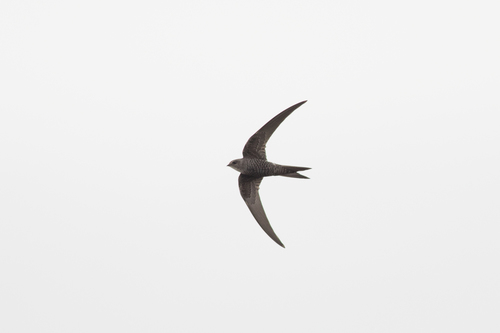
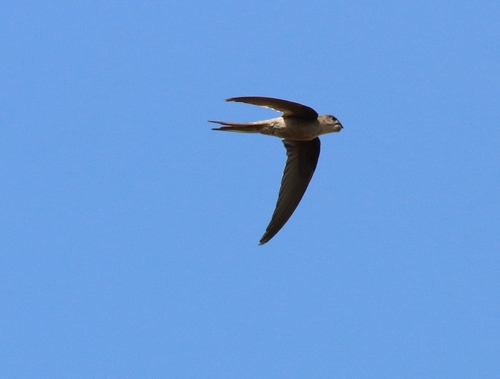
Pacific Swift (Apus pacificus) Pacific Swift
Asian Palm Swift (Cypsiurus balasiensis) Asian Palm Swift

Media

Loading…

In short

The Pacific Swift (Apus pacificus) and Asian Palm Swift (Cypsiurus balasiensis) can be distinguished by their tail shape and flight style. The Pacific Swift has a deeply forked tail and a more robust build, while the Asian Palm Swift has a slender body with a longer, more pointed tail. Both species are agile fliers, but the Pacific Swift is typically seen higher in the sky.

Identification tips

  1. Look for the deeply forked tail of the Pacific Swift, compared to the more pointed tail of the Asian Palm Swift. 2. Note the white rump patch on the Pacific Swift. 3. Observe flight height: Pacific Swifts are usually higher up. 4. Consider habitat: Asian Palm Swifts are often near palms and human structures.

Size

Pacific Swift is larger and more robust compared to the smaller, more slender Asian Palm Swift.

Plumage

Pacific Swift has a dark body with a white rump patch, whereas the Asian Palm Swift is uniformly brownish without a distinct rump patch.

Behaviour

Pacific Swifts are often seen flying high and fast in open skies, while Asian Palm Swifts are more likely to be observed flying lower and closer to palm trees.

Habitat

Pacific Swifts are often found in open areas and over forests, while Asian Palm Swifts are closely associated with palm groves and human settlements.

Voice

Both species have high-pitched calls, but specific vocal differences are not well-documented.

Submit a better description

Use the same sections as the comparison. Your text is published immediately.

The Pacific Swift (Apus pacificus) and Asian Palm Swift (Cypsiurus balasiensis) can be distinguished by their tail shape and flight style. The Pacific Swift has a deeply forked tail and a more robust build, while the Asian Palm Swift has a slender body with a longer, more pointed tail. Both species are agile fliers, but the Pacific Swift is typically seen higher in the sky.

  1. Look for the deeply forked tail of the Pacific Swift, compared to the more pointed tail of the Asian Palm Swift. 2. Note the white rump patch on the Pacific Swift. 3. Observe flight height: Pacific Swifts are usually higher up. 4. Consider habitat: Asian Palm Swifts are often near palms and human structures.

Pacific Swift is larger and more robust compared to the smaller, more slender Asian Palm Swift.

Pacific Swift has a dark body with a white rump patch, whereas the Asian Palm Swift is uniformly brownish without a distinct rump patch.

Pacific Swifts are often seen flying high and fast in open skies, while Asian Palm Swifts are more likely to be observed flying lower and closer to palm trees.

Pacific Swifts are often found in open areas and over forests, while Asian Palm Swifts are closely associated with palm groves and human settlements.

Both species have high-pitched calls, but specific vocal differences are not well-documented.

Discard your changes?

You have unsaved edits. If you leave now, those changes will be lost.

Pacific Swift · Asian Palm Swift · My Tricky Birds