
Pale Chanting-Goshawk vs Gabar Goshawk
Melierax canorus versus Micronisus gabar
Play a quiz with Pale Chanting-Goshawk and Gabar Goshawk
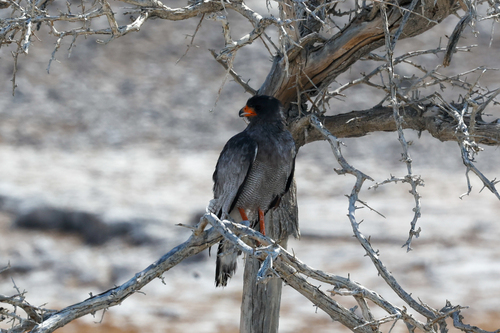 Pale Chanting-Goshawk
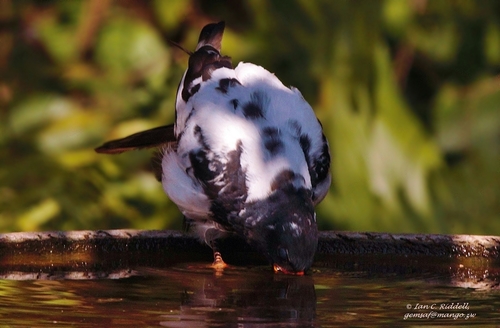 Gabar Goshawk
In short
The most reliable field mark between Pale Chanting-Goshawk and Gabar Goshawk is size: Pale Chanting-Goshawk is much larger and bulkier, with a mass nearly five times that of Gabar Goshawk. For immatures, check the underwing and tail in flight—Pale Chanting-Goshawk juveniles show white flight feathers and tail with black barring, while Gabar Goshawk immatures are browner and have untidier barring. Adults of both species have grey upperparts and white rumps, but Pale Chanting-Goshawk is paler overall, with longer red legs and a heavier, more upright stance. Gabar Goshawk is much smaller, more compact, and can appear almost entirely black in its dark morph, a feature never shown by Pale Chanting-Goshawk.
Identification tips
- Size is the most immediate clue: Pale Chanting-Goshawk is much larger and bulkier than Gabar Goshawk—if the bird looks crow-sized or bigger, it's not a Gabar.
- Leg length and color: Pale Chanting-Goshawk has very long, bright red legs (adults); Gabar Goshawk's legs are also long but slimmer, and yellow in immatures.
- Bill and cere color: Adult Pale Chanting-Goshawk shows a red bill base and cere; Gabar Goshawk adults have a red cere, but immatures have yellow.
- Upright posture: Pale Chanting-Goshawk often stands very upright and tall, especially when perched, while Gabar Goshawk is more compact and less upright.
- Plumage in immatures (flight): Juvenile Pale Chanting-Goshawk shows white flight feathers and tail with black barring from below, and rufous underparts; Gabar Goshawk immatures are browner with messier barring, and yellow legs/cere.
- Adult upperparts: Both are grey above with a white rump, but Pale Chanting-Goshawk is paler overall and larger; Gabar Goshawk is darker grey and more compact.
- Tail pattern: Pale Chanting-Goshawk has central tail feathers black-tipped with white and outer tail feathers barred grey and white; Gabar Goshawk's tail is dark grey with barring.
- Underparts (adults): Pale Chanting-Goshawk adults have finely barred dark grey and white underparts; Gabar Goshawk pale morph adults have white and grey barring on chest, thighs, and underwings.
- Dark morph: Only Gabar Goshawk can be almost entirely black (dark morph)—never shown by Pale Chanting-Goshawk.
- Eye color: Adult Pale Chanting-Goshawk has dark brown eyes; Gabar Goshawk adults also have dark eyes, but immatures have pale yellow eyes (Pale Chanting-Goshawk) vs. yellow cere/legs (Gabar).
- Perching behavior: Pale Chanting-Goshawk often perches on exposed poles or treetops in open country; Gabar Goshawk is more often in trees or denser habitat.
- Flight style: Pale Chanting-Goshawk is steady and direct, often gliding on long wings; Gabar Goshawk is agile, quick, and more likely to dash through trees.
- Habitat context: Open, arid country favors Pale Chanting-Goshawk; woodland or bushy areas favor Gabar Goshawk.
- Vocalization: If you hear a tuneful 'kleeu-kleeu-kleeu-ku-ku-ku' from a high perch, it's Pale Chanting-Goshawk.
- Sexual dimorphism: Gabar Goshawk females are larger than males, but both sexes are still much smaller than any Pale Chanting-Goshawk.
Size
Pale Chanting-Goshawk is a large raptor (body mass ~810g, length ~55 cm, wingspan ~110 cm), while Gabar Goshawk is much smaller (body mass ~165g, length 28–36 cm, wingspan ~63 cm). In the field, Pale Chanting-Goshawk appears long-legged and rangy, often dwarfing nearby birds of prey, while Gabar Goshawk is compact and noticeably smaller, closer in size to a pigeon or small crow. This size gap is often obvious even at a distance or in flight, and is a key separation point.
Plumage
For immatures: Pale Chanting-Goshawk juveniles have brown upperparts, a white rump, and black-barred tail; from below, the flight feathers and tail are white with black barring, and the underparts are rufous with a dark-streaked white throat. Gabar Goshawk immatures are generally browner overall, with yellow legs and cere, and the pale morph has messier barring on the chest compared to adults. In adults, both species show grey upperparts and a white rump, but Pale Chanting-Goshawk is paler, with finely barred underparts and a distinctive red bill base, cere, and long legs. Gabar Goshawk adults have a dark eye, red cere and legs, and a more compact, less upright look. The Gabar Goshawk's dark morph is nearly all black—never matched by Pale Chanting-Goshawk. In flight, Pale Chanting-Goshawk adults show black primaries, very pale (almost white) secondaries, and grey forewings; Gabar Goshawk adults have white and grey barring on the chest, thighs, and underwings, and a dark grey, barred tail.
Behaviour
Pale Chanting-Goshawk is often seen perched conspicuously on telephone poles or high perches in open country, scanning for prey, and tends to be more sedentary and visible. Gabar Goshawk is more likely to be seen alone or in pairs, often hunting persistently through trees or making energetic pursuits of prey, and is less likely to perch in the open for long periods. Gabar Goshawk may also be observed attacking weaver nests or using spider webs in nest construction—behaviors not noted for Pale Chanting-Goshawk.
Habitat
Pale Chanting-Goshawk is a resident of dry, open semi-desert and arid savanna with less than 75 cm annual rainfall, often seen in very open, sparsely treed landscapes and along roadsides. Gabar Goshawk is more flexible, found in a variety of wooded habitats across Africa and Arabia, including acacia woodland and areas with more tree cover than typically used by Pale Chanting-Goshawk. Thus, a bird in very open, arid country is more likely to be Pale Chanting-Goshawk, while one in denser woodland could be Gabar Goshawk.
Voice
Pale Chanting-Goshawk gives a tuneful, whistling 'kleeu-kleeu-kleeu-ku-ku-ku' call, usually from a high perch during the breeding season. Gabar Goshawk's vocalizations are not described in the provided notes, so voice is not a reliable separator unless the Pale Chanting-Goshawk's distinctive call is heard.