Birdr

Pale-headed Munia vs Chestnut-breasted Munia

Lonchura pallida versus Lonchura castaneothorax

Play a quiz with Pale-headed Munia and Chestnut-breasted Munia
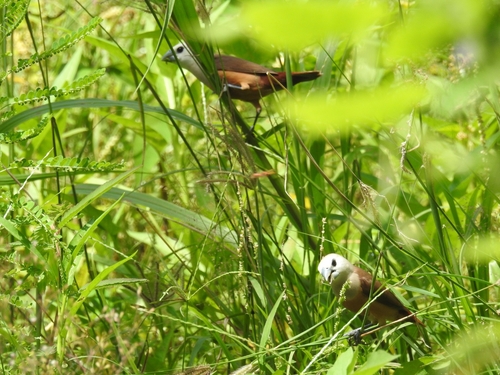
Pale-headed Munia (Lonchura pallida) Pale-headed Munia
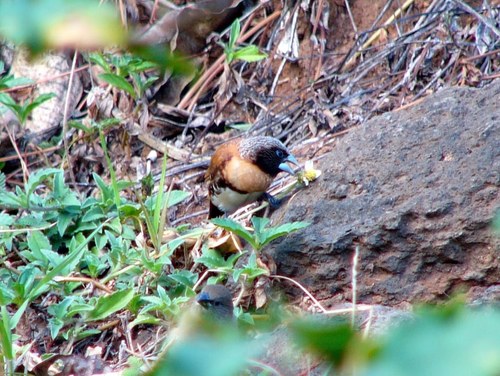
Chestnut-breasted Munia (Lonchura castaneothorax) Chestnut-breasted Munia

Media

Loading…

In short

The Pale-headed Munia and Chestnut-breasted Munia can be distinguished by their head and breast coloration. The Pale-headed Munia has a distinctive pale head, while the Chestnut-breasted Munia features a rich chestnut breast. Both species share a similar structure, but these color differences are key identifiers.

Identification tips

  1. Look for the pale head of the Pale-headed Munia versus the chestnut breast of the Chestnut-breasted Munia. 2. Observe the overall color contrast: Pale-headed Munia has a stark contrast between head and body, while Chestnut-breasted Munia appears more uniform. 3. Consider habitat: if in a wetter area, it might be more likely to encounter a Chestnut-breasted Munia.

Size

Both species are similar in size, typical of small munias.

Plumage

The Pale-headed Munia has a pale, almost white head, contrasting with its darker body. In contrast, the Chestnut-breasted Munia has a chestnut-colored breast and a darker head, creating a more uniform appearance with its body.

Behaviour

Both species exhibit similar behaviors typical of munias, such as flocking and feeding on seeds.

Habitat

Both species are often found in grasslands and open fields, but the Chestnut-breasted Munia can also be found in wetter habitats like reed beds.

Voice

Vocalizations are not a reliable differentiator between these two species, as they are quite similar.

Submit a better description

Use the same sections as the comparison. Your text is published immediately.

The Pale-headed Munia and Chestnut-breasted Munia can be distinguished by their head and breast coloration. The Pale-headed Munia has a distinctive pale head, while the Chestnut-breasted Munia features a rich chestnut breast. Both species share a similar structure, but these color differences are key identifiers.

  1. Look for the pale head of the Pale-headed Munia versus the chestnut breast of the Chestnut-breasted Munia. 2. Observe the overall color contrast: Pale-headed Munia has a stark contrast between head and body, while Chestnut-breasted Munia appears more uniform. 3. Consider habitat: if in a wetter area, it might be more likely to encounter a Chestnut-breasted Munia.

Both species are similar in size, typical of small munias.

The Pale-headed Munia has a pale, almost white head, contrasting with its darker body. In contrast, the Chestnut-breasted Munia has a chestnut-colored breast and a darker head, creating a more uniform appearance with its body.

Both species exhibit similar behaviors typical of munias, such as flocking and feeding on seeds.

Both species are often found in grasslands and open fields, but the Chestnut-breasted Munia can also be found in wetter habitats like reed beds.

Vocalizations are not a reliable differentiator between these two species, as they are quite similar.

Discard your changes?

You have unsaved edits. If you leave now, those changes will be lost.

Pale-headed Munia · Chestnut-breasted Munia · My Tricky Birds