
Pale Thrush vs Dusky Thrush
Turdus pallidus versus Turdus eunomus
Play a quiz with Pale Thrush and Dusky Thrush
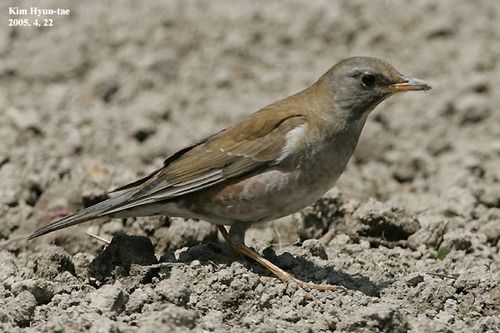 Pale Thrush
 Dusky Thrush
In short
The most reliable field mark between Pale Thrush and Dusky Thrush is the underwing color: Pale Thrush shows grey or white underwing-coverts, while Dusky Thrush has distinctly reddish-brown underwings. In all plumages, Dusky Thrush stands out with bold blackish face, breast, and flank markings, and a crisp white belly, whereas Pale Thrush is overall plainer with a blue-grey head (male) and more uniform brownish underparts. Both species are similar in size and structure, but Dusky Thrush tends to look stockier and more contrastingly marked, especially in adults. Immature birds of both species are duller, but Dusky Thrush still shows a stronger face pattern. Use the underwing and face pattern as your first checks, especially in flight or when views are brief.
Identification tips
- Underwing color in flight: Dusky Thrush shows reddish-brown underwings, while Pale Thrush has grey or white underwing-coverts. This is the single best mark when birds flush or fly overhead (all ages).
- Face pattern: Dusky Thrush has a bold pale supercilium and strong blackish markings on the face, especially in adults. Pale Thrush is much plainer-faced, with only subtle contrast even in males.
- Breast and flank markings: Dusky Thrush has bold blackish spots on the breast and flanks, giving a strikingly patterned look. Pale Thrush is more uniform, with pale brown underparts and only slightly darker flanks.
- Belly and undertail: Both species have whitish bellies and undertail-coverts, but the contrast is sharper in Dusky Thrush due to the dark upperparts and flank spots.
- Back and rump color: Dusky Thrush has a dark brown back and rump, while Pale Thrush is brown above with a blue-grey head and throat in males.
- Head and throat color: Male Pale Thrushes have a blue-grey head and throat, a subtle but helpful mark at close range. Females are browner but still lack the strong face pattern of Dusky Thrush.
- Tail pattern: Pale Thrush has dark grey tail feathers with white tips on the outer feathers, but this is subtle and not always visible.
- Bill and feet: Pale Thrush has a grey upper mandible and yellow lower mandible, and pale pinkish-brown feet. These are minor marks and require close views.
- Overall contrast: Dusky Thrush appears more contrasting and boldly marked, especially on the head and underparts. Pale Thrush is softer and more uniform in tone.
- Immature birds: Young Dusky Thrushes are duller but still show a pale supercilium and some face pattern; immature Pale Thrushes remain plain and lack strong markings.
- Structure: Dusky Thrush is described as stockier and more fieldfare-like, but this is subtle and easily missed.
- Sex differences: Female Pale Thrushes are duller than males but still lack the strong face and breast pattern of Dusky Thrush.
- Habitat and context: Not reliable for separation in areas of overlap; both species use similar habitats in winter.
- Vocalizations: Not diagnostic in the field; both species have typical Turdus calls and songs.
- Pitfalls: Beware of dull or immature Dusky Thrushes, which may look less contrasting but still show the reddish underwing and pale supercilium. Always check underwing color and face pattern first.
Size
Both species are medium-sized thrushes, with Pale Thrush weighing about 70 g [wikidata]. Dusky Thrush is described as stocky and reminiscent of a small fieldfare, but no precise mass is given. In the field, size alone is not a reliable separator between these two, as they overlap considerably.
Plumage
For all ages, the underwing is a key separator: Pale Thrush has grey or white underwing-coverts, while Dusky Thrush shows reddish-brown underwings. Adult male Pale Thrushes are brown above with a blue-grey head and throat, pale brown underparts, and a whitish belly and undertail; females are duller with a browner head and pale throat. Dusky Thrush adults have a dark brown back and rump, bold blackish face, breast, and flank spots, and a white belly and undertail. Both sexes of Dusky Thrush show a pale supercilium. Immature Dusky Thrushes have weaker patterning but still retain the pale supercilium and some face contrast, while immature Pale Thrushes are plainer overall. The tail of Pale Thrush is dark grey with white tips to the outer feathers, a subtle mark that is less obvious than the overall contrast in Dusky Thrush. In flight, Dusky Thrush's reddish underwing is often visible, while Pale Thrush lacks this feature.
Behaviour
Both species behave like typical Turdus thrushes, often foraging on the ground or in low vegetation. Dusky Thrush may appear stockier and more upright, reminiscent of a small fieldfare, but behavioral differences are subtle and not reliable for separation in the field.
Habitat
Both species occur in overlapping wintering areas in East Asia, frequenting open woodlands, parks, and scrubby areas. Habitat is not a reliable separator where ranges overlap, though Dusky Thrush's breeding range extends further north and east.
Voice
No distinctive vocal differences are described in the notes for field separation between Pale Thrush and Dusky Thrush. Dusky Thrush is noted to have a fluted or whistling song similar to Redwing, but this is not a practical field mark for most observers.