
Pallas's Grasshopper Warbler vs Lanceolated Warbler
Helopsaltes certhiola versus Locustella lanceolata
Play a quiz with Pallas's Grasshopper Warbler and Lanceolated Warbler
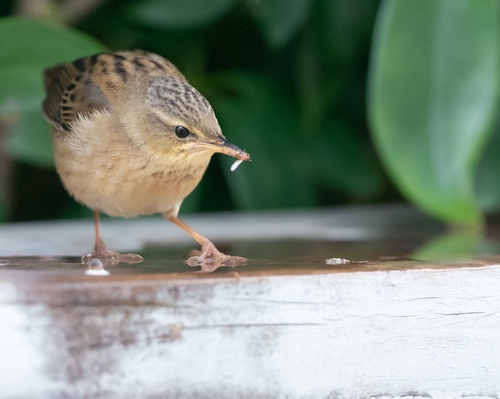 Pallas's Grasshopper Warbler
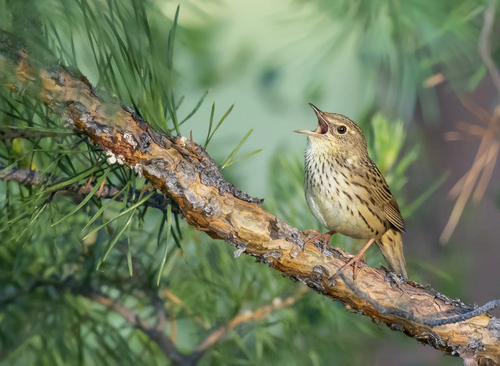 Lanceolated Warbler
In short
The most reliable field mark is the underpart streaking: Lanceolated Warbler shows fine, dark streaks across the breast, flanks, and undertail, while Pallas's Grasshopper Warbler has clean, unstreaked underparts except for some streaks on the undertail. Both have streaked brown backs and can look similar at a glance, especially in dense cover or poor light. Pallas's Grasshopper Warbler is slightly larger, with a warmer brown rump and distinctive white tips to the tail and tertials (the 'PG Tips' mark), while Lanceolated Warbler is smaller and more finely streaked below. Juveniles of both are yellower underneath, but the underpart streaking difference remains key. Their songs differ: Pallas's is a melodic warble, not the insect-like reel of Lanceolated. Careful attention to underpart streaking and tail/wing pattern is the best way to separate these two in the field.
Identification tips
- Underpart streaking is the single most reliable mark: Lanceolated Warbler always shows fine, dark streaks on the breast, flanks, and undertail, in all plumages. Pallas's Grasshopper Warbler is clean and unstreaked below except for some streaks on the undertail. This works for adults and juveniles.
- Look for white tips on tail and tertials (Pallas's): Pallas's Grasshopper Warbler shows crisp white tips to the tail and tertials, especially when the bird flicks its tail or wings. Lanceolated Warbler lacks these white tips.
- Rump color: Pallas's has a warmer, rusty-brown rump compared to the less contrasting rump of Lanceolated. This is subtle but can help if the bird fans its tail or shows its back.
- Size: Pallas's is slightly larger and bulkier than Lanceolated, but this is only useful if you have direct comparison or experience.
- Juvenile coloration: Both species' juveniles are yellower below, but the streaking pattern remains diagnostic: Lanceolated is streaked, Pallas's is not (except undertail).
- Song: Pallas's sings a melodic, Acrocephalus-like warble; Lanceolated (by implication) gives a more typical Locustella reeling song. Use song with caution, as both can be ventriloquial and hard to localize.
- Back streaking: Both have streaked brown backs; this is not a separator.
- Undertail streaking: Both show some streaking here, but only Lanceolated extends this streaking up the flanks and breast.
- Habitat: Both use dense, grassy cover and can overlap in range; habitat is not a safe separator.
- Behavior: Both are skulking and hard to see, creeping through grass; behavior does not reliably separate them.
- Bill, wing, and tail structure: No strong differences noted; both are typical Locustella/Helopsaltes warblers in shape.
- Flight views: Watch for white tail tips on Pallas's in flight; Lanceolated's tail is plain.
- Context: If seen singing, note the song type for additional confirmation.
- Pitfalls: Do not rely on back streaking or overall brownness; focus on underpart streaking and tail/wing tip color.
- Sex and season: Both sexes are alike; seasonal variation is minimal except for juvenile yellowness, which does not affect the main streaking difference.
Size
Pallas's Grasshopper Warbler is a medium-sized warbler, slightly larger than Lanceolated Warbler, which is described as small. The difference is subtle in the field and not always reliable on a lone bird, but if seen side by side, Pallas's appears a bit bulkier and longer, especially in the tail. Both species are similarly proportioned otherwise, with no mention of obvious differences in bill length or wing projection.
Plumage
- Juvenile/immature birds: Both species' young are yellower below, but Lanceolated Warbler juveniles already show the characteristic fine, dark streaks on the breast, flanks, and undertail, while Pallas's Grasshopper Warbler juveniles remain largely unstreaked below except for some undertail streaks.
- Adults: Pallas's Grasshopper Warbler has a streaked brown back, warm brown rump, and clean whitish-grey underparts with no streaks except on the undertail. Its tail and tertials show white tips, which can be seen in good light or when the bird fans its tail or flicks its wings. Lanceolated Warbler adults have a streaked brown back, but their underparts are distinctly streaked with fine, dark 'lance-head' marks across the breast, flanks, and undertail. The tail and tertials lack the crisp white tips of Pallas's. Both have similar upperpart streaking, but the underpart pattern is the main separator.
- Flight views: No specific notes on upperwing or flight pattern differences, but the white tail tips of Pallas's may show in flight, whereas Lanceolated's tail appears plainer.
Behaviour
Both species are secretive and prefer to skulk in dense grass or low foliage, rarely showing themselves except when singing. Pallas's Grasshopper Warbler is noted as especially difficult to see, creeping through grass and low shrubs. There is no mention of major behavioral differences between the two, so behavior alone is not a reliable separator.
Habitat
Both species breed in wet grasslands, marshes, or dense grassy areas across the Palearctic, with overlapping ranges in parts of northeastern Asia. Pallas's Grasshopper Warbler breeds from the Altai Mountains through Mongolia and northeastern China to Sakhalin and the Kurils, while Lanceolated Warbler breeds from northwest European Russia to northern Japan. Both winter in Southeast Asia. Habitat is not a strong separator where their ranges overlap, as both favor similar dense, grassy environments.
Voice
Pallas's Grasshopper Warbler has a song that is an inventive, Acrocephalus-like melody, quite unlike the mechanical, insect-like reeling of the Common Grasshopper Warbler and other Locustella warblers. Lanceolated Warbler's song is not described in detail here, but by omission, it is implied to be more typical of Locustella (reeling or insect-like). Thus, if you hear a melodic warble, it points to Pallas's; if you hear a mechanical reel, suspect Lanceolated (but confirm with visual marks, as song can be variable and hard to localize in dense cover).
Pallas's Grasshopper Warbler · Lanceolated Warbler · My Tricky Birds