
Pallas's Sandgrouse vs Asian Houbara
Syrrhaptes paradoxus versus Chlamydotis macqueenii
Play a quiz with Pallas's Sandgrouse and Asian Houbara
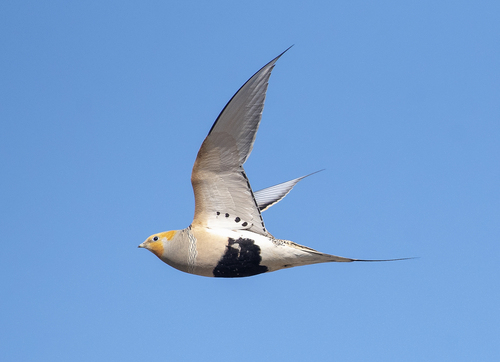 Pallas's Sandgrouse
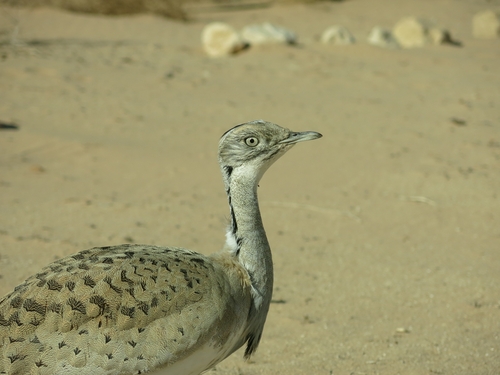 Asian Houbara
In short
Pallas's Sandgrouse and Asian Houbara are distinct in structure and behavior. Pallas's Sandgrouse is more compact with a shorter neck and tail, while the Asian Houbara is larger and more elongated, resembling a bustard. Observing their flight patterns and preferred habitats can aid in identification.
Identification tips
Look for the compact, short-necked profile and flocking behavior of Pallas's Sandgrouse. The Asian Houbara's larger size, elongated neck, and solitary nature are key differences. Observe flight patterns: rapid and direct for the sandgrouse, slower for the houbara.
Size
Pallas's Sandgrouse is smaller and more compact compared to the larger and more elongated Asian Houbara.
Behaviour
Pallas's Sandgrouse often flies in flocks and is known for its rapid, direct flight. In contrast, the Asian Houbara is more solitary or found in small groups and displays a slower, more deliberate flight.
Habitat
Pallas's Sandgrouse prefers open, arid steppes and deserts, while the Asian Houbara is found in similar arid regions but can also be seen in semi-desert and scrubby areas.