Birdr

Pallas's Sandgrouse vs Pin-tailed Sandgrouse

Syrrhaptes paradoxus versus Pterocles alchata

Play a quiz with Pallas's Sandgrouse and Pin-tailed Sandgrouse
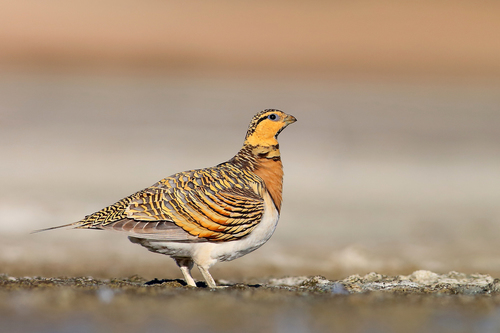
Pallas's Sandgrouse (Syrrhaptes paradoxus) Pallas's Sandgrouse
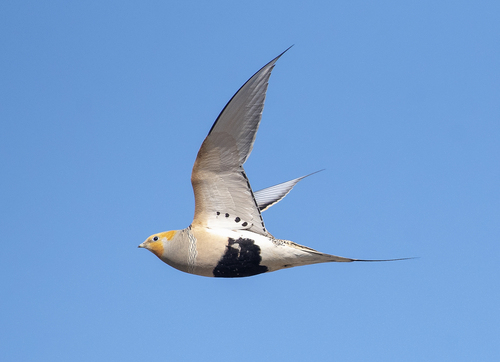
Pin-tailed Sandgrouse (Pterocles alchata) Pin-tailed Sandgrouse

Media

Loading…

In short

Pallas's Sandgrouse and Pin-tailed Sandgrouse can be distinguished by their tail shapes and plumage patterns. Pallas's Sandgrouse has a more elongated tail with central feathers extending beyond the rest, while Pin-tailed Sandgrouse has a distinctive pin-like tail. Both species have similar sandy coloration but differ in specific markings.

Identification tips

  1. Tail shape: Look for the elongated central tail feathers in Pallas's Sandgrouse. 2. Plumage patterns: Note the more uniform sandy color of Pallas's Sandgrouse versus the contrasting patterns on Pin-tailed Sandgrouse. 3. Habitat: Consider the environment; Pallas's Sandgrouse is more likely in arid steppes, while Pin-tailed Sandgrouse may be near cultivated fields. 4. Behavior: Observe flocking behavior and flight patterns; both species are similar, but habitat context can aid identification.

Size

Both species are similar in size, but Pallas's Sandgrouse may appear slightly larger due to its longer tail feathers.

Plumage

Pallas's Sandgrouse has a more uniform sandy color with less contrast, while Pin-tailed Sandgrouse shows more distinct black and white barring on the wings and a striking white belly. The male Pin-tailed Sandgrouse also has a prominent black breast band.

Behaviour

Both species exhibit similar behaviors, such as flying in flocks and being ground-dwelling, but Pallas's Sandgrouse is more likely to be seen in open steppe environments.

Habitat

Pallas's Sandgrouse prefers open steppes and semi-deserts, often in more arid regions, while Pin-tailed Sandgrouse is found in dry, open plains and cultivated areas, often near water sources.

Voice

Vocalizations are not a primary distinguishing feature, but Pallas's Sandgrouse has a softer, more mellow call compared to the sharper calls of Pin-tailed Sandgrouse.

Submit a better description

Use the same sections as the comparison. Your text is published immediately.

Pallas's Sandgrouse and Pin-tailed Sandgrouse can be distinguished by their tail shapes and plumage patterns. Pallas's Sandgrouse has a more elongated tail with central feathers extending beyond the rest, while Pin-tailed Sandgrouse has a distinctive pin-like tail. Both species have similar sandy coloration but differ in specific markings.

  1. Tail shape: Look for the elongated central tail feathers in Pallas's Sandgrouse. 2. Plumage patterns: Note the more uniform sandy color of Pallas's Sandgrouse versus the contrasting patterns on Pin-tailed Sandgrouse. 3. Habitat: Consider the environment; Pallas's Sandgrouse is more likely in arid steppes, while Pin-tailed Sandgrouse may be near cultivated fields. 4. Behavior: Observe flocking behavior and flight patterns; both species are similar, but habitat context can aid identification.

Both species are similar in size, but Pallas's Sandgrouse may appear slightly larger due to its longer tail feathers.

Pallas's Sandgrouse has a more uniform sandy color with less contrast, while Pin-tailed Sandgrouse shows more distinct black and white barring on the wings and a striking white belly. The male Pin-tailed Sandgrouse also has a prominent black breast band.

Both species exhibit similar behaviors, such as flying in flocks and being ground-dwelling, but Pallas's Sandgrouse is more likely to be seen in open steppe environments.

Pallas's Sandgrouse prefers open steppes and semi-deserts, often in more arid regions, while Pin-tailed Sandgrouse is found in dry, open plains and cultivated areas, often near water sources.

Vocalizations are not a primary distinguishing feature, but Pallas's Sandgrouse has a softer, more mellow call compared to the sharper calls of Pin-tailed Sandgrouse.

Discard your changes?

You have unsaved edits. If you leave now, those changes will be lost.

Pallas's Sandgrouse · Pin-tailed Sandgrouse · My Tricky Birds