Birdr

Pallid Harrier vs Eurasian Sparrowhawk

Circus macrourus versus Accipiter nisus

Play a quiz with Pallid Harrier and Eurasian Sparrowhawk

Pallid Harrier (Circus macrourus) Pallid Harrier
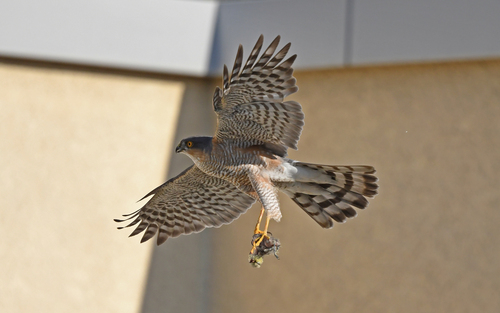
Eurasian Sparrowhawk (Accipiter nisus) Eurasian Sparrowhawk

Media

Loading…

In short

The Pallid Harrier and Eurasian Sparrowhawk can be distinguished by their structure and flight behavior. The Pallid Harrier is more slender with longer wings and tail, while the Eurasian Sparrowhawk is more compact with broader wings. Plumage differences are subtle, but juvenile Pallid Harriers show a distinctive facial pattern.

Identification tips

  1. Look for the Pallid Harrier's longer wings and tail, and its low, gliding flight style. 2. Note the facial pattern in juvenile Pallid Harriers. 3. Observe the habitat: open areas suggest Pallid Harrier, wooded areas suggest Eurasian Sparrowhawk. 4. Consider the season and location, as Pallid Harriers are migratory and more likely in open habitats during migration.

Size

The Pallid Harrier is generally larger and more slender than the Eurasian Sparrowhawk, with longer wings and tail.

Plumage

Pallid Harriers, especially juveniles, have a distinctive facial pattern with a pale collar and dark cheek patches. Eurasian Sparrowhawks have a more uniform appearance with males showing slate-blue upperparts and females gray-brown with a prominent supercilium.

Behaviour

Pallid Harriers often glide low over fields with wings held in a shallow 'V', while Eurasian Sparrowhawks are more likely to be seen in rapid, agile flight through wooded areas.

Habitat

Pallid Harriers are typically found in open grasslands and marshes, whereas Eurasian Sparrowhawks prefer woodlands and gardens.

Voice

Vocalizations are not a reliable field mark for distinguishing these species, as both are generally silent outside of the breeding season.

Submit a better description

Use the same sections as the comparison. Your text is published immediately.

The Pallid Harrier and Eurasian Sparrowhawk can be distinguished by their structure and flight behavior. The Pallid Harrier is more slender with longer wings and tail, while the Eurasian Sparrowhawk is more compact with broader wings. Plumage differences are subtle, but juvenile Pallid Harriers show a distinctive facial pattern.

  1. Look for the Pallid Harrier's longer wings and tail, and its low, gliding flight style. 2. Note the facial pattern in juvenile Pallid Harriers. 3. Observe the habitat: open areas suggest Pallid Harrier, wooded areas suggest Eurasian Sparrowhawk. 4. Consider the season and location, as Pallid Harriers are migratory and more likely in open habitats during migration.

The Pallid Harrier is generally larger and more slender than the Eurasian Sparrowhawk, with longer wings and tail.

Pallid Harriers, especially juveniles, have a distinctive facial pattern with a pale collar and dark cheek patches. Eurasian Sparrowhawks have a more uniform appearance with males showing slate-blue upperparts and females gray-brown with a prominent supercilium.

Pallid Harriers often glide low over fields with wings held in a shallow 'V', while Eurasian Sparrowhawks are more likely to be seen in rapid, agile flight through wooded areas.

Pallid Harriers are typically found in open grasslands and marshes, whereas Eurasian Sparrowhawks prefer woodlands and gardens.

Vocalizations are not a reliable field mark for distinguishing these species, as both are generally silent outside of the breeding season.

Discard your changes?

You have unsaved edits. If you leave now, those changes will be lost.

Pallid Harrier · Eurasian Sparrowhawk · My Tricky Birds