
Pallid Harrier vs Montagu's Harrier
Circus macrourus versus Circus pygargus
Play a quiz with Pallid Harrier and Montagu's Harrier
 Pallid Harrier
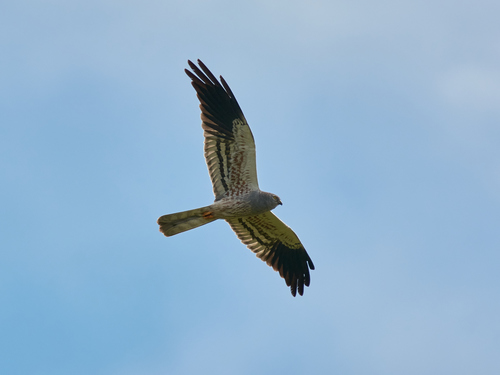 Montagu's Harrier
In short
The most reliable field mark to separate Pallid Harrier from Montagu's Harrier, especially in females and juveniles, is the presence of a well-defined pale collar around the neck in Pallid, which Montagu's always lacks. In flight, both can look very similar, but subtle differences in underpart color, facial pattern, and wing shape can help. Adult males are easier: Pallid is paler and cleaner white below, while Montagu's is darker and more mottled. Both species are slim, long-winged harriers, but careful attention to age, sex, and especially the head and neck pattern is key for a confident ID.
Identification tips
- Pale neck collar (female/juvenile): Pallid Harrier females and juveniles show a well-defined pale collar around the neck, absent in Montagu's at all ages. This is the most reliable field mark in direct comparison.
- Facial pattern (female/juvenile): Pallid has a more sharply defined facial pattern, while Montagu's is less distinct. Check for contrast around the eyes and cheeks.
- Underpart color (female/juvenile): Pallid's belly is paler and less streaked than Montagu's, which shows more yellow-brown with longitudinal stripes and, in adults, spotted wing coverts.
- Juvenile underwing/belly: Montagu's juveniles are uniformly red-brown below and under the wing, lacking the spotting seen in adults. Pallid juveniles are buff with brown streaks.
- Adult male color: Pallid males are much paler—whitish-grey above, white below, with narrow black wingtips. Montagu's males are darker, more mottled, with black secondary bands and rusty streaks on the belly/flanks.
- Secondary bands (adult male): Montagu's males show black bands along the secondaries (above and below), which are not present in Pallid males.
- Wing shape in flight: Both are slim and long-winged, but Montagu's can appear even more slender, with longer, narrower wings and a longer tail. The 'hand' (outer wing) is more pointed in Montagu's.
- Flight style: Montagu's has more elastic, tern-like wingbeats and a particularly buoyant, smooth flight. Pallid is also graceful but may seem less 'tern-like.'
- Melanistic morphs: Only Montagu's Harrier regularly shows melanistic (very dark) individuals. A very dark harrier is almost certainly Montagu's.
- White upper tail coverts ('ringtail'): Both species show this feature in females and juveniles, so it is not diagnostic between them.
- Size: Pallid averages slightly heavier, but this is not a reliable field mark in most circumstances.
- Context: Both species can occur together in migration or winter, so do not rely on location alone for ID.
- Perched views: Look for the pale collar and facial pattern in Pallid; Montagu's will lack the collar and have a plainer face.
- Sexual dimorphism: Both species show strong differences between males and females, so always consider sex and age when comparing field marks.
- Beware overlap with Hen Harrier: Some marks (like white upper tail coverts and general shape) are shared with Hen Harrier, but the pale collar (Pallid) and secondary bands (Montagu's male) are key for this pair.
Size
Pallid Harrier is slightly heavier on average (383.5g vs 315.5g for Montagu's [wikidata]), with females of both species being larger than males. In the field, this difference is subtle and not usually diagnostic. Both species are similarly long-winged and slender, but Montagu's is sometimes described as even more slender and long-tailed in flight. Overall, size alone is not a reliable separator between these two.
Plumage
For females and juveniles (the most challenging ages):
- Pallid Harrier shows a clear pale collar around the neck and a paler belly, with a well-defined facial pattern. The underparts are buff with brown streaks, and the upperparts are brown with white upper tail coverts ('ringtail').
- Montagu's Harrier lacks the pale collar and has a less distinct facial pattern. The underparts are pale yellow-brown with longitudinal stripes, and the wing coverts are spotted. Juveniles are more uniform red-brown below, lacking the spotting of adults. Both have white upper tail coverts.
For adult males:
- Pallid Harrier males are whitish-grey above and white below, with narrow black wingtips. They appear paler and cleaner than Montagu's.
- Montagu's Harrier males are darker and more mottled, with black bands along the secondaries (above and below) and rusty streaks on the belly and flanks. The overall impression is darker and more patterned than Pallid.
Melanistic forms occur in Montagu's but not in Pallid.
Behaviour
Both species hunt by drifting low over open fields and moors, holding their wings in a shallow V. Montagu's Harrier is noted for particularly smooth, buoyant, and elegant flight, with more elastic, tern-like wingbeats. Both species exhibit typical harrier hunting behavior, but Montagu's may appear even more graceful and slender in the air. Perched, both look slim and long-winged, with subtle differences in head pattern that are best seen at close range.
Habitat
Both species breed in open country—Pallid Harrier in southern parts of eastern Europe, central Asia, and Iran, and Montagu's Harrier more broadly across the Palearctic. In winter, Pallid Harrier moves mainly to India and southeast Asia, while Montagu's winters in Africa, the Indian subcontinent, and parts of the Arabian Peninsula. Their ranges overlap in some areas, but context alone is rarely diagnostic between these two.