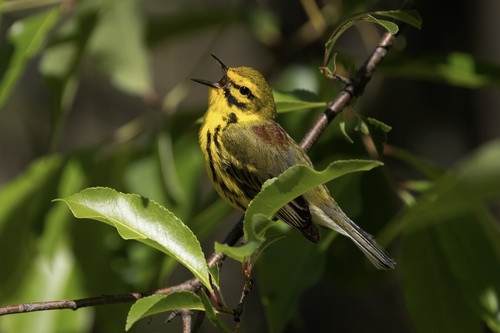
Palm Warbler vs Prairie Warbler
Setophaga palmarum versus Setophaga discolor
Play a quiz with Palm Warbler and Prairie Warbler
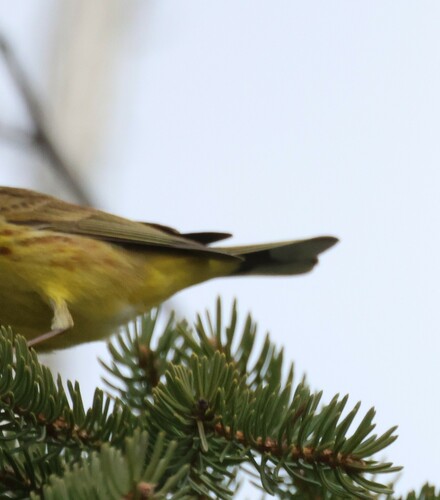
Palm Warbler
Prairie Warbler
In short
The Palm Warbler and Prairie Warbler can be distinguished by their tail-wagging behavior and plumage details. Palm Warblers often exhibit a distinctive tail-bobbing motion and have a more uniform brownish-olive plumage with a rusty cap. Prairie Warblers have a brighter yellow underpart with bold black streaks on the sides.
Identification tips
1. Tail-wagging behavior: Look for the characteristic tail-bobbing of the Palm Warbler. 2. Plumage details: Note the rusty cap of the Palm Warbler versus the bright yellow and streaked sides of the Prairie Warbler. 3. Habitat preference: Consider the habitat; Palm Warblers are more likely in open areas, while Prairie Warblers prefer scrubby fields. 4. Vocalizations: If heard, use song differences, though this requires experience.
Size
Both species are similar in size, typical of small warblers.
Plumage
Palm Warblers have a rusty cap and a more uniform brownish-olive plumage, while Prairie Warblers are brighter with yellow underparts and bold black streaks on the sides. Prairie Warblers also have a more pronounced facial pattern with a dark eye line and a yellow supercilium.
Behaviour
Palm Warblers are known for their constant tail-wagging behavior, which is a key behavioral difference from Prairie Warblers.
Habitat
Palm Warblers are often found in open areas with scattered trees, especially during migration. Prairie Warblers prefer scrubby fields and open woodlands, often with a preference for early successional habitats.
Voice
The songs and calls of these species differ, with Palm Warblers having a more monotonous trill, while Prairie Warblers have a rising and accelerating series of notes. However, vocalizations can be challenging to distinguish without prior experience.