Birdr

Parker's Spinetail vs Line-cheeked Spinetail

Cranioleuca vulpecula versus Cranioleuca antisiensis

Play a quiz with Parker's Spinetail and Line-cheeked Spinetail
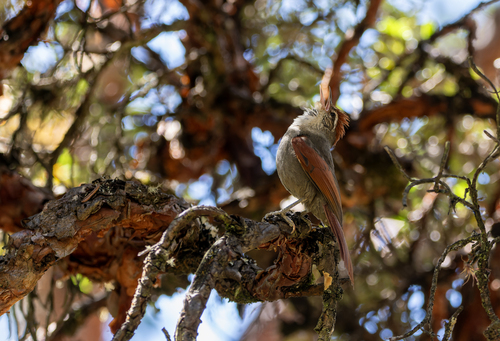
Parker's Spinetail (Cranioleuca vulpecula) Parker's Spinetail
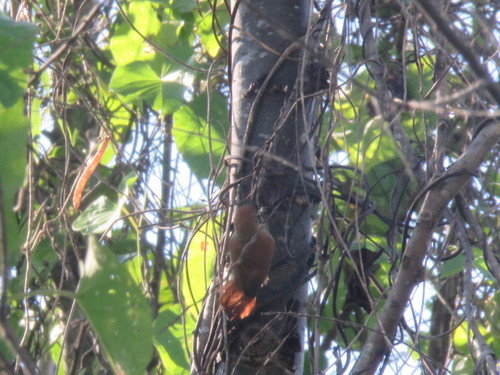
Line-cheeked Spinetail (Cranioleuca antisiensis) Line-cheeked Spinetail

Media

Loading…

In short

Parker's Spinetail and Line-cheeked Spinetail are both members of the Cranioleuca genus, but they can be distinguished by their habitat preferences and plumage. Parker's Spinetail has bright rufous upperparts and is found on young Amazonian river islands, while the Line-cheeked Spinetail is part of a complex with varying plumage over a wide range.

Identification tips

Size

Both species are similar in size, typical of spinetails, with no significant size differences noted.

Plumage

Parker's Spinetail features bright rufous upperparts and dull grayish-brown underparts with a whiter throat. The Line-cheeked Spinetail shows a range of plumage variations, but generally lacks the bright rufous coloration and has more muted tones.

Behaviour

Parker's Spinetail forages higher in vegetation and is often found in pairs in dense thickets. Behavior specifics for Line-cheeked Spinetail are less documented, but it is part of a complex with variable behaviors.

Habitat

Parker's Spinetail is found on young Amazonian river islands in central Brazil, northern Bolivia, eastern Peru, and eastern Ecuador. The Line-cheeked Spinetail is part of a cline with no clear geographic division, but generally occupies Andean regions.

Voice

Vocalizations are not well-documented for either species in the sources, but Parker's Spinetail is noted to have distinctive calls compared to other spinetails.

Submit a better description

Use the same sections as the comparison. Your text is published immediately.

Parker's Spinetail and Line-cheeked Spinetail are both members of the Cranioleuca genus, but they can be distinguished by their habitat preferences and plumage. Parker's Spinetail has bright rufous upperparts and is found on young Amazonian river islands, while the Line-cheeked Spinetail is part of a complex with varying plumage over a wide range.

  • Look for bright rufous upperparts in Parker's Spinetail.
  • Observe habitat: Parker's is on young river islands, while Line-cheeked is more Andean.
  • Note foraging height: Parker's Spinetail forages higher in vegetation.
  • Be aware of the Line-cheeked Spinetail's variable plumage due to its cline.

Both species are similar in size, typical of spinetails, with no significant size differences noted.

Parker's Spinetail features bright rufous upperparts and dull grayish-brown underparts with a whiter throat. The Line-cheeked Spinetail shows a range of plumage variations, but generally lacks the bright rufous coloration and has more muted tones.

Parker's Spinetail forages higher in vegetation and is often found in pairs in dense thickets. Behavior specifics for Line-cheeked Spinetail are less documented, but it is part of a complex with variable behaviors.

Parker's Spinetail is found on young Amazonian river islands in central Brazil, northern Bolivia, eastern Peru, and eastern Ecuador. The Line-cheeked Spinetail is part of a cline with no clear geographic division, but generally occupies Andean regions.

Vocalizations are not well-documented for either species in the sources, but Parker's Spinetail is noted to have distinctive calls compared to other spinetails.

Discard your changes?

You have unsaved edits. If you leave now, those changes will be lost.

Parker's Spinetail · Line-cheeked Spinetail · My Tricky Birds