Birdr

Patagonian Canastero vs Bay-capped Wren-Spinetail

Pseudasthenes patagonica versus Spartonoica maluroides

Play a quiz with Patagonian Canastero and Bay-capped Wren-Spinetail
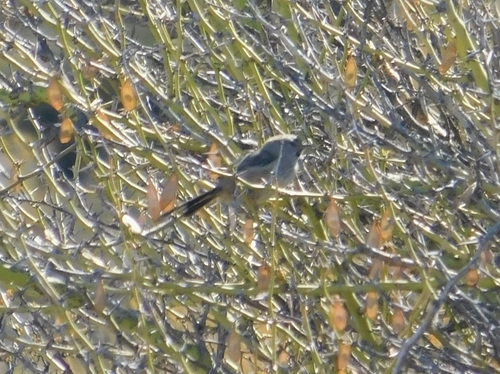
Patagonian Canastero (Pseudasthenes patagonica) Patagonian Canastero
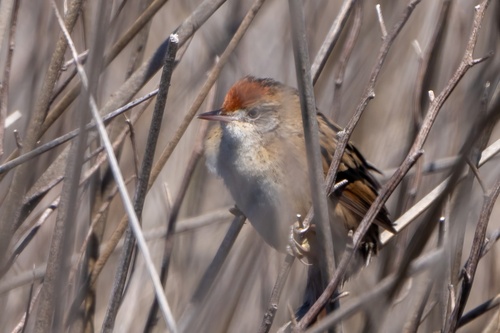
Bay-capped Wren-Spinetail (Spartonoica maluroides) Bay-capped Wren-Spinetail

Media

Loading…

In short

The Patagonian Canastero and the Bay-capped Wren-Spinetail are both small, ground-dwelling birds of the Furnariidae family, but they differ in plumage and habitat preferences. The Patagonian Canastero is more uniform in color, while the Bay-capped Wren-Spinetail has a distinctive rufous cap and contrasting plumage.

Identification tips

Look for the rufous cap and contrasting plumage of the Bay-capped Wren-Spinetail, especially in marshy habitats. In arid regions, the more uniform Patagonian Canastero is likely. Listen for song differences: mechanical for the Canastero, musical for the Wren-Spinetail.

Size

Both species are similar in size, typical of small passerines, with no significant differences in overall body length.

Plumage

The Patagonian Canastero has a more uniform brownish-grey plumage, whereas the Bay-capped Wren-Spinetail is notable for its rufous cap and contrasting pale throat and underparts. The Wren-Spinetail also has a more pronounced supercilium.

Behaviour

Both species are ground-dwelling and often seen foraging low in vegetation, but the Bay-capped Wren-Spinetail may be more active and conspicuous in its movements.

Habitat

The Patagonian Canastero is typically found in arid, open habitats such as shrublands and steppes, while the Bay-capped Wren-Spinetail prefers marshy areas and reedbeds.

Voice

Vocalizations differ, with the Patagonian Canastero having a more repetitive and mechanical song, while the Bay-capped Wren-Spinetail's song is more musical and varied.

Submit a better description

Use the same sections as the comparison. Your text is published immediately.

The Patagonian Canastero and the Bay-capped Wren-Spinetail are both small, ground-dwelling birds of the Furnariidae family, but they differ in plumage and habitat preferences. The Patagonian Canastero is more uniform in color, while the Bay-capped Wren-Spinetail has a distinctive rufous cap and contrasting plumage.

Look for the rufous cap and contrasting plumage of the Bay-capped Wren-Spinetail, especially in marshy habitats. In arid regions, the more uniform Patagonian Canastero is likely. Listen for song differences: mechanical for the Canastero, musical for the Wren-Spinetail.

Both species are similar in size, typical of small passerines, with no significant differences in overall body length.

The Patagonian Canastero has a more uniform brownish-grey plumage, whereas the Bay-capped Wren-Spinetail is notable for its rufous cap and contrasting pale throat and underparts. The Wren-Spinetail also has a more pronounced supercilium.

Both species are ground-dwelling and often seen foraging low in vegetation, but the Bay-capped Wren-Spinetail may be more active and conspicuous in its movements.

The Patagonian Canastero is typically found in arid, open habitats such as shrublands and steppes, while the Bay-capped Wren-Spinetail prefers marshy areas and reedbeds.

Vocalizations differ, with the Patagonian Canastero having a more repetitive and mechanical song, while the Bay-capped Wren-Spinetail's song is more musical and varied.

Discard your changes?

You have unsaved edits. If you leave now, those changes will be lost.

Patagonian Canastero · Bay-capped Wren-Spinetail · My Tricky Birds