Birdr

Pavonine Cuckoo vs Common Squirrel-Cuckoo

Dromococcyx pavoninus versus Piaya cayana

Play a quiz with Pavonine Cuckoo and Common Squirrel-Cuckoo

Pavonine Cuckoo (Dromococcyx pavoninus) Pavonine Cuckoo
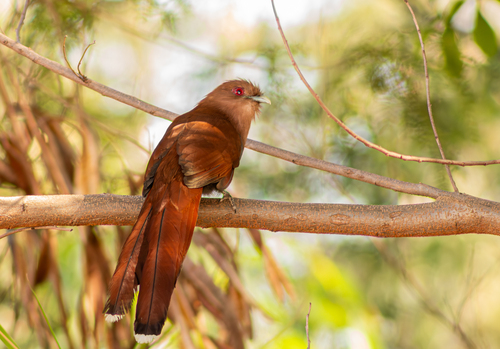
Common Squirrel-Cuckoo (Piaya cayana) Common Squirrel-Cuckoo

Media

Loading…

In short

The Pavonine Cuckoo and Common Squirrel-Cuckoo are both members of the cuckoo family but can be distinguished by their size and tail characteristics. The Pavonine Cuckoo is more elusive and often heard rather than seen, whereas the Common Squirrel-Cuckoo is more conspicuous and frequently observed.

Identification tips

  1. Look for the long, rufous tail of the Common Squirrel-Cuckoo, often held upright. 2. Note the size difference: the Common Squirrel-Cuckoo is larger. 3. Listen for vocalizations: the Pavonine Cuckoo has a more singular call, while the Common Squirrel-Cuckoo has a varied repertoire. 4. Observe behavior: the Pavonine Cuckoo is more secretive, often staying hidden, while the Common Squirrel-Cuckoo is more active and visible.

Size

The Common Squirrel-Cuckoo is larger and more robust compared to the smaller and slimmer Pavonine Cuckoo.

Plumage

The Pavonine Cuckoo has a more uniform brown plumage with a slightly iridescent sheen, while the Common Squirrel-Cuckoo displays a rufous upper body with a distinctive long, graduated tail that is often held upright.

Behaviour

The Pavonine Cuckoo is reclusive and often stays hidden in dense foliage, making it difficult to spot. In contrast, the Common Squirrel-Cuckoo is more active and can be seen gliding between trees or perching in the open.

Habitat

Both species inhabit forested areas, but the Pavonine Cuckoo is more likely to be found in dense, humid forests, whereas the Common Squirrel-Cuckoo is adaptable to a variety of wooded habitats, including edges and gardens.

Voice

The Pavonine Cuckoo is more often heard than seen, with a distinctive call that is less varied than the Common Squirrel-Cuckoo, which has a wide range of vocalizations including a distinctive, repetitive 'pi-pi-pi' call.

Submit a better description

Use the same sections as the comparison. Your text is published immediately.

The Pavonine Cuckoo and Common Squirrel-Cuckoo are both members of the cuckoo family but can be distinguished by their size and tail characteristics. The Pavonine Cuckoo is more elusive and often heard rather than seen, whereas the Common Squirrel-Cuckoo is more conspicuous and frequently observed.

  1. Look for the long, rufous tail of the Common Squirrel-Cuckoo, often held upright. 2. Note the size difference: the Common Squirrel-Cuckoo is larger. 3. Listen for vocalizations: the Pavonine Cuckoo has a more singular call, while the Common Squirrel-Cuckoo has a varied repertoire. 4. Observe behavior: the Pavonine Cuckoo is more secretive, often staying hidden, while the Common Squirrel-Cuckoo is more active and visible.

The Common Squirrel-Cuckoo is larger and more robust compared to the smaller and slimmer Pavonine Cuckoo.

The Pavonine Cuckoo has a more uniform brown plumage with a slightly iridescent sheen, while the Common Squirrel-Cuckoo displays a rufous upper body with a distinctive long, graduated tail that is often held upright.

The Pavonine Cuckoo is reclusive and often stays hidden in dense foliage, making it difficult to spot. In contrast, the Common Squirrel-Cuckoo is more active and can be seen gliding between trees or perching in the open.

Both species inhabit forested areas, but the Pavonine Cuckoo is more likely to be found in dense, humid forests, whereas the Common Squirrel-Cuckoo is adaptable to a variety of wooded habitats, including edges and gardens.

The Pavonine Cuckoo is more often heard than seen, with a distinctive call that is less varied than the Common Squirrel-Cuckoo, which has a wide range of vocalizations including a distinctive, repetitive 'pi-pi-pi' call.

Discard your changes?

You have unsaved edits. If you leave now, those changes will be lost.

Pavonine Cuckoo · Common Squirrel-Cuckoo · My Tricky Birds