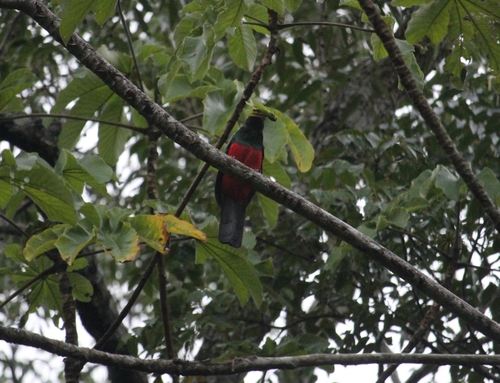
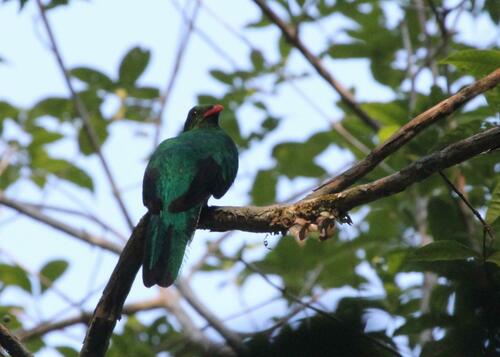
Pavonine Quetzal vs Slaty-tailed Trogon
Pharomachrus pavoninus versus Trogon massena
Play a quiz with Pavonine Quetzal and Slaty-tailed Trogon
Pavonine Quetzal
Slaty-tailed Trogon
In short
The reddish bill of the Pavonine Quetzal is the most reliable field mark distinguishing it from the Slaty-tailed Trogon, which has a dark bill. Both species have metallic green plumage, but the Pavonine Quetzal's males have a green head and black undertail, while the Slaty-tailed Trogon has a slaty tail and lacks the red belly.
Identification tips
1. Bill color: Look for the reddish bill of the Pavonine Quetzal versus the dark bill of the Slaty-tailed Trogon. 2. Tail and belly: Note the black undertail and red belly of the Pavonine Quetzal, absent in the Slaty-tailed Trogon. 3. Vocalizations: Listen for the distinct whistle pattern of the Pavonine Quetzal. 4. Geographic range: Consider the location; Pavonine Quetzal is more likely in the Amazon basin, while Slaty-tailed Trogon is found further north.
Size
Both species are similar in size, typical of trogons, with no significant difference in body length or wingspan.
Plumage
The Pavonine Quetzal is metallic green with a red belly and a reddish bill. Males have a green head and black undertail, while females have grayish heads and a gray breast band. The Slaty-tailed Trogon has a slaty tail, a dark bill, and lacks the red belly, with a more uniform green or blue-green body.
Behaviour
Both species exhibit typical trogon behavior, often perching quietly in the mid to upper canopy. No significant behavioral differences are noted.
Habitat
Both species inhabit tropical forests, but the Pavonine Quetzal is more associated with the Amazon basin, while the Slaty-tailed Trogon is found in Central America and parts of northern South America.
Voice
The Pavonine Quetzal's call is a long, mournful whistle followed by a shorter whistle, sometimes with a series of deep, short whistles. The Slaty-tailed Trogon has a different call, typically a series of soft, low-pitched notes.