Birdr

Pearl-breasted Swallow vs Barn Swallow

Hirundo dimidiata versus Hirundo rustica

Play a quiz with Pearl-breasted Swallow and Barn Swallow
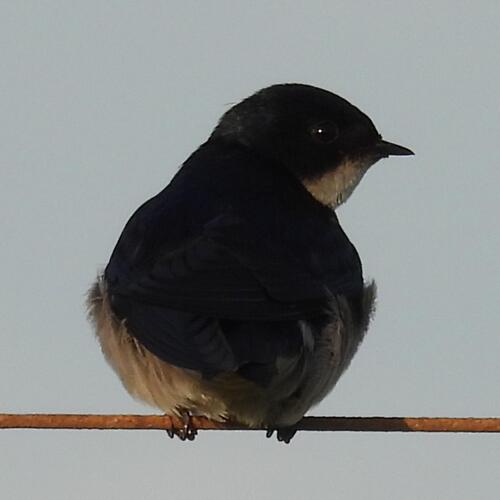
Pearl-breasted Swallow (Hirundo dimidiata) Pearl-breasted Swallow
Barn Swallow (Hirundo rustica) Barn Swallow

Media

Loading…

In short

The Pearl-breasted Swallow and Barn Swallow can be distinguished primarily by their tail shape and plumage. The Barn Swallow has a notably long, deeply forked tail and a glossy steel-blue upperpart, while the Pearl-breasted Swallow has a shorter, less forked tail and a more muted plumage. Observing these features in flight or perched can help differentiate them.

Identification tips

Size

The Barn Swallow is generally larger, with a length of 17–19 cm, compared to the smaller Pearl-breasted Swallow.

Plumage

Barn Swallows have glossy steel-blue upperparts with rufous-chestnut forehead and throat, and creamy or buffy white underparts. Pearl-breasted Swallows have less glossy blue-black upperparts and a white underpart with a distinctive pearl-like sheen.

Behaviour

Both species are aerial insectivores, often seen flying swiftly over open areas. However, Barn Swallows are more likely to be seen in larger flocks and are more widespread.

Habitat

Barn Swallows are found in a wide range of open habitats, including urban areas, while Pearl-breasted Swallows prefer open grasslands and savannas in southern Africa.

Voice

The Barn Swallow's song is a cheerful series of twitters and warbles, while the Pearl-breasted Swallow's vocalizations are less documented but generally consist of softer calls.

Submit a better description

Use the same sections as the comparison. Your text is published immediately.

The Pearl-breasted Swallow and Barn Swallow can be distinguished primarily by their tail shape and plumage. The Barn Swallow has a notably long, deeply forked tail and a glossy steel-blue upperpart, while the Pearl-breasted Swallow has a shorter, less forked tail and a more muted plumage. Observing these features in flight or perched can help differentiate them.

  • Tail Shape: Look for the Barn Swallow's long, deeply forked tail compared to the shorter, less forked tail of the Pearl-breasted Swallow.
  • Plumage: Note the Barn Swallow's glossy steel-blue upperparts and rufous-chestnut throat versus the Pearl-breasted Swallow's less glossy blue-black upperparts and white underparts.
  • Size: Barn Swallows are larger and more robust.
  • Habitat: Consider the location; Barn Swallows are more adaptable to various environments, including urban areas, while Pearl-breasted Swallows are more restricted to southern African grasslands.

The Barn Swallow is generally larger, with a length of 17–19 cm, compared to the smaller Pearl-breasted Swallow.

Barn Swallows have glossy steel-blue upperparts with rufous-chestnut forehead and throat, and creamy or buffy white underparts. Pearl-breasted Swallows have less glossy blue-black upperparts and a white underpart with a distinctive pearl-like sheen.

Both species are aerial insectivores, often seen flying swiftly over open areas. However, Barn Swallows are more likely to be seen in larger flocks and are more widespread.

Barn Swallows are found in a wide range of open habitats, including urban areas, while Pearl-breasted Swallows prefer open grasslands and savannas in southern Africa.

The Barn Swallow's song is a cheerful series of twitters and warbles, while the Pearl-breasted Swallow's vocalizations are less documented but generally consist of softer calls.

Discard your changes?

You have unsaved edits. If you leave now, those changes will be lost.

Pearl-breasted Swallow · Barn Swallow · My Tricky Birds