Birdr

Pearl-spotted Owlet vs African Barred Owlet

Glaucidium perlatum versus Glaucidium capense

Play a quiz with Pearl-spotted Owlet and African Barred Owlet
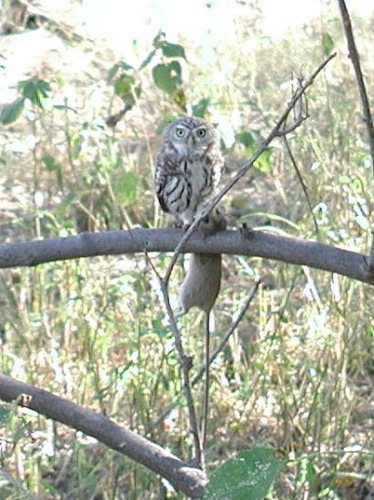
Pearl-spotted Owlet (Glaucidium perlatum) Pearl-spotted Owlet
African Barred Owlet (Glaucidium capense) African Barred Owlet

Media

Loading…

In short

The Pearl-spotted Owlet and African Barred Owlet are small, similar-looking owls found in overlapping regions of Africa. The most reliable field mark is the presence of false 'eyes' on the back of the Pearl-spotted Owlet's head, which the African Barred Owlet lacks. Both species are active during the day, but differ in vocalizations and subtle plumage details.

Identification tips

Size

Both species are small owls, similar in size, making size an unreliable distinguishing feature.

Plumage

The Pearl-spotted Owlet has distinctive false 'eyes' on the back of its head, while the African Barred Owlet does not. The Pearl-spotted Owlet also tends to have a more spotted appearance overall, whereas the African Barred Owlet has more prominent barring on its underparts.

Behaviour

Both owlets are diurnal and can be seen hunting during daylight, especially at dusk and dawn. They may be mobbed by other birds when detected.

Habitat

Both species inhabit a variety of wooded areas across central, eastern, and southern Africa. The African Barred Owlet is found in both lowland and montane areas, while the Pearl-spotted Owlet is more commonly found in savannas and open woodlands.

Voice

The Pearl-spotted Owlet has a distinctive, repetitive whistling call, while the African Barred Owlet's call is a series of rapid hoots. These vocal differences can be a useful identification tool.

Submit a better description

Use the same sections as the comparison. Your text is published immediately.

The Pearl-spotted Owlet and African Barred Owlet are small, similar-looking owls found in overlapping regions of Africa. The most reliable field mark is the presence of false 'eyes' on the back of the Pearl-spotted Owlet's head, which the African Barred Owlet lacks. Both species are active during the day, but differ in vocalizations and subtle plumage details.

  • Look for the false 'eyes' on the back of the Pearl-spotted Owlet's head.
  • Note the more spotted appearance of the Pearl-spotted Owlet compared to the barred pattern of the African Barred Owlet.
  • Listen for the distinct calls: whistling for the Pearl-spotted and hooting for the African Barred.
  • Consider habitat: Pearl-spotted is more common in savannas, while African Barred can be found in a wider range of wooded areas.

Both species are small owls, similar in size, making size an unreliable distinguishing feature.

The Pearl-spotted Owlet has distinctive false 'eyes' on the back of its head, while the African Barred Owlet does not. The Pearl-spotted Owlet also tends to have a more spotted appearance overall, whereas the African Barred Owlet has more prominent barring on its underparts.

Both owlets are diurnal and can be seen hunting during daylight, especially at dusk and dawn. They may be mobbed by other birds when detected.

Both species inhabit a variety of wooded areas across central, eastern, and southern Africa. The African Barred Owlet is found in both lowland and montane areas, while the Pearl-spotted Owlet is more commonly found in savannas and open woodlands.

The Pearl-spotted Owlet has a distinctive, repetitive whistling call, while the African Barred Owlet's call is a series of rapid hoots. These vocal differences can be a useful identification tool.

Discard your changes?

You have unsaved edits. If you leave now, those changes will be lost.

Pearl-spotted Owlet · African Barred Owlet · My Tricky Birds