Birdr

Pied Plover vs Collared Plover

Hoploxypterus cayanus versus Anarhynchus collaris

Play a quiz with Pied Plover and Collared Plover
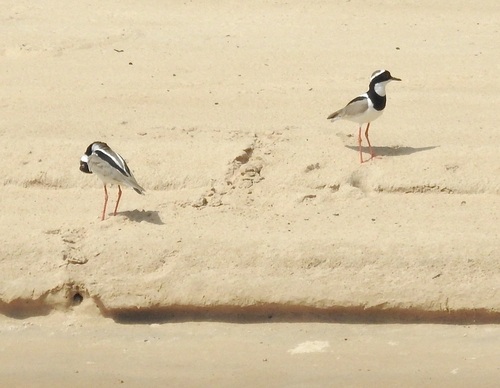
Pied Plover (Hoploxypterus cayanus) Pied Plover
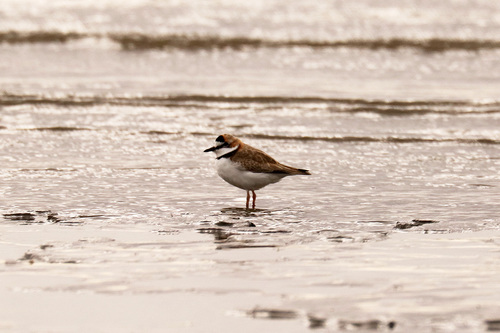
Collared Plover (Anarhynchus collaris) Collared Plover

Media

Loading…

In short

To distinguish a Pied Plover from a Collared Plover, focus on the head pattern and bill shape. The Pied Plover has a striking black-and-white head pattern with a prominent black cap, while the Collared Plover features a more subdued head with a brown cap and a distinctive white collar. Both species are small plovers, but their habitats and behaviors can also aid in identification.

Identification tips

  1. Look for the black-and-white head pattern of the Pied Plover, especially the black cap. 2. Note the white collar and brown cap of the Collared Plover. 3. Observe the habitat: Pied Plovers prefer sandbars and shorelines, while Collared Plovers may be found in more varied open areas. 4. Consider size and structure: Pied Plovers appear slightly larger and more robust. 5. Use behavior as a secondary clue, as both species have similar running and stopping habits.

Size

Both species are small plovers, but the Pied Plover tends to appear slightly larger and more robust than the Collared Plover.

Plumage

The Pied Plover has a bold black-and-white head pattern with a black cap and white face, while the Collared Plover has a brown cap, a white collar around the neck, and a more uniform brownish body. The Pied Plover's contrasting head pattern is a key distinguishing feature.

Behaviour

The Pied Plover is known for running short distances and stopping abruptly, often seen on sandbars and shorelines. The Collared Plover also exhibits similar behavior but may be less conspicuous due to its more muted coloration.

Habitat

Pied Plovers are typically found on sandbars and shorelines of ponds and rivers, preferring open sandy or muddy areas. Collared Plovers can be found in similar habitats but may also inhabit more open, grassy areas near water.

Voice

The Pied Plover is fairly quiet and usually detected visually rather than by sound. There is limited information on the vocalizations of the Collared Plover, but it is not known for being particularly vocal either.

Submit a better description

Use the same sections as the comparison. Your text is published immediately.

To distinguish a Pied Plover from a Collared Plover, focus on the head pattern and bill shape. The Pied Plover has a striking black-and-white head pattern with a prominent black cap, while the Collared Plover features a more subdued head with a brown cap and a distinctive white collar. Both species are small plovers, but their habitats and behaviors can also aid in identification.

  1. Look for the black-and-white head pattern of the Pied Plover, especially the black cap. 2. Note the white collar and brown cap of the Collared Plover. 3. Observe the habitat: Pied Plovers prefer sandbars and shorelines, while Collared Plovers may be found in more varied open areas. 4. Consider size and structure: Pied Plovers appear slightly larger and more robust. 5. Use behavior as a secondary clue, as both species have similar running and stopping habits.

Both species are small plovers, but the Pied Plover tends to appear slightly larger and more robust than the Collared Plover.

The Pied Plover has a bold black-and-white head pattern with a black cap and white face, while the Collared Plover has a brown cap, a white collar around the neck, and a more uniform brownish body. The Pied Plover's contrasting head pattern is a key distinguishing feature.

The Pied Plover is known for running short distances and stopping abruptly, often seen on sandbars and shorelines. The Collared Plover also exhibits similar behavior but may be less conspicuous due to its more muted coloration.

Pied Plovers are typically found on sandbars and shorelines of ponds and rivers, preferring open sandy or muddy areas. Collared Plovers can be found in similar habitats but may also inhabit more open, grassy areas near water.

The Pied Plover is fairly quiet and usually detected visually rather than by sound. There is limited information on the vocalizations of the Collared Plover, but it is not known for being particularly vocal either.

Discard your changes?

You have unsaved edits. If you leave now, those changes will be lost.

Pied Plover · Collared Plover · My Tricky Birds