Birdr

Pied Wheatear vs White-crowned Wheatear

Oenanthe pleschanka versus Oenanthe leucopyga

Play a quiz with Pied Wheatear and White-crowned Wheatear
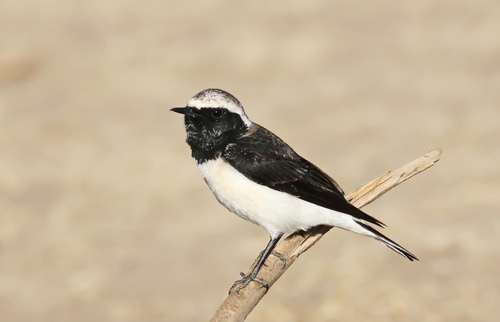
Pied Wheatear (Oenanthe pleschanka) Pied Wheatear
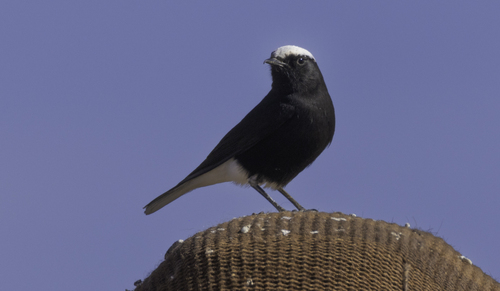
White-crowned Wheatear (Oenanthe leucopyga) White-crowned Wheatear

Media

Loading…

In short

The Pied Wheatear (Oenanthe pleschanka) and the White-crowned Wheatear (Oenanthe leucopyga aegra) are two distinct species that can be differentiated by their plumage, vocalizations, and preferred habitats. While both species exhibit similar behaviors typical of wheatears, key visual and vocal characteristics can assist birdwatchers in identification.

Identification tips

  1. Birds of the World Similar-Species Diagnostics:
  2. The expert source mentions that the Pied Wheatear has “distinctive black and white plumage” and a “more pronounced contrast between the black upperparts and white underparts” compared to the White-crowned Wheatear. The latter is characterized by its “white crown and nape” which contrasts with its darker back and wings.

  3. AI Field Diagnostics:

  4. Plumage Details: Pay close attention to the color contrast in plumage. The Pied Wheatear's stark black-and-white appearance is a key identifier, particularly in males. The White-crowned Wheatear’s white crown is a standout feature.
  5. Size and Shape: The White-crowned Wheatear is generally larger. If possible, observe them side by side to gauge size differences.
  6. Vocalization: Listen for the call differences; the Pied Wheatear's calls are more abrupt and sharp, while the White-crowned Wheatear has a more melodious quality.
  7. Habitat Preferences: When birdwatching, consider the habitat. If you are in a rocky, arid area, you are more likely to see the Pied Wheatear. In more vegetated, hilly areas, look for the White-crowned Wheatear.
  8. Behavioral Observations: Note the social behavior as well; if you see a bird foraging alone, it might be a Pied Wheatear, whereas the White-crowned Wheatear may be in small groups.

By focusing on these specific traits, birdwatchers can effectively distinguish between the Pied Wheatear and the White-crowned Wheatear in the field.

Size

Plumage

Behaviour

Habitat

Voice

Submit a better description

Use the same sections as the comparison. Your text is published immediately.

The Pied Wheatear (Oenanthe pleschanka) and the White-crowned Wheatear (Oenanthe leucopyga aegra) are two distinct species that can be differentiated by their plumage, vocalizations, and preferred habitats. While both species exhibit similar behaviors typical of wheatears, key visual and vocal characteristics can assist birdwatchers in identification.

  1. Birds of the World Similar-Species Diagnostics:
  2. The expert source mentions that the Pied Wheatear has “distinctive black and white plumage” and a “more pronounced contrast between the black upperparts and white underparts” compared to the White-crowned Wheatear. The latter is characterized by its “white crown and nape” which contrasts with its darker back and wings.

  3. AI Field Diagnostics:

  4. Plumage Details: Pay close attention to the color contrast in plumage. The Pied Wheatear's stark black-and-white appearance is a key identifier, particularly in males. The White-crowned Wheatear’s white crown is a standout feature.
  5. Size and Shape: The White-crowned Wheatear is generally larger. If possible, observe them side by side to gauge size differences.
  6. Vocalization: Listen for the call differences; the Pied Wheatear's calls are more abrupt and sharp, while the White-crowned Wheatear has a more melodious quality.
  7. Habitat Preferences: When birdwatching, consider the habitat. If you are in a rocky, arid area, you are more likely to see the Pied Wheatear. In more vegetated, hilly areas, look for the White-crowned Wheatear.
  8. Behavioral Observations: Note the social behavior as well; if you see a bird foraging alone, it might be a Pied Wheatear, whereas the White-crowned Wheatear may be in small groups.

By focusing on these specific traits, birdwatchers can effectively distinguish between the Pied Wheatear and the White-crowned Wheatear in the field.

  • Pied Wheatear: Generally measures about 14-16 cm in length, with a wingspan of approximately 30-34 cm. They have a compact body structure.
  • White-crowned Wheatear: Slightly larger, measuring around 15-18 cm in length and with a wingspan of approximately 30-36 cm. They also exhibit a more robust body compared to the Pied Wheatear.
  • Pied Wheatear: Exhibits a striking contrast in plumage. Males in breeding plumage have a black head and upperparts, white underparts, and a distinctive white wing patch. Females are more muted with brownish tones and lack the stark contrasts seen in males.
  • White-crowned Wheatear: Characterized by its white crown and nape, contrasting with its dark back and wings. The underparts are typically a lighter shade, and the overall pattern is less contrasting than that of the Pied Wheatear. Males and females have similar plumage, making them harder to distinguish in the field.
  • Pied Wheatear: Often seen foraging on the ground, they exhibit a distinctive bobbing motion while searching for insects. They are known for their erratic flight patterns, often darting from a perch to the ground.
  • White-crowned Wheatear: Similar foraging behavior but tends to be more social, often found in pairs or small groups. Their flight is generally more direct compared to the Pied Wheatear.
  • Pied Wheatear: Prefers open, rocky areas, steppes, and edges of desert regions. They are typically found in more arid environments.
  • White-crowned Wheatear: Favors more stony, hilly terrains and is often associated with more vegetation compared to the Pied Wheatear. They are commonly found in mountainous regions.
  • Pied Wheatear: Their calls are sharp and clear, often described as a high-pitched "chek" sound. Songs can be melodious and are usually delivered from a prominent perch.
  • White-crowned Wheatear: Produces a series of whistles and chirps, which are more varied and complex compared to the Pied Wheatear’s calls. Their vocalizations are often described as sweeter and less harsh.

Discard your changes?

You have unsaved edits. If you leave now, those changes will be lost.

Pied Wheatear · White-crowned Wheatear · My Tricky Birds