Birdr

Pin-tailed Sandgrouse vs Asian Houbara

Pterocles alchata versus Chlamydotis macqueenii

Play a quiz with Pin-tailed Sandgrouse and Asian Houbara
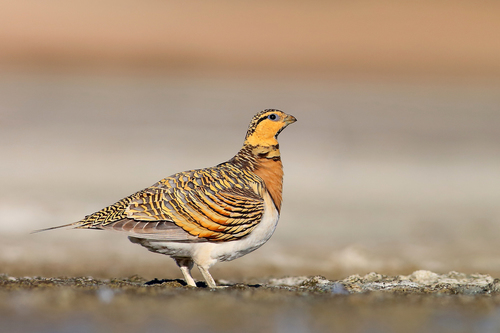
Pin-tailed Sandgrouse (Pterocles alchata) Pin-tailed Sandgrouse
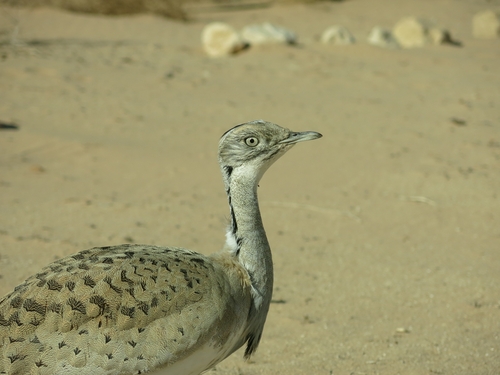
Asian Houbara (Chlamydotis macqueenii) Asian Houbara

Media

Loading…

In short

The Pin-tailed Sandgrouse and Asian Houbara are distinct in both structure and behavior. The sandgrouse is smaller and more compact, with a long, pointed tail, while the houbara is larger and more elongated, resembling a bustard. Both species inhabit arid environments, but their vocalizations and flight patterns differ significantly.

Identification tips

Look for the long, pointed tail of the Pin-tailed Sandgrouse, especially in flight. Note the compact, flocking behavior of sandgrouse versus the solitary or paired nature of the houbara. In terms of plumage, the chestnut breast band of the sandgrouse is a key feature. The houbara's sandy tones and lack of a long tail are distinguishing. Listen for the repetitive calls of the sandgrouse, contrasting with the quieter houbara.

Size

The Pin-tailed Sandgrouse is smaller and more compact compared to the larger, more elongated Asian Houbara.

Plumage

Pin-tailed Sandgrouse has a striking pattern with a white belly and chestnut breast band, and a long, pointed tail. The Asian Houbara has a more subdued coloration with sandy tones and lacks the distinct tail of the sandgrouse.

Behaviour

Pin-tailed Sandgrouse often seen in flocks, flying in tight formations, while the Asian Houbara is more solitary or found in pairs, with a more deliberate, ground-dwelling behavior.

Habitat

Both species prefer arid and semi-arid regions, but the Pin-tailed Sandgrouse is more likely found in open plains and steppe, whereas the Asian Houbara is adapted to desert and scrubland environments.

Voice

Pin-tailed Sandgrouse has a distinctive, repetitive 'kew-kew' call, while the Asian Houbara is generally quieter, with low, guttural calls during display.

Submit a better description

Use the same sections as the comparison. Your text is published immediately.

The Pin-tailed Sandgrouse and Asian Houbara are distinct in both structure and behavior. The sandgrouse is smaller and more compact, with a long, pointed tail, while the houbara is larger and more elongated, resembling a bustard. Both species inhabit arid environments, but their vocalizations and flight patterns differ significantly.

Look for the long, pointed tail of the Pin-tailed Sandgrouse, especially in flight. Note the compact, flocking behavior of sandgrouse versus the solitary or paired nature of the houbara. In terms of plumage, the chestnut breast band of the sandgrouse is a key feature. The houbara's sandy tones and lack of a long tail are distinguishing. Listen for the repetitive calls of the sandgrouse, contrasting with the quieter houbara.

The Pin-tailed Sandgrouse is smaller and more compact compared to the larger, more elongated Asian Houbara.

Pin-tailed Sandgrouse has a striking pattern with a white belly and chestnut breast band, and a long, pointed tail. The Asian Houbara has a more subdued coloration with sandy tones and lacks the distinct tail of the sandgrouse.

Pin-tailed Sandgrouse often seen in flocks, flying in tight formations, while the Asian Houbara is more solitary or found in pairs, with a more deliberate, ground-dwelling behavior.

Both species prefer arid and semi-arid regions, but the Pin-tailed Sandgrouse is more likely found in open plains and steppe, whereas the Asian Houbara is adapted to desert and scrubland environments.

Pin-tailed Sandgrouse has a distinctive, repetitive 'kew-kew' call, while the Asian Houbara is generally quieter, with low, guttural calls during display.

Discard your changes?

You have unsaved edits. If you leave now, those changes will be lost.

Pin-tailed Sandgrouse · Asian Houbara · My Tricky Birds