Birdr

Pin-tailed Sandgrouse vs Spotted Sandgrouse

Pterocles alchata versus Pterocles senegallus

Play a quiz with Pin-tailed Sandgrouse and Spotted Sandgrouse
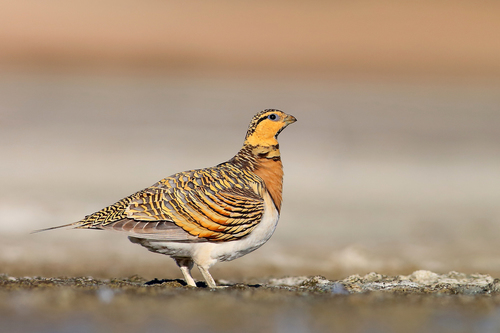
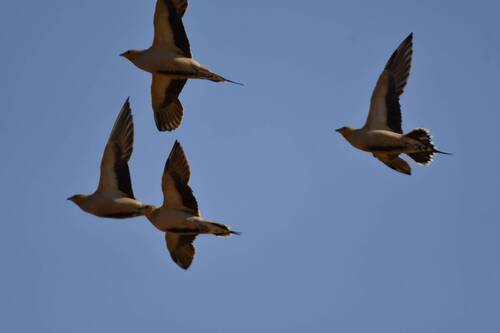
Pin-tailed Sandgrouse (Pterocles alchata) Pin-tailed Sandgrouse
Spotted Sandgrouse (Pterocles senegallus) Spotted Sandgrouse

Media

Loading…

In short

The Pin-tailed Sandgrouse and Spotted Sandgrouse can be distinguished by their tail and plumage patterns. The Pin-tailed Sandgrouse has a distinctive long, pointed tail, while the Spotted Sandgrouse has a shorter tail with a more rounded appearance. Both species share similar habitats but differ in vocalizations and some plumage details.

Identification tips

  1. Look for the long, pointed tail of the Pin-tailed Sandgrouse. 2. Note the black and white belly pattern in males of the Pin-tailed Sandgrouse. 3. Observe the spotted wing pattern of the Spotted Sandgrouse. 4. Listen for the more melodious call of the Pin-tailed Sandgrouse. 5. Consider habitat overlap but focus on tail and plumage for reliable ID.

Size

Both species are similar in size, typical of sandgrouse, with no significant differences in overall body size.

Plumage

Pin-tailed Sandgrouse males have a striking black and white pattern on the belly and a greenish-yellow head, while females are more cryptically colored. Spotted Sandgrouse males have a more uniform sandy color with distinctive black spots on the wings, and females are similarly patterned but duller.

Behaviour

Both species exhibit similar behaviors typical of sandgrouse, such as flying in flocks and visiting water sources at dawn and dusk.

Habitat

Both species inhabit arid and semi-arid regions, often found in open plains and deserts. There is overlap in their habitat preferences, making habitat alone an unreliable distinguishing factor.

Voice

The Pin-tailed Sandgrouse has a more melodious and varied call compared to the Spotted Sandgrouse, which has a simpler, repetitive call. Listening for these differences can aid in identification.

Submit a better description

Use the same sections as the comparison. Your text is published immediately.

The Pin-tailed Sandgrouse and Spotted Sandgrouse can be distinguished by their tail and plumage patterns. The Pin-tailed Sandgrouse has a distinctive long, pointed tail, while the Spotted Sandgrouse has a shorter tail with a more rounded appearance. Both species share similar habitats but differ in vocalizations and some plumage details.

  1. Look for the long, pointed tail of the Pin-tailed Sandgrouse. 2. Note the black and white belly pattern in males of the Pin-tailed Sandgrouse. 3. Observe the spotted wing pattern of the Spotted Sandgrouse. 4. Listen for the more melodious call of the Pin-tailed Sandgrouse. 5. Consider habitat overlap but focus on tail and plumage for reliable ID.

Both species are similar in size, typical of sandgrouse, with no significant differences in overall body size.

Pin-tailed Sandgrouse males have a striking black and white pattern on the belly and a greenish-yellow head, while females are more cryptically colored. Spotted Sandgrouse males have a more uniform sandy color with distinctive black spots on the wings, and females are similarly patterned but duller.

Both species exhibit similar behaviors typical of sandgrouse, such as flying in flocks and visiting water sources at dawn and dusk.

Both species inhabit arid and semi-arid regions, often found in open plains and deserts. There is overlap in their habitat preferences, making habitat alone an unreliable distinguishing factor.

The Pin-tailed Sandgrouse has a more melodious and varied call compared to the Spotted Sandgrouse, which has a simpler, repetitive call. Listening for these differences can aid in identification.

Discard your changes?

You have unsaved edits. If you leave now, those changes will be lost.

Pin-tailed Sandgrouse · Spotted Sandgrouse · My Tricky Birds