Birdr

Pine Bunting vs Cretzschmar's Bunting

Emberiza leucocephalos versus Emberiza caesia

Play a quiz with Pine Bunting and Cretzschmar's Bunting

Pine Bunting (Emberiza leucocephalos) Pine Bunting
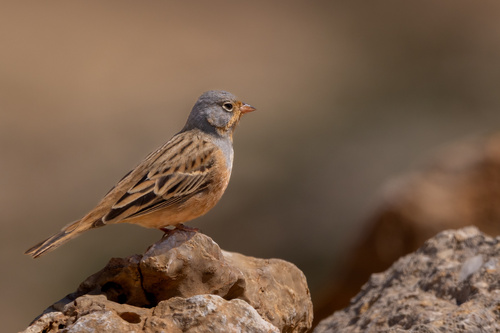
Cretzschmar's Bunting (Emberiza caesia) Cretzschmar's Bunting

Media

Loading…

In short

Pine Bunting and Cretzschmar's Bunting are both Old World buntings with subtle differences. The most reliable field mark is the head pattern: Pine Bunting typically shows a more contrasting face with a white supercilium, while Cretzschmar's Bunting has a more uniform and less contrasting head. Both species can be confused with other buntings, so careful observation is necessary.

Identification tips

  1. Head Pattern: Look for a white supercilium and contrasting face in Pine Bunting. 2. Plumage Streaking: Check for more pronounced streaking on the underparts in Pine Bunting. 3. Habitat: Note the habitat; Pine Bunting in woodlands, Cretzschmar's in rocky areas. 4. Seasonal Variation: Be aware of seasonal plumage changes, especially in females and immatures.

Size

Both species are similar in size, typical of small buntings.

Plumage

Pine Bunting often displays a white supercilium and a more contrasting face pattern, especially in males. Cretzschmar's Bunting has a less contrasting head with a more uniform appearance. Females and immatures of both species can be quite similar, but Pine Bunting tends to have more pronounced streaking on the underparts.

Behaviour

Both species exhibit typical bunting behavior, often foraging on the ground or low in vegetation.

Habitat

Pine Bunting is usually found in open woodlands and forest edges, while Cretzschmar's Bunting prefers dry, rocky hillsides and scrubby areas.

Voice

The songs and calls of these species are not well-documented in the notes provided, but they are generally similar to other Emberiza buntings.

Submit a better description

Use the same sections as the comparison. Your text is published immediately.

Pine Bunting and Cretzschmar's Bunting are both Old World buntings with subtle differences. The most reliable field mark is the head pattern: Pine Bunting typically shows a more contrasting face with a white supercilium, while Cretzschmar's Bunting has a more uniform and less contrasting head. Both species can be confused with other buntings, so careful observation is necessary.

  1. Head Pattern: Look for a white supercilium and contrasting face in Pine Bunting. 2. Plumage Streaking: Check for more pronounced streaking on the underparts in Pine Bunting. 3. Habitat: Note the habitat; Pine Bunting in woodlands, Cretzschmar's in rocky areas. 4. Seasonal Variation: Be aware of seasonal plumage changes, especially in females and immatures.

Both species are similar in size, typical of small buntings.

Pine Bunting often displays a white supercilium and a more contrasting face pattern, especially in males. Cretzschmar's Bunting has a less contrasting head with a more uniform appearance. Females and immatures of both species can be quite similar, but Pine Bunting tends to have more pronounced streaking on the underparts.

Both species exhibit typical bunting behavior, often foraging on the ground or low in vegetation.

Pine Bunting is usually found in open woodlands and forest edges, while Cretzschmar's Bunting prefers dry, rocky hillsides and scrubby areas.

The songs and calls of these species are not well-documented in the notes provided, but they are generally similar to other Emberiza buntings.

Discard your changes?

You have unsaved edits. If you leave now, those changes will be lost.

Pine Bunting · Cretzschmar's Bunting · My Tricky Birds