Birdr

Pine Grosbeak vs Asian Rosy-Finch

Pinicola enucleator versus Leucosticte arctoa

Play a quiz with Pine Grosbeak and Asian Rosy-Finch

Pine Grosbeak (Pinicola enucleator) Pine Grosbeak
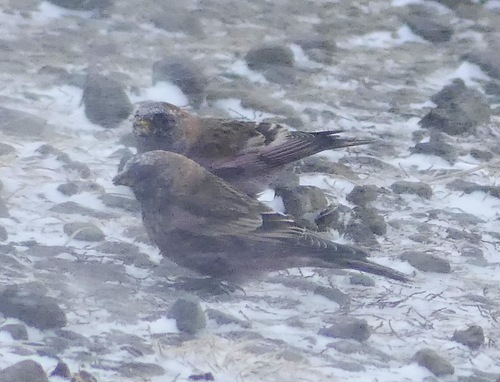
Asian Rosy-Finch (Leucosticte arctoa) Asian Rosy-Finch

Media

Loading…

In short

The Pine Grosbeak and Asian Rosy-Finch can be distinguished by their bill shape and plumage coloration. Pine Grosbeaks have a thicker, more conical bill, while Asian Rosy-Finches have a more slender bill. Plumage differences include the Pine Grosbeak's more uniform coloration compared to the Asian Rosy-Finch's distinct rosy and brown tones.

Identification tips

  1. Bill Shape: Look for the Pine Grosbeak's thicker, conical bill versus the Asian Rosy-Finch's slender bill. 2. Plumage Coloration: Note the Pine Grosbeak's more uniform pinkish-red (in males) compared to the Asian Rosy-Finch's contrasting rosy and brown tones. 3. Habitat: Consider the habitat; Pine Grosbeaks prefer coniferous forests, while Asian Rosy-Finches are found in alpine areas. 4. Vocalization: Listen for the Pine Grosbeak's more melodic song.

Size

Both species are similar in size, but the Pine Grosbeak is generally bulkier.

Plumage

Pine Grosbeaks typically have a more uniform coloration with males showing a pinkish-red hue, whereas Asian Rosy-Finches exhibit a mix of rosy and brown tones with more contrast, especially on the wings and back.

Behaviour

Both species are often seen in flocks, especially in winter, but the Pine Grosbeak is more likely to be found feeding on berries and seeds in trees, while the Asian Rosy-Finch often forages on the ground.

Habitat

Pine Grosbeaks are found in coniferous forests, often at higher elevations or in northern latitudes, while Asian Rosy-Finches are typically found in alpine and subalpine regions.

Voice

The Pine Grosbeak has a more melodic and varied song compared to the simpler calls of the Asian Rosy-Finch.

Submit a better description

Use the same sections as the comparison. Your text is published immediately.

The Pine Grosbeak and Asian Rosy-Finch can be distinguished by their bill shape and plumage coloration. Pine Grosbeaks have a thicker, more conical bill, while Asian Rosy-Finches have a more slender bill. Plumage differences include the Pine Grosbeak's more uniform coloration compared to the Asian Rosy-Finch's distinct rosy and brown tones.

  1. Bill Shape: Look for the Pine Grosbeak's thicker, conical bill versus the Asian Rosy-Finch's slender bill. 2. Plumage Coloration: Note the Pine Grosbeak's more uniform pinkish-red (in males) compared to the Asian Rosy-Finch's contrasting rosy and brown tones. 3. Habitat: Consider the habitat; Pine Grosbeaks prefer coniferous forests, while Asian Rosy-Finches are found in alpine areas. 4. Vocalization: Listen for the Pine Grosbeak's more melodic song.

Both species are similar in size, but the Pine Grosbeak is generally bulkier.

Pine Grosbeaks typically have a more uniform coloration with males showing a pinkish-red hue, whereas Asian Rosy-Finches exhibit a mix of rosy and brown tones with more contrast, especially on the wings and back.

Both species are often seen in flocks, especially in winter, but the Pine Grosbeak is more likely to be found feeding on berries and seeds in trees, while the Asian Rosy-Finch often forages on the ground.

Pine Grosbeaks are found in coniferous forests, often at higher elevations or in northern latitudes, while Asian Rosy-Finches are typically found in alpine and subalpine regions.

The Pine Grosbeak has a more melodic and varied song compared to the simpler calls of the Asian Rosy-Finch.

Discard your changes?

You have unsaved edits. If you leave now, those changes will be lost.

Pine Grosbeak · Asian Rosy-Finch · My Tricky Birds