Birdr

Pine Grosbeak vs Two-barred Crossbill

Pinicola enucleator versus Loxia leucoptera

Play a quiz with Pine Grosbeak and Two-barred Crossbill

Pine Grosbeak (Pinicola enucleator) Pine Grosbeak
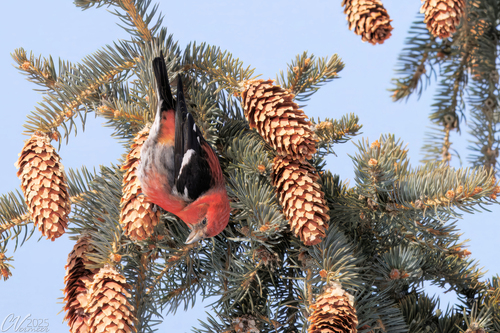
Two-barred Crossbill (Loxia leucoptera) Two-barred Crossbill

Media

Loading…

In short

The Pine Grosbeak and Two-barred Crossbill are both finches found in coniferous habitats, but they can be distinguished by their bill shape and feeding behavior. The Pine Grosbeak has a stout, conical bill, while the Two-barred Crossbill features a distinctive crossed bill adapted for extracting seeds from conifer cones.

Identification tips

1. Bill Shape: Look for the stout, conical bill of the Pine Grosbeak versus the crossed bill of the Two-barred Crossbill. 2. Wing Bars: Note the prominent white wing bars on the Two-barred Crossbill. 3. Behavior: Observe feeding behavior; Two-barred Crossbills are adept at extracting seeds from cones. 4. Vocalization: Listen for the soft whistles of the Pine Grosbeak compared to the metallic calls of the Two-barred Crossbill.

Size

The Pine Grosbeak is generally larger and more robust than the Two-barred Crossbill.

Plumage

Pine Grosbeaks are often reddish or pinkish in males, with females showing more muted colors, whereas Two-barred Crossbills have prominent white wing bars and a more uniform coloration with less sexual dimorphism.

Behaviour

Two-barred Crossbills are highly nomadic and often found in large flocks, feeding on conifer seeds using their specialized bills. Pine Grosbeaks are less nomadic and feed on a wider range of plant material.

Habitat

Both species inhabit coniferous forests, but the Pine Grosbeak is more likely to be found in boreal and subalpine regions, while the Two-barred Crossbill follows cone crop availability more closely.

Voice

Pine Grosbeaks have a soft, whistled song and call, whereas Two-barred Crossbills have a more metallic and varied call, often described as a 'jip-jip' sound.

Submit a better description

Use the same sections as the comparison. Your text is published immediately.

The Pine Grosbeak and Two-barred Crossbill are both finches found in coniferous habitats, but they can be distinguished by their bill shape and feeding behavior. The Pine Grosbeak has a stout, conical bill, while the Two-barred Crossbill features a distinctive crossed bill adapted for extracting seeds from conifer cones.

1. Bill Shape: Look for the stout, conical bill of the Pine Grosbeak versus the crossed bill of the Two-barred Crossbill. 2. Wing Bars: Note the prominent white wing bars on the Two-barred Crossbill. 3. Behavior: Observe feeding behavior; Two-barred Crossbills are adept at extracting seeds from cones. 4. Vocalization: Listen for the soft whistles of the Pine Grosbeak compared to the metallic calls of the Two-barred Crossbill.

The Pine Grosbeak is generally larger and more robust than the Two-barred Crossbill.

Pine Grosbeaks are often reddish or pinkish in males, with females showing more muted colors, whereas Two-barred Crossbills have prominent white wing bars and a more uniform coloration with less sexual dimorphism.

Two-barred Crossbills are highly nomadic and often found in large flocks, feeding on conifer seeds using their specialized bills. Pine Grosbeaks are less nomadic and feed on a wider range of plant material.

Both species inhabit coniferous forests, but the Pine Grosbeak is more likely to be found in boreal and subalpine regions, while the Two-barred Crossbill follows cone crop availability more closely.

Pine Grosbeaks have a soft, whistled song and call, whereas Two-barred Crossbills have a more metallic and varied call, often described as a 'jip-jip' sound.

Discard your changes?

You have unsaved edits. If you leave now, those changes will be lost.

Pine Grosbeak · Two-barred Crossbill · My Tricky Birds