Birdr

Pine Warbler vs Townsend's Warbler

Setophaga pinus versus Setophaga townsendi

Play a quiz with Pine Warbler and Townsend's Warbler
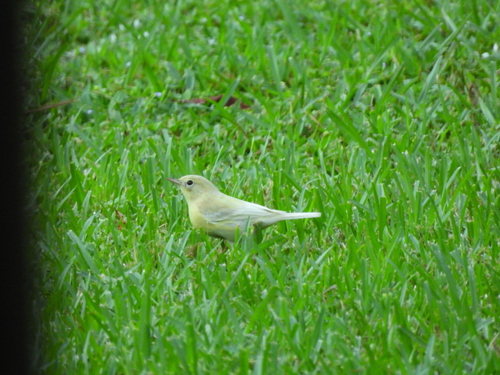
Pine Warbler (Setophaga pinus) Pine Warbler
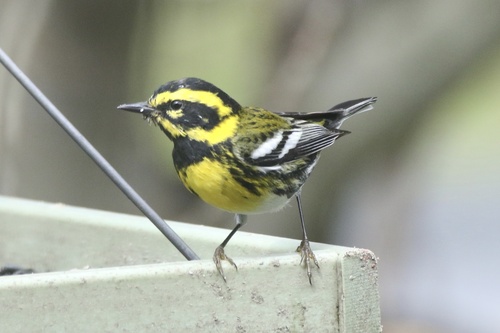
Townsend's Warbler (Setophaga townsendi) Townsend's Warbler

Media

Loading…

In short

Pine Warblers and Townsend's Warblers can be tricky to differentiate, especially in overlapping ranges during migration. Key differences include the Pine Warbler's more muted plumage and preference for pine habitats, while Townsend's Warbler displays more contrasting facial markings and is often found in coniferous forests.

Identification tips

Size

Both species are similar in size, typical of small warblers, with no significant size difference to rely on.

Plumage

Pine Warblers have a more uniform olive-green to yellow plumage with less contrast, lacking distinct facial markings. Townsend's Warblers show a striking black-and-yellow face pattern, with a bold black throat and contrasting white wing bars.

Behaviour

Pine Warblers are often seen foraging in pine trees and may visit feeders, especially in winter. Townsend's Warblers are more likely to be seen actively foraging in mixed-species flocks in coniferous forests.

Habitat

Pine Warblers are closely associated with pine forests, while Townsend's Warblers prefer coniferous forests, particularly during breeding in the Pacific Northwest.

Voice

Pine Warblers have a musical trill that can be confused with Chipping Sparrows, whereas Townsend's Warblers have a more varied song with a series of buzzy notes.

Submit a better description

Use the same sections as the comparison. Your text is published immediately.

Pine Warblers and Townsend's Warblers can be tricky to differentiate, especially in overlapping ranges during migration. Key differences include the Pine Warbler's more muted plumage and preference for pine habitats, while Townsend's Warbler displays more contrasting facial markings and is often found in coniferous forests.

  • Facial markings: Look for the bold black-and-yellow face of the Townsend's Warbler.
  • Habitat: Note the habitat; Pine Warblers prefer pine forests, while Townsend's Warblers are found in coniferous forests.
  • Plumage: Pine Warblers have more uniform plumage without the contrasting facial pattern of Townsend's.
  • Song: Listen for the musical trill of the Pine Warbler compared to the buzzy notes of Townsend's.

Both species are similar in size, typical of small warblers, with no significant size difference to rely on.

Pine Warblers have a more uniform olive-green to yellow plumage with less contrast, lacking distinct facial markings. Townsend's Warblers show a striking black-and-yellow face pattern, with a bold black throat and contrasting white wing bars.

Pine Warblers are often seen foraging in pine trees and may visit feeders, especially in winter. Townsend's Warblers are more likely to be seen actively foraging in mixed-species flocks in coniferous forests.

Pine Warblers are closely associated with pine forests, while Townsend's Warblers prefer coniferous forests, particularly during breeding in the Pacific Northwest.

Pine Warblers have a musical trill that can be confused with Chipping Sparrows, whereas Townsend's Warblers have a more varied song with a series of buzzy notes.

Discard your changes?

You have unsaved edits. If you leave now, those changes will be lost.

Pine Warbler · Townsend's Warbler · My Tricky Birds