
Pink-footed Goose vs Barnacle Goose
Anser brachyrhynchus versus Branta leucopsis
Play a quiz with Pink-footed Goose and Barnacle Goose
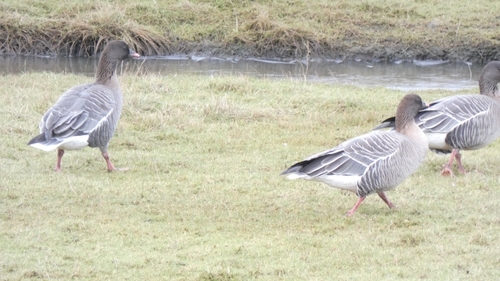 Pink-footed Goose
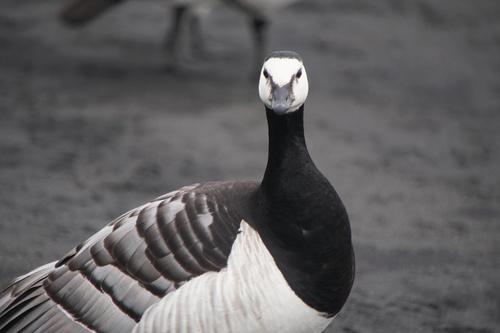 Barnacle Goose
In short
The most reliable way to separate Pink-footed Goose from Barnacle Goose is by head and bill pattern: Pink-footed has a plain dark brown head and a short, mostly pink bill with black at the base and tip, while Barnacle Goose shows a striking white face with a black head and neck, and a small all-black bill. In flight, Barnacle Goose reveals a bold white rump and silvery underwings, contrasting with Pink-footed's more uniform grey-brown upperparts and broad white tail tip. Juveniles of both species resemble adults closely, but Barnacle Goose immatures have slightly rounder mantle and flank feathers. Pink-footed is larger and heavier, but overlap can occur. Both species may be found in mixed flocks during migration or winter, so careful attention to head and wing pattern is essential.
Identification tips
- Head and face pattern is the single most reliable field mark: Pink-footed Goose has a plain, dark brown head and neck with no white, while Barnacle Goose has a bold white face and black head/neck. This is obvious at any distance and in all ages.
- Bill color and structure: Pink-footed Goose shows a short bill with a distinctive pink band in the middle, black at the base and tip; Barnacle Goose has a small, all-black bill. Bill color is diagnostic at close range.
- Leg and foot color: Pink-footed Goose has bright pink feet, while Barnacle Goose has black legs and feet. This is useful when birds are on the ground and visible.
- Body and upperpart color: Pink-footed is mid-grey-brown overall, with a darker brown head/neck and paler bluish-grey upperwing coverts; Barnacle is much more contrasting, with silvery-grey barred upperparts and a white belly.
- Tail and rump in flight: Barnacle Goose shows a striking white rump patch and black tail, forming a sharp V shape; Pink-footed Goose has a grey tail with a broad white tip, but the white is less extensive and not V-shaped.
- Underwing pattern: Barnacle Goose has silvery-grey underwing linings, which can appear pale in flight; Pink-footed's underwing is more uniformly dark.
- Juvenile differences: Juvenile Barnacle Geese have slightly rounder mantle and flank feathers, but this is subtle and not usually visible in the field. Juvenile Pink-footed closely resembles adults.
- Size: Pink-footed Goose is larger and heavier, but there is overlap; only use size if birds are together for direct comparison.
- Flock structure and behavior: Pink-footed often forms huge, noisy flocks on farmland; Barnacle flocks are usually smaller and more coastal, but this is not diagnostic.
- Vocalizations: Pink-footed is much more vocal, with high-pitched honking in flight; Barnacle's calls are less distinctive for separation.
- Habitat: Both can occur together in winter, but Pink-footed prefers farmland, Barnacle more often on saltmarsh or coastal grassland. Use only as supporting context.
- Sex and seasonal variation: Both species show little to no sexual or seasonal plumage difference; all field marks above apply year-round and to both sexes.
- Pitfalls: In poor light or at great distance, Barnacle's white face may appear duller, and Pink-footed's brown head may seem paler; always check multiple features. Mixed flocks are possible, so scan carefully.
- Flight jizz: Barnacle Goose appears more compact and short-necked in flight, with a more obvious white rump; Pink-footed is longer-necked and plainer above.
- Do not confuse with other geese: Barnacle's black-and-white head pattern is unique among European geese except for Brant, which is smaller and darker overall; Pink-footed's pink bill and feet are unique among Anser geese in the region.
Size
Pink-footed Goose is the larger and heavier of the two, with an average body mass of about 2505 g compared to Barnacle Goose's 1687 g [wikidata]. Pink-footed measures 60–75 cm in length with a wingspan of 135–170 cm, while Barnacle Goose is 55–70 cm long with a wingspan of 120–145 cm [wikipedia]. However, their sizes can overlap, so size alone is not a reliable field mark unless birds are side by side.
Plumage
Juvenile and adult Barnacle Geese both have a distinctive black head and neck with a white face and belly, and silvery-grey barred upperparts. In flight, Barnacle Goose shows a prominent V-shaped white rump patch and pale underwing linings, which are visible at a distance. Pink-footed Goose, regardless of age, has a uniform dark brown head and neck, mid-grey-brown body, and pink feet. Its upperwing coverts are pale bluish-grey, but the overall wing and body coloration is much plainer than Barnacle. The tail of Pink-footed is grey with a broad white tip, while Barnacle's white rump is more extensive and contrasts sharply with the black tail. Juvenile Barnacle Geese can be told from adults by slightly rounder mantle and flank feathers, but this is subtle and not usually visible in the field. Both species lack strong seasonal or sex-based plumage differences.
Behaviour
Both species are highly gregarious, often forming large flocks in winter. Pink-footed Geese are often seen grazing in huge numbers on farmland, sometimes in the tens of thousands, and are particularly vocal in flight, producing a medley of high-pitched honks. Barnacle Geese also form dense flocks, but their feeding and flocking behavior is not as distinctive as Pink-footed. Both species may mix with other geese, so behavioral context is not usually diagnostic.
Habitat
Both species breed in the Arctic and winter in northwest Europe, often sharing the same general regions (Ireland, Great Britain, Netherlands, Denmark). Pink-footed Goose tends to winter in larger flocks on farmland, especially in eastern Scotland and eastern England, while Barnacle Goose is more often found in coastal areas, estuaries, and saltmarshes, though it can also graze inland. Habitat overlap is common in winter, so habitat alone is not a reliable separator.
Voice
Pink-footed Goose is noted for its very vocal, high-pitched honking, especially when flocks are in flight, which can be almost deafening. Barnacle Goose also calls in flight, but its voice is less described in the sources and is not a primary field mark for separation between these two species.