Birdr

Pink-footed Goose vs Brent Goose

Anser brachyrhynchus versus Branta bernicla

Play a quiz with Pink-footed Goose and Brent Goose
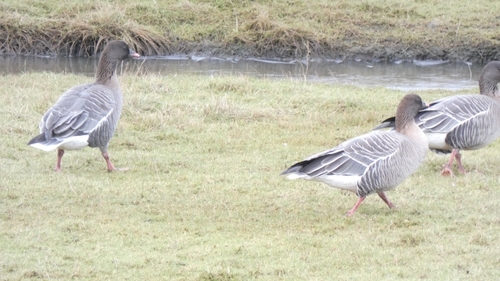
Pink-footed Goose (Anser brachyrhynchus) Pink-footed Goose
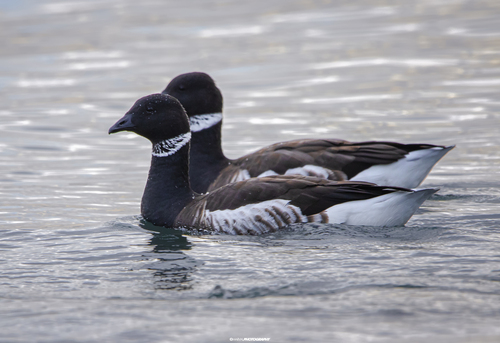
Brent Goose (Branta bernicla) Brent Goose

Media

Loading…

In short

The most reliable field mark to separate Pink-footed Goose from Brent Goose is overall coloration and structural jizz: Pink-footed Goose is a medium-sized, brownish-grey goose with a short pink-and-black bill and pink legs, while Brent Goose is smaller, darker, and more compact, with a black head and neck, a small white neck patch, and a very short black tail. In flight or at rest, Pink-footed Goose shows a paler body and upperwing with a white rump and broad white tail tip, contrasting with Brent Goose’s much darker, more uniform plumage and pure white under-tail. Juvenile and adult Brent Geese are always much darker and more compact than any Pink-footed Goose. Bill color and leg color are key: Pink-footed Goose has a distinctive pink bill band and pink feet, while Brent Goose’s bill and legs are black. These differences are visible at distance with binoculars, especially in mixed flocks or on open water.

Identification tips

  1. Bill color and pattern: Pink-footed Goose has a short bill with a bright pink band in the middle and black at the base and tip; Brent Goose has a short, entirely black bill. This is visible at moderate range and is diagnostic.
  2. Leg and foot color: Pink-footed Goose has pink legs and feet; Brent Goose has black legs and feet. This is a key check when birds are walking or standing.
  3. Head and neck color: Pink-footed Goose shows a brown head and neck, slightly darker than the body; Brent Goose has a black head and neck with a small white patch on each side of the neck (all ages/subspecies).
  4. Body coloration: Pink-footed Goose is mid-grey-brown with a paler body and contrasting darker head/neck; Brent Goose is much darker overall, with dark grey-brown to blackish-brown body and little contrast between back and belly (except in pale-bellied forms, which still appear darker than Pink-footed Goose).
  5. Tail pattern: Pink-footed Goose has a grey tail with a broad white tip, and a conspicuous white rump and vent; Brent Goose has a very short, black tail (the shortest of any goose) and a pure white under-tail, but no broad white tail tip.
  6. Size and structure: Pink-footed Goose is larger, longer-necked, and bulkier; Brent Goose is smaller, more compact, and short-necked. In mixed flocks, the difference is obvious, but beware lone birds.
  7. Upperwing color: Pink-footed Goose shows pale bluish-grey upperwing coverts and blackish-grey flight feathers; Brent Goose’s upperwing is uniformly dark and lacks pale panels.
  8. Flank and belly: Pink-footed Goose has a uniform mid-grey-brown belly; Brent Goose subspecies vary, but all have darker bellies, with pale-bellied forms showing a marked contrast between pale flanks/belly and darker back, but still much darker than Pink-footed Goose overall.
  9. White neck patch: Only Brent Goose has a small white patch on either side of the neck (all ages/subspecies); Pink-footed Goose never shows this.
  10. Habitat context: Pink-footed Goose is usually inland on farmland or freshwater; Brent Goose is almost always coastal on saltmarsh or tidal flats.
  11. Flight flock appearance: Pink-footed Goose flocks are larger, noisier, and show pale upperwings and white rumps; Brent Goose flocks are more compact, quieter, and appear dark with white under-tails.
  12. Vocalizations: Pink-footed Goose is very vocal with high-pitched honking; Brent Goose is quieter with more guttural calls.
  13. Juvenile confusion: Juvenile Brent Goose is already dark and compact, not resembling Pink-footed Goose at any age.
  14. Subspecies pitfalls: Pale-bellied Brent Goose is paler below but still darker and more compact than Pink-footed Goose; black brant is even more contrasting and unlikely to be confused.
  15. Tail length: Brent Goose’s tail is extremely short and black, while Pink-footed Goose’s is longer with a white tip. Check tail shape when birds are preening or swimming.

Size

Pink-footed Goose is significantly larger and heavier than Brent Goose. Pink-footed Goose measures 60–75 cm in length with a wingspan of 135–170 cm and a body mass around 2505 g [wikidata], while Brent Goose is smaller at 55–66 cm in length, wingspan 106–121 cm, and mass 880–2200 g [wikipedia]. In the field, Pink-footed Goose appears longer-necked and bulkier, whereas Brent Goose is compact and short-necked. When seen side by side, the size difference is obvious, but beware lone birds or distant flocks where posture can be misleading.

Plumage

No age-specific upperwing patterns are described for either species, but overall coloration is highly diagnostic at all ages. Pink-footed Goose (adult and immature) is mid-grey-brown with a darker brown head and neck, pale bluish-grey upperwing coverts, blackish-grey flight feathers, white rump and vent, and a grey tail with a broad white tip. The bill is short with a pink band and black base/tip, and the legs are pink. Brent Goose (all subspecies and ages) is much darker: the body is dark grey-brown to blackish-brown, with the head and neck black and a small white patch on the neck sides. The under-tail is pure white, and the tail is very short and black. Subspecies vary in belly color, but all are darker and more uniform than Pink-footed Goose. The black brant form is especially striking, with a strong black-and-white contrast and a prominent white flank patch. Juvenile Brent Geese resemble adults in darkness and structure, so confusion with Pink-footed Goose is unlikely if overall tone is noted.

Behaviour

Both species are gregarious and often found in large flocks, especially in winter. Pink-footed Goose typically grazes on farmland and open fields, sometimes forming huge flocks. Brent Goose is more coastal, feeding on saltmarshes and estuaries, and is rarely seen far from tidal waters. In flight, Pink-footed Goose flocks are often noisy, with high-pitched honking, and show pale upperwings and a white rump; Brent Goose flocks are quieter, more compact, and appear much darker in the air.

Habitat

Pink-footed Goose winters mainly inland or in lowland farmland, especially in Britain, Ireland, the Netherlands, and Denmark, often far from the sea. Brent Goose is strongly coastal, wintering almost exclusively along temperate sea-coasts, saltmarshes, and estuaries. If you see a flock feeding on stubble fields well inland, it is almost certainly Pink-footed Goose; if it is on tidal mudflats or saltmarsh, Brent Goose is much more likely.

Voice

Pink-footed Goose is very vocal, especially in flight, producing a medley of high-pitched honking calls that can be deafening in large skeins. Brent Goose is generally quieter, with softer, more guttural calls. If you hear a loud, high-pitched chorus overhead, suspect Pink-footed Goose; if the flock is mostly silent or gives low, gruff calls, Brent Goose is more likely.

Submit a better description

Use the same sections as the comparison. Your text is published immediately.

The most reliable field mark to separate Pink-footed Goose from Brent Goose is overall coloration and structural jizz: Pink-footed Goose is a medium-sized, brownish-grey goose with a short pink-and-black bill and pink legs, while Brent Goose is smaller, darker, and more compact, with a black head and neck, a small white neck patch, and a very short black tail. In flight or at rest, Pink-footed Goose shows a paler body and upperwing with a white rump and broad white tail tip, contrasting with Brent Goose’s much darker, more uniform plumage and pure white under-tail. Juvenile and adult Brent Geese are always much darker and more compact than any Pink-footed Goose. Bill color and leg color are key: Pink-footed Goose has a distinctive pink bill band and pink feet, while Brent Goose’s bill and legs are black. These differences are visible at distance with binoculars, especially in mixed flocks or on open water.

  1. Bill color and pattern: Pink-footed Goose has a short bill with a bright pink band in the middle and black at the base and tip; Brent Goose has a short, entirely black bill. This is visible at moderate range and is diagnostic.
  2. Leg and foot color: Pink-footed Goose has pink legs and feet; Brent Goose has black legs and feet. This is a key check when birds are walking or standing.
  3. Head and neck color: Pink-footed Goose shows a brown head and neck, slightly darker than the body; Brent Goose has a black head and neck with a small white patch on each side of the neck (all ages/subspecies).
  4. Body coloration: Pink-footed Goose is mid-grey-brown with a paler body and contrasting darker head/neck; Brent Goose is much darker overall, with dark grey-brown to blackish-brown body and little contrast between back and belly (except in pale-bellied forms, which still appear darker than Pink-footed Goose).
  5. Tail pattern: Pink-footed Goose has a grey tail with a broad white tip, and a conspicuous white rump and vent; Brent Goose has a very short, black tail (the shortest of any goose) and a pure white under-tail, but no broad white tail tip.
  6. Size and structure: Pink-footed Goose is larger, longer-necked, and bulkier; Brent Goose is smaller, more compact, and short-necked. In mixed flocks, the difference is obvious, but beware lone birds.
  7. Upperwing color: Pink-footed Goose shows pale bluish-grey upperwing coverts and blackish-grey flight feathers; Brent Goose’s upperwing is uniformly dark and lacks pale panels.
  8. Flank and belly: Pink-footed Goose has a uniform mid-grey-brown belly; Brent Goose subspecies vary, but all have darker bellies, with pale-bellied forms showing a marked contrast between pale flanks/belly and darker back, but still much darker than Pink-footed Goose overall.
  9. White neck patch: Only Brent Goose has a small white patch on either side of the neck (all ages/subspecies); Pink-footed Goose never shows this.
  10. Habitat context: Pink-footed Goose is usually inland on farmland or freshwater; Brent Goose is almost always coastal on saltmarsh or tidal flats.
  11. Flight flock appearance: Pink-footed Goose flocks are larger, noisier, and show pale upperwings and white rumps; Brent Goose flocks are more compact, quieter, and appear dark with white under-tails.
  12. Vocalizations: Pink-footed Goose is very vocal with high-pitched honking; Brent Goose is quieter with more guttural calls.
  13. Juvenile confusion: Juvenile Brent Goose is already dark and compact, not resembling Pink-footed Goose at any age.
  14. Subspecies pitfalls: Pale-bellied Brent Goose is paler below but still darker and more compact than Pink-footed Goose; black brant is even more contrasting and unlikely to be confused.
  15. Tail length: Brent Goose’s tail is extremely short and black, while Pink-footed Goose’s is longer with a white tip. Check tail shape when birds are preening or swimming.

Pink-footed Goose is significantly larger and heavier than Brent Goose. Pink-footed Goose measures 60–75 cm in length with a wingspan of 135–170 cm and a body mass around 2505 g [wikidata], while Brent Goose is smaller at 55–66 cm in length, wingspan 106–121 cm, and mass 880–2200 g [wikipedia]. In the field, Pink-footed Goose appears longer-necked and bulkier, whereas Brent Goose is compact and short-necked. When seen side by side, the size difference is obvious, but beware lone birds or distant flocks where posture can be misleading.

No age-specific upperwing patterns are described for either species, but overall coloration is highly diagnostic at all ages. Pink-footed Goose (adult and immature) is mid-grey-brown with a darker brown head and neck, pale bluish-grey upperwing coverts, blackish-grey flight feathers, white rump and vent, and a grey tail with a broad white tip. The bill is short with a pink band and black base/tip, and the legs are pink. Brent Goose (all subspecies and ages) is much darker: the body is dark grey-brown to blackish-brown, with the head and neck black and a small white patch on the neck sides. The under-tail is pure white, and the tail is very short and black. Subspecies vary in belly color, but all are darker and more uniform than Pink-footed Goose. The black brant form is especially striking, with a strong black-and-white contrast and a prominent white flank patch. Juvenile Brent Geese resemble adults in darkness and structure, so confusion with Pink-footed Goose is unlikely if overall tone is noted.

Both species are gregarious and often found in large flocks, especially in winter. Pink-footed Goose typically grazes on farmland and open fields, sometimes forming huge flocks. Brent Goose is more coastal, feeding on saltmarshes and estuaries, and is rarely seen far from tidal waters. In flight, Pink-footed Goose flocks are often noisy, with high-pitched honking, and show pale upperwings and a white rump; Brent Goose flocks are quieter, more compact, and appear much darker in the air.

Pink-footed Goose winters mainly inland or in lowland farmland, especially in Britain, Ireland, the Netherlands, and Denmark, often far from the sea. Brent Goose is strongly coastal, wintering almost exclusively along temperate sea-coasts, saltmarshes, and estuaries. If you see a flock feeding on stubble fields well inland, it is almost certainly Pink-footed Goose; if it is on tidal mudflats or saltmarsh, Brent Goose is much more likely.

Pink-footed Goose is very vocal, especially in flight, producing a medley of high-pitched honking calls that can be deafening in large skeins. Brent Goose is generally quieter, with softer, more guttural calls. If you hear a loud, high-pitched chorus overhead, suspect Pink-footed Goose; if the flock is mostly silent or gives low, gruff calls, Brent Goose is more likely.

Discard your changes?

You have unsaved edits. If you leave now, those changes will be lost.

Pink-footed Goose · Brent Goose · My Tricky Birds