Piping Hornbill vs Leaf-love
Bycanistes fistulator versus Phyllastrephus scandens
Play a quiz with Piping Hornbill and Leaf-love
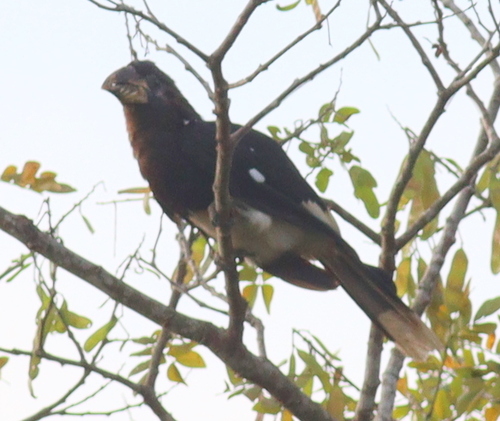 Piping Hornbill
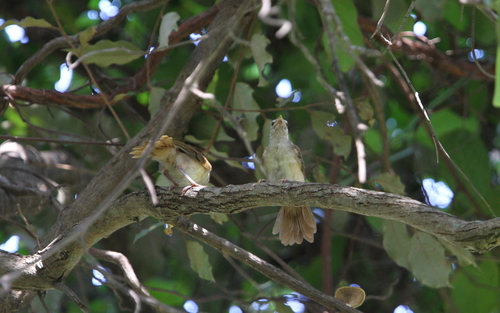 Leaf-love
In short
The most reliable way to separate Piping Hornbill from Leaf-love is by overall size and structure: Piping Hornbill is a large, striking black-and-white bird with a massive bill and obvious casque, while Leaf-love is a much smaller, plain songbird with a slender bill and no casque. Even at a distance or in flight, the hornbill’s size, heavy bill, and contrasting plumage stand out against the Leaf-love’s more compact, uniform appearance. Both may occur in similar West and Central African forests, so careful attention to shape and proportions is essential. Immature or perched birds can be especially confusing, but focusing on bill structure and body bulk will prevent most mix-ups.
Identification tips
- Size is the first check: If the bird is anywhere near crow-sized, it is a Piping Hornbill; if it is thrush- or bulbul-sized, it is a Leaf-love. This works for all ages and sexes.
- Bill structure is decisive: Piping Hornbill has a massive, downcurved bill with a prominent casque (a raised ridge on top), visible even at a distance or in silhouette. Leaf-love has a slim, straight bill with no casque. This is diagnostic in all views.
- Plumage contrast: Piping Hornbill is boldly black-and-white, with clear separation between dark upperparts and white underparts, and white in the wings and tail. Leaf-love is plain olive-brownish with a reddish tail, lacking any strong contrast. Use this in all ages and seasons.
- Tail pattern: Hornbill’s tail is long and often shows white, while Leaf-love’s tail is shorter and red-toned (if seen well). In poor light, rely on structure over color.
- Flight silhouette: Hornbill flies with slow, deep wingbeats and appears heavy and elongated, with a long tail and huge bill. Leaf-love is quick, agile, and compact in flight.
- Perched posture: Hornbill perches upright and often exposes its bill and casque; Leaf-love sits more horizontally and appears much smaller and less imposing.
- Group behavior: Hornbills may be seen in small groups or pairs, often high in the canopy or crossing gaps; Leaf-love is usually in pairs or small groups, but stays lower and more hidden.
- Habitat context: If in dense, mature forest, hornbill is more likely; if in edge, secondary growth, or savanna, Leaf-love is more likely, but overlap occurs.
- No age-specific flight marks: Neither species has a unique juvenile or immature upperwing pattern described in the sources, so rely on structure and color at all ages.
- No sexual dimorphism: Both species are similar in appearance between sexes, so do not use sex as a cue.
- Vocalizations not described: If you hear a loud, far-carrying call, it may be hornbill, but do not rely on this without more information.
- Common pitfalls: Immature hornbills may look less contrasting, but will always show the huge bill and casque. Leaf-love never shows a large bill or bold black-and-white pattern.
- Lighting and distance: In poor light, focus on size and bill shape rather than color. At a distance, hornbill’s silhouette is diagnostic.
- Checklist context: In West and Central Africa, both may be present, so do not assume based on location alone.
- Summary tip: If you see a large, black-and-white bird with a huge bill, it is a hornbill; if you see a small, plain bird with a slim bill, it is a Leaf-love.
Size
Piping Hornbill is about 50 cm (20 in) in length, making it the smallest Bycanistes hornbill but still vastly larger than Leaf-love, which is a typical bulbul-sized songbird (exact length not given, but much smaller than any hornbill) [wikipedia]. The hornbill’s bulk, long tail, and huge bill with a casque are unmistakable when seen well. Leaf-love is compact, with a proportionally small, slender bill and a much lighter build. Even in poor views, the size gap is dramatic.
Plumage
Piping Hornbill is boldly black-and-white at all ages, with a strong contrast between the dark upperparts and white underparts, and white in the wings and tail. This contrast is visible both perched and in flight. Leaf-love, in contrast, is much plainer, with a uniform or slightly olive-brownish plumage and a red tail (as per alternate name 'red-tailed leaflove'), lacking any bold black-and-white patterning. No distinctive age-specific wing or tail markings are noted for either species in the sources, so focus on overall contrast and color. Juvenile or immature birds of either species are not described as having unique flight marks, so these general patterns apply to all ages.
Behaviour
Piping Hornbill is often seen flying with slow, deep wingbeats, sometimes in small groups, and perches high in the canopy or on exposed branches, where its size and silhouette are obvious. Leaf-love behaves like a typical bulbul, foraging actively in the midstory or lower canopy, often in pairs or small groups, and is much less conspicuous in flight or when perched. Hornbills are generally more obvious and less skulking than bulbuls.
Habitat
Both species occur in humid forest and secondary growth across West and Central Africa [wikipedia]. Piping Hornbill is more strictly associated with dense forest and mature second growth, while Leaf-love can also be found in moist savanna and forest edge. Overlap is possible, so habitat alone is not diagnostic, but hornbills are more likely in tall, mature forest, and Leaf-love may be more common in edge or degraded habitats.