
Plain-breasted Ground Dove vs Blue Ground Dove
Columbina minuta versus Claravis pretiosa
Play a quiz with Plain-breasted Ground Dove and Blue Ground Dove
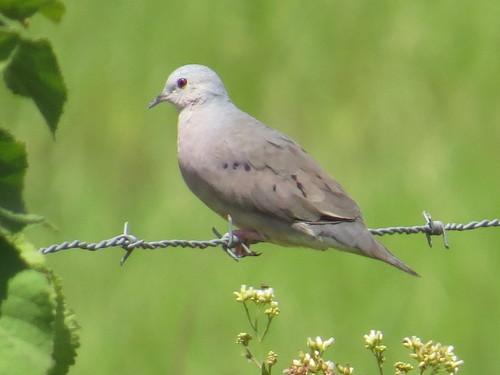 Plain-breasted Ground Dove
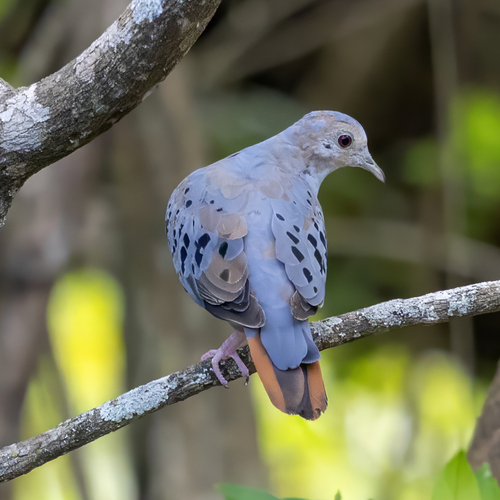 Blue Ground Dove
In short
The most reliable field mark between these two is the presence or absence of bold wing spotting: Blue Ground Dove (especially adult males) shows prominent black or chestnut spots on the wings, while Plain-breasted Ground Dove has only subtle dark violet spots on paler wings. Juvenile Blue Ground Doves have ruddy scaling on the back, which is never shown by Plain-breasted. Structurally, Blue Ground Dove is noticeably larger and heavier-bodied, with a stouter appearance in the field. Plain-breasted Ground Dove lacks the scaled or speckled feathering on the head and breast that is typical of Common Ground Dove, and is overall plainer and smaller than Blue Ground Dove. Sex and age differences are important: female and immature Blue Ground Doves are browner and show chestnut wing spots, while Plain-breasted remains more uniformly colored and lacks strong contrast.
Identification tips
- Wing spotting in flight or at rest: Adult Blue Ground Doves (especially males) show bold black (male) or chestnut (female/immature) spots on the wings, often forming a band; Plain-breasted Ground Dove has only subtle dark violet spots on paler wings, never forming a strong band. This is the single most reliable mark in all ages.
- Juvenile/immature back pattern: Juvenile Blue Ground Doves have ruddy scaling on the back; Plain-breasted Ground Dove never shows this feature at any age.
- Overall size and structure: Blue Ground Dove is much larger and heavier, with a bulkier body and longer tail. Plain-breasted Ground Dove is tiny and delicate, often appearing noticeably smaller than other ground doves.
- Male plumage: Adult male Blue Ground Dove is blue-grey above, paler below, with a contrasting pale face and bold black wing spots; Plain-breasted Ground Dove is uniformly dark grey-brown, with no strong contrast or blue tones.
- Female/immature plumage: Female Blue Ground Dove is brownish with a ruddy back and chestnut rump/tail, and chestnut wing spots. Plain-breasted Ground Dove females are similar to males, lacking the ruddy or chestnut tones and strong color contrasts.
- Breast and head pattern: Plain-breasted Ground Dove has a plain, unmarked breast and head, lacking any scaled or speckled appearance. Blue Ground Dove males have a clean, pale face, while females show some contrast between head and back.
- Underwing color: Plain-breasted Ground Dove has mostly rufous underwings, which may be visible in flight; Blue Ground Dove females have pale blue-grey underwings.
- Bill, legs, and eye color: Plain-breasted Ground Dove has a grey bill, pink legs, and reddish eyes. Blue Ground Dove has a red or yellow iris, green bare eyering, and flesh-pink legs (these may be hard to see in the field).
- Behavior in pairs: Blue Ground Dove is often seen as a blue-grey and brown bird flying together (male and female); Plain-breasted Ground Dove is more often solitary or in small, uniform groups.
- Habitat context: In humid, wooded, or forest edge habitats, Blue Ground Dove is more likely; in dry, open country, Plain-breasted Ground Dove is more typical.
- Confusion with other doves: Plain-breasted Ground Dove can be confused with Common Ground Dove, but lacks the scaled head and neck. Blue Ground Dove females may resemble female Ruddy Ground Dove, but are larger and have chestnut (not blackish) wing spots.
- Flight style: Blue Ground Dove has a more powerful, steady flight; Plain-breasted Ground Dove's flight is quick and fluttery, matching its small size.
- Sexual dimorphism: Blue Ground Dove shows strong sexual dimorphism (blue-grey male, brownish female); Plain-breasted Ground Dove is much less sexually dimorphic, with both sexes similar.
- Group composition: If you see a mixed pair (blue-grey and brown) together, it's likely Blue Ground Dove; Plain-breasted Ground Dove groups are more uniform in color.
- When in doubt, focus on wing pattern and size: These two marks—wing spotting and overall size—are the most consistently reliable for separating these species in all ages and sexes.
Size
Blue Ground Dove is substantially larger and heavier: adults are about 20 cm long and weigh 65–72 g [wikidata], while Plain-breasted Ground Dove is only 14.5–16 cm and 24–42 g [wikipedia]. In the field, Blue Ground Dove appears bulkier and more robust, with a heavier build and a slightly longer tail. Plain-breasted Ground Dove is one of the smallest columbids by mass and looks distinctly petite, especially when seen side by side or in mixed flocks.
Plumage
- Juveniles/immatures: Juvenile Blue Ground Doves show ruddy scaling on the back, a feature never present in Plain-breasted Ground Dove. Immature Blue Ground Doves (like females) have chestnut-brown spots in the wings, while Plain-breasted Ground Dove's wing spots are dark violet but much less bold and never chestnut.
- Adult males: Blue Ground Dove males are blue-grey above with paler grey underparts and bold black wing spots (often forming bands), blackish flight feathers, and a grey-white face. Plain-breasted Ground Dove is dark grey to brown overall, with paler wings and subtle dark violet spots, and rufous underwings. It lacks any bold banding or strong contrast in the wings.
- Adult females: Female Blue Ground Dove has a grey-brown head, neck, and breast, pale blue-grey underwings and belly, a ruddy brown back, and chestnut rump/tail, with chestnut wing spots. Plain-breasted Ground Dove females are similar to males but slightly paler, and lack the strong color contrasts and chestnut tones of Blue Ground Dove females.
- Head and breast: Plain-breasted Ground Dove is named for its unmarked, plain breast, lacking the scaled or speckled appearance seen in some similar species. Blue Ground Dove males have a clean, pale face, while females are more muted but still show contrast between head, back, and rump.
Behaviour
Both species are ground-foraging doves, but Blue Ground Dove often forages in pairs (sometimes a blue-grey male and brownish female together), which can be a clue. Plain-breasted Ground Dove is more likely to be seen singly or in small groups and tends to be more inconspicuous due to its smaller size and plainer coloration. In flight, Blue Ground Dove's larger size and more robust wingbeats are noticeable compared to the quick, fluttery flight of Plain-breasted.
Habitat
Both species can occur in open country, forest edges, and scrub, but Blue Ground Dove is more often found in humid tropical regions and can be seen in more wooded or edge habitats. Plain-breasted Ground Dove is typically found in open, drier areas and avoids dense forest. Local abundance may differ: in some regions, Blue Ground Dove is less common and more localized, while Plain-breasted Ground Dove may be overlooked due to its small size and cryptic plumage.
Plain-breasted Ground Dove · Blue Ground Dove · My Tricky Birds