Birdr

Plain-coloured Tanager vs Blue Dacnis

Tangara inornata versus Dacnis cayana

Play a quiz with Plain-coloured Tanager and Blue Dacnis
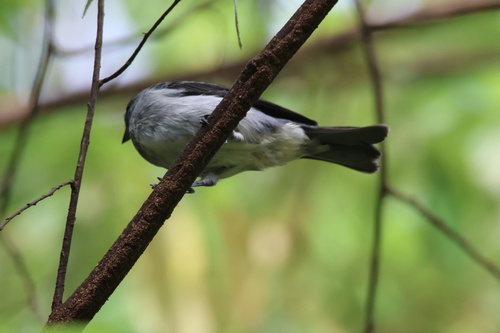
Plain-coloured Tanager (Tangara inornata) Plain-coloured Tanager
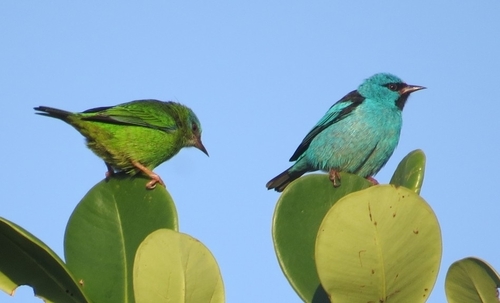
Blue Dacnis (Dacnis cayana) Blue Dacnis

Media

Loading…

In short

The Plain-colored Tanager and the Blue Dacnis can be distinguished by their plumage and behavior. The Plain-colored Tanager is more uniformly colored, while the Blue Dacnis exhibits striking blue and black plumage. Both species are found in similar habitats but have different foraging behaviors.

Identification tips

  1. Look for the uniform plumage of the Plain-colored Tanager versus the bright blue and black of the male Blue Dacnis. 2. Observe behavior: Plain-colored Tanagers are less acrobatic than Blue Dacnis. 3. Note the habitat: both can be found at forest edges, but Blue Dacnis may be higher in the canopy.

Size

Both species are similar in size, typical of small tanagers.

Plumage

The Plain-colored Tanager is mostly dull grayish or olive with no striking color contrasts, living up to its name. In contrast, the Blue Dacnis male is bright turquoise-blue with black on the face and wings, while the female is greenish with a blue head.

Behaviour

Plain-colored Tanagers often forage in pairs or small groups and may join mixed-species flocks. Blue Dacnis are more acrobatic, often seen foraging for insects on leaves and paying attention to leaf damage.

Habitat

Both species are found at forest edges and in second growth woodland, but the Blue Dacnis may also be seen in the canopy of taller trees.

Voice

Vocalizations are not well-documented for these species, but generally, tanagers have simple, high-pitched calls.

Submit a better description

Use the same sections as the comparison. Your text is published immediately.

The Plain-colored Tanager and the Blue Dacnis can be distinguished by their plumage and behavior. The Plain-colored Tanager is more uniformly colored, while the Blue Dacnis exhibits striking blue and black plumage. Both species are found in similar habitats but have different foraging behaviors.

  1. Look for the uniform plumage of the Plain-colored Tanager versus the bright blue and black of the male Blue Dacnis. 2. Observe behavior: Plain-colored Tanagers are less acrobatic than Blue Dacnis. 3. Note the habitat: both can be found at forest edges, but Blue Dacnis may be higher in the canopy.

Both species are similar in size, typical of small tanagers.

The Plain-colored Tanager is mostly dull grayish or olive with no striking color contrasts, living up to its name. In contrast, the Blue Dacnis male is bright turquoise-blue with black on the face and wings, while the female is greenish with a blue head.

Plain-colored Tanagers often forage in pairs or small groups and may join mixed-species flocks. Blue Dacnis are more acrobatic, often seen foraging for insects on leaves and paying attention to leaf damage.

Both species are found at forest edges and in second growth woodland, but the Blue Dacnis may also be seen in the canopy of taller trees.

Vocalizations are not well-documented for these species, but generally, tanagers have simple, high-pitched calls.

Discard your changes?

You have unsaved edits. If you leave now, those changes will be lost.

Plain-coloured Tanager · Blue Dacnis · My Tricky Birds