Birdr

Plumbeous Kite vs Long-winged Harrier

Ictinia plumbea versus Circus buffoni

Play a quiz with Plumbeous Kite and Long-winged Harrier

Plumbeous Kite (Ictinia plumbea) Plumbeous Kite
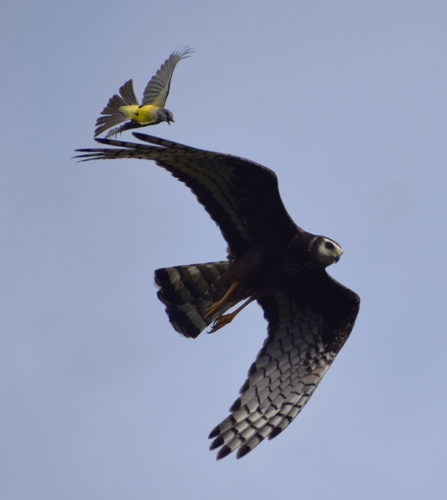
Long-winged Harrier (Circus buffoni) Long-winged Harrier

Media

Loading…

In short

The Plumbeous Kite and Long-winged Harrier can be distinguished by their wing shape and flight style. The Plumbeous Kite has long, pointed wings and a buoyant flight, while the Long-winged Harrier has broader wings and a more gliding flight pattern. Both species share a similar grayish plumage but differ in their tail and wing markings.

Identification tips

  1. Wing Shape: Look for the Plumbeous Kite's pointed wings versus the Long-winged Harrier's broader wings. 2. Tail Pattern: Note the Plumbeous Kite's plain tail against the Long-winged Harrier's banded or patterned tail. 3. Flight Style: Observe the Plumbeous Kite's buoyant flight compared to the Long-winged Harrier's gliding, low flight. 4. Habitat: Consider the environment; kites in wooded areas, harriers in open fields.

Size

The Plumbeous Kite is generally smaller and more compact compared to the larger and more elongated Long-winged Harrier.

Plumage

The Plumbeous Kite has a uniform slate-gray plumage with a slightly lighter head and a dark tail with no bands. In contrast, the Long-winged Harrier features a more varied plumage with a white rump and a tail that often shows bands or a distinct pattern.

Behaviour

Plumbeous Kites are known for their agile, buoyant flight, often seen soaring or gliding with minimal wingbeats. Long-winged Harriers exhibit a more deliberate, gliding flight, often flying low over open areas.

Habitat

Plumbeous Kites are typically found in forested areas and open woodlands, while Long-winged Harriers prefer open grasslands, marshes, and agricultural fields.

Voice

Vocalizations are not a primary distinguishing feature between these two species, as both are relatively silent, especially when compared to other raptors.

Submit a better description

Use the same sections as the comparison. Your text is published immediately.

The Plumbeous Kite and Long-winged Harrier can be distinguished by their wing shape and flight style. The Plumbeous Kite has long, pointed wings and a buoyant flight, while the Long-winged Harrier has broader wings and a more gliding flight pattern. Both species share a similar grayish plumage but differ in their tail and wing markings.

  1. Wing Shape: Look for the Plumbeous Kite's pointed wings versus the Long-winged Harrier's broader wings. 2. Tail Pattern: Note the Plumbeous Kite's plain tail against the Long-winged Harrier's banded or patterned tail. 3. Flight Style: Observe the Plumbeous Kite's buoyant flight compared to the Long-winged Harrier's gliding, low flight. 4. Habitat: Consider the environment; kites in wooded areas, harriers in open fields.

The Plumbeous Kite is generally smaller and more compact compared to the larger and more elongated Long-winged Harrier.

The Plumbeous Kite has a uniform slate-gray plumage with a slightly lighter head and a dark tail with no bands. In contrast, the Long-winged Harrier features a more varied plumage with a white rump and a tail that often shows bands or a distinct pattern.

Plumbeous Kites are known for their agile, buoyant flight, often seen soaring or gliding with minimal wingbeats. Long-winged Harriers exhibit a more deliberate, gliding flight, often flying low over open areas.

Plumbeous Kites are typically found in forested areas and open woodlands, while Long-winged Harriers prefer open grasslands, marshes, and agricultural fields.

Vocalizations are not a primary distinguishing feature between these two species, as both are relatively silent, especially when compared to other raptors.

Discard your changes?

You have unsaved edits. If you leave now, those changes will be lost.

Plumbeous Kite · Long-winged Harrier · My Tricky Birds