Birdr

Plumbeous Redstart vs White-capped Redstart

Phoenicurus fuliginosus versus Phoenicurus leucocephalus

Play a quiz with Plumbeous Redstart and White-capped Redstart

Plumbeous Redstart (Phoenicurus fuliginosus) Plumbeous Redstart
White-capped Redstart (Phoenicurus leucocephalus) White-capped Redstart

Media

Loading…

In short

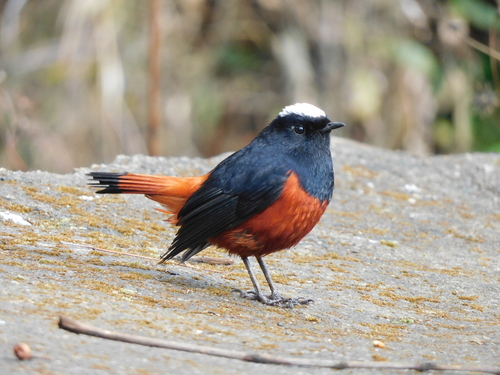
The Plumbeous Redstart and White-capped Redstart are both small, active birds often found near streams. The most reliable way to distinguish them is by their head markings: the White-capped Redstart has a distinctive white cap, while the Plumbeous Redstart lacks this feature. Both species are similar in size and behavior, but their plumage and vocalizations offer additional clues.

Identification tips

  1. Look for the white cap on the White-capped Redstart, absent in the Plumbeous Redstart. 2. Note the slate-blue coloration of the Plumbeous Redstart compared to the black body of the White-capped Redstart. 3. Observe their behavior near streams; both are active, but the head markings are key. 4. Listen for song differences, though these can be subtle.

Size

Both species are similar in size, typical of small Old World flycatchers.

Plumage

The Plumbeous Redstart is mostly slate-blue with a dark head and bright rufous tail. In contrast, the White-capped Redstart features a striking white cap, black body, and also a rufous tail. These head markings are the most distinctive difference.

Behaviour

Both species are often seen flitting around streams, exhibiting similar active behaviors such as tail-fanning and wing-flicking.

Habitat

Both species prefer habitats near fast-flowing streams and rivers, often in mountainous regions.

Voice

Vocalizations are not the most reliable distinguishing feature, but the White-capped Redstart's song is generally more varied and complex compared to the simpler song of the Plumbeous Redstart.

Submit a better description

Use the same sections as the comparison. Your text is published immediately.

The Plumbeous Redstart and White-capped Redstart are both small, active birds often found near streams. The most reliable way to distinguish them is by their head markings: the White-capped Redstart has a distinctive white cap, while the Plumbeous Redstart lacks this feature. Both species are similar in size and behavior, but their plumage and vocalizations offer additional clues.

  1. Look for the white cap on the White-capped Redstart, absent in the Plumbeous Redstart. 2. Note the slate-blue coloration of the Plumbeous Redstart compared to the black body of the White-capped Redstart. 3. Observe their behavior near streams; both are active, but the head markings are key. 4. Listen for song differences, though these can be subtle.

Both species are similar in size, typical of small Old World flycatchers.

The Plumbeous Redstart is mostly slate-blue with a dark head and bright rufous tail. In contrast, the White-capped Redstart features a striking white cap, black body, and also a rufous tail. These head markings are the most distinctive difference.

Both species are often seen flitting around streams, exhibiting similar active behaviors such as tail-fanning and wing-flicking.

Both species prefer habitats near fast-flowing streams and rivers, often in mountainous regions.

Vocalizations are not the most reliable distinguishing feature, but the White-capped Redstart's song is generally more varied and complex compared to the simpler song of the Plumbeous Redstart.

Discard your changes?

You have unsaved edits. If you leave now, those changes will be lost.

Plumbeous Redstart · White-capped Redstart · My Tricky Birds