Birdr

Pomarine Skua vs South Polar Skua

Stercorarius pomarinus versus Stercorarius maccormicki

Play a quiz with Pomarine Skua and South Polar Skua
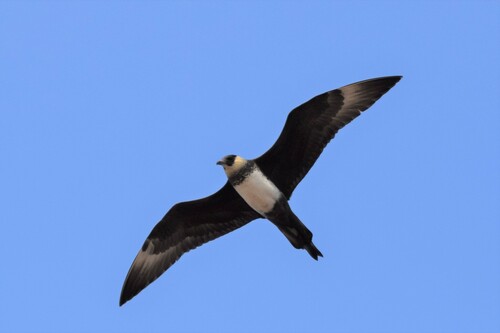
Pomarine Skua (Stercorarius pomarinus) Pomarine Skua
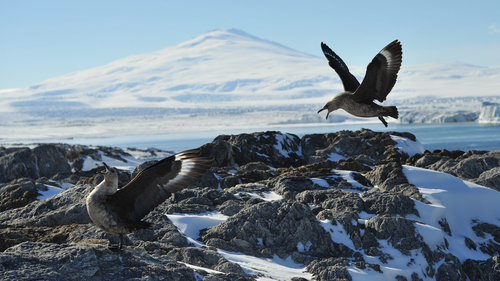
South Polar Skua (Stercorarius maccormicki) South Polar Skua

Media

Loading…

In short

The South Polar Skua (Stercorarius maccormicki) and the Pomarine Skua (Stercorarius pomarinus) can both be challenging to distinguish in the field due to their similar appearances. However, key differences lie in their plumage coloration, size, and distinctive flight patterns. The South Polar Skua typically exhibits a more consistent cold-toned plumage with a notable "skua flash," while the Pomarine Skua is characterized by its more variable coloration and distinctively shaped wing morphology.

Identification tips

  1. Birds of the World Similar-Species Diagnostics:
  2. The South Polar Skua is distinguished by its contrasting plumage dominated by cold tones and the absence of rufous, with a white "skua flash" along the primary bases of all plumages. Adults exhibit a buffy yellow nape and hindneck, absent in juveniles.
  3. The Pomarine Skua has both dark and light morphs, with dark morphs being scarce. The adult Pomarine Skua's flight style is characterized by a more elongated body and longer wings compared to the South Polar Skua, making it more acrobatic in flight.

  4. AI Field Diagnostics:

  5. When trying to distinguish between these two skuas, pay attention to the size and shape of the wings. The Pomarine Skua’s wings are more pointed and elongated, while the South Polar Skua’s wings are broader and more robust.
  6. Observe the plumage closely; if the bird has a distinct white "skua flash" and lacks any rufous tones, it is likely a South Polar Skua. The Pomarine Skua can appear more uniformly brown or warm-toned, especially in lighter morphs.
  7. Listen for vocalizations; the South Polar Skua has a harsher, more grating call, while the Pomarine Skua has a unique "kak" sound.
  8. Lastly, consider their behavior; the Pomarine Skua is often more agile and dynamic in flight, whereas the South Polar Skua tends to have a more powerful, soaring flight.

By focusing on these key differences, birdwatchers can effectively identify and distinguish between the South Polar Skua and the Pomarine Skua in the field.

Size

Plumage

Behaviour

Habitat

Voice

Submit a better description

Use the same sections as the comparison. Your text is published immediately.

The South Polar Skua (Stercorarius maccormicki) and the Pomarine Skua (Stercorarius pomarinus) can both be challenging to distinguish in the field due to their similar appearances. However, key differences lie in their plumage coloration, size, and distinctive flight patterns. The South Polar Skua typically exhibits a more consistent cold-toned plumage with a notable "skua flash," while the Pomarine Skua is characterized by its more variable coloration and distinctively shaped wing morphology.

  1. Birds of the World Similar-Species Diagnostics:
  2. The South Polar Skua is distinguished by its contrasting plumage dominated by cold tones and the absence of rufous, with a white "skua flash" along the primary bases of all plumages. Adults exhibit a buffy yellow nape and hindneck, absent in juveniles.
  3. The Pomarine Skua has both dark and light morphs, with dark morphs being scarce. The adult Pomarine Skua's flight style is characterized by a more elongated body and longer wings compared to the South Polar Skua, making it more acrobatic in flight.

  4. AI Field Diagnostics:

  5. When trying to distinguish between these two skuas, pay attention to the size and shape of the wings. The Pomarine Skua’s wings are more pointed and elongated, while the South Polar Skua’s wings are broader and more robust.
  6. Observe the plumage closely; if the bird has a distinct white "skua flash" and lacks any rufous tones, it is likely a South Polar Skua. The Pomarine Skua can appear more uniformly brown or warm-toned, especially in lighter morphs.
  7. Listen for vocalizations; the South Polar Skua has a harsher, more grating call, while the Pomarine Skua has a unique "kak" sound.
  8. Lastly, consider their behavior; the Pomarine Skua is often more agile and dynamic in flight, whereas the South Polar Skua tends to have a more powerful, soaring flight.

By focusing on these key differences, birdwatchers can effectively identify and distinguish between the South Polar Skua and the Pomarine Skua in the field.

  • South Polar Skua: Typically measures about 53 to 60 cm in length with a wingspan of approximately 130 to 150 cm. It has a robust body and a relatively large head.
  • Pomarine Skua: Slightly larger, it ranges from 54 to 61 cm long with a wingspan that can reach up to 155 cm. It has a more elongated body and longer wings compared to the South Polar Skua.
  • South Polar Skua: Exhibits two morphs: the pale morph is distinctive with light-colored plumage, while the dark morph is dominated by cold tones with no rufous hues. All plumages feature a contrasting white "skua flash" along the primary bases and a buffy yellow nape in adults, which is absent in juveniles.
  • Pomarine Skua: Offers more variation, with both dark and light morphs present, though dark morphs are relatively scarce (<15% of the population). The light morph is more uniform and often has a more brownish or warm tone overall than the South Polar Skua. Notably, the Pomarine Skua’s wings are more pointed at the tips, giving it a sleeker appearance in flight.
  • South Polar Skua: Known for its aggressive behavior, particularly during breeding season. It often scavenges and preys on smaller birds, showing a characteristic soaring flight style.
  • Pomarine Skua: Displays a more acrobatic flight style with a tendency to hunt for food in a more opportunistic manner, often engaging in piracy against other seabirds. Its reproductive ecology is more localized and episodic.
  • South Polar Skua: Breeds in sub-Antarctic regions and along the Antarctic Peninsula, preferring coastal areas for nesting. Outside the breeding season, it migrates north to open ocean waters.
  • Pomarine Skua: Primarily breeds in the Arctic tundra of northern Alaska and parts of Siberia, favoring marshy areas near water bodies. In winter, it migrates to oceanic waters in the southern hemisphere.
  • South Polar Skua: Vocalizations include harsh, grating calls that can be quite loud and are often used during aggressive interactions.
  • Pomarine Skua: Generally emits a variety of harsh calls, including a distinctive "kak" sound, especially during breeding season.

Discard your changes?

You have unsaved edits. If you leave now, those changes will be lost.

Pomarine Skua · South Polar Skua · My Tricky Birds