

Purple-crowned Fairy vs Green Thorntail
Heliothryx barroti versus Discosura conversii
Play a quiz with Purple-crowned Fairy and Green Thorntail
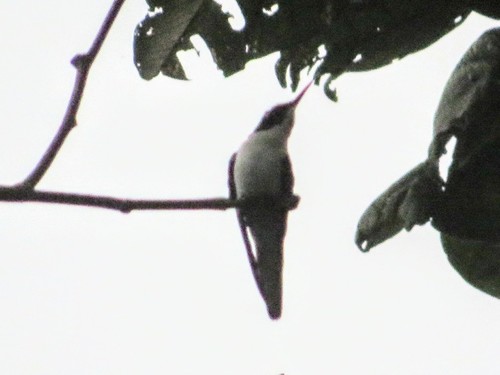 Purple-crowned Fairy
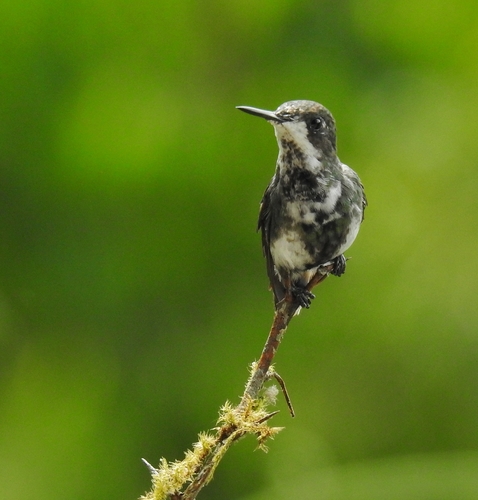 Green Thorntail
In short
The most reliable field mark to separate Purple-crowned Fairy from Green Thorntail is tail shape and pattern: adult male Green Thorntails have a deeply forked, very narrow tail, while Purple-crowned Fairy of all ages and sexes has a long, pointed tail with blue-black central feathers and white outer feathers. Immature Purple-crowned Fairies show cinnamon fringes on the upperparts and sparse dusky spots on the underparts, which are never present in Green Thorntail. Female Green Thorntails have a broad white cheek patch and a notched (not forked) tail, while female Purple-crowned Fairies lack the cheek patch and have a green crown. Both species are small, slender hummingbirds, but the Green Thorntail is noticeably lighter and, in males, more compact with a shorter bill. In flight or perched, focus on tail shape, cheek pattern, and underpart coloration for the quickest separation.
Identification tips
- Tail shape and structure (all ages/sexes): Male Green Thorntail has a deeply forked, extremely narrow tail—almost threadlike—while Purple-crowned Fairy (both sexes, all ages) has a long, pointed tail with blue-black central and white outer feathers. Female Green Thorntail has a notched, not forked, tail with complex color patterning; Purple-crowned Fairy female's tail is long, pointed, and lacks the notched/forked look.
- Juvenile/immature marks: Immature Purple-crowned Fairy shows cinnamon fringes on upperparts and sparse dusky spots on throat and breast—never seen in Green Thorntail of any age. Green Thorntail juveniles only differ from adults by a grayish white chin.
- Crown and face (adult males): Purple-crowned Fairy male has a metallic violet forecrown and a black eye patch with a violet spot and green below; Green Thorntail male has a dark green crown with no violet or facial spots.
- Crown and face (adult females): Female Purple-crowned Fairy has a green crown and less black on the face, lacking any white cheek patch. Female Green Thorntail has a broad white cheek patch and a dull black chin with white spots.
- Underparts: Purple-crowned Fairy (all ages/sexes) has pure white underparts; Green Thorntail male has metallic green and greenish blue underparts, female has dull black breast/belly with dull green flanks and a white spot.
- Rump and back: Green Thorntail male has a coppery bronze rump with a bold white band—very distinctive in good light. Purple-crowned Fairy has bright emerald green upperparts but no white rump band or bronze tones.
- Bill: Purple-crowned Fairy has a short, straight, black bill. Green Thorntail's bill is also short and straight, but the bird overall is more compact and lighter.
- Size and build: Purple-crowned Fairy is larger and heavier, appearing more elongated. Green Thorntail is noticeably lighter and, in males, more compact with a proportionally shorter bill and very narrow tail.
- Feeding behavior: Green Thorntail often hovers with its tail cocked at a right angle and is more strictly a canopy specialist. Purple-crowned Fairy forages at various heights and is aggressive toward other hummingbirds but less aerial in feeding style.
- Habitat context: In Costa Rica and Panama, Green Thorntail is almost always in the canopy or at flowering trees in clearings, while Purple-crowned Fairy can be found lower or at forest edges.
- Sex differences: Male Green Thorntail is more dramatically forked-tailed and metallic below; female is less so but still shows the white cheek patch and notched tail. Purple-crowned Fairy males and females differ mainly in crown color and face pattern, but both have the same tail structure.
- Plumage pitfalls: Beware of lighting: Green Thorntail's metallics can appear dark or blackish in shade, but the white rump band and cheek patch (female) are reliable. Purple-crowned Fairy's white underparts and tail pattern are consistent in all lights.
- Flight jizz: Green Thorntail's flight is more fluttery and erratic, with the tail often fanned or cocked; Purple-crowned Fairy is more direct and slender in flight.
- Voice: Not diagnostic from available notes.
- Overlap zones: In areas where both occur, focus on tail shape and underpart color first, then check for white cheek patch (female Thorntail) or violet crown (male Fairy).
Size
Purple-crowned Fairy is larger and heavier: 9–13 cm long, about 5.5 g. Green Thorntail males are 9.5–10.2 cm, but much lighter (average 3.0 g), and females are even smaller (6.6–7.5 cm). The Fairy appears more elongated and slender, while the Thorntail, especially the male, is compact with a proportionally shorter bill and a very narrow, deeply forked tail. In the field, Green Thorntail often looks daintier and lighter, especially when perched.
Plumage
- Juveniles/immatures: Purple-crowned Fairy immatures have cinnamon fringes on the upperparts and sparse dusky spots on the throat and breast. Green Thorntail juveniles are similar to adults but have a grayish white chin, lacking cinnamon or dusky spotting.
- Adult males: Purple-crowned Fairy males have a metallic violet forecrown, emerald green upperparts, pure white underparts, and a long pointed tail with blue-black central and white outer feathers. Green Thorntail males have a dark green crown, metallic green back, coppery bronze rump with bluish black, a bold white rump band, and a deeply forked, very narrow bluish black tail. Their throat is bright metallic green, with the breast and belly mostly darker green and a metallic greenish blue center.
- Adult females: Female Purple-crowned Fairies have a green crown, less black on the face, and lack the violet and green face spots of males. Their tail is long and pointed, patterned as in the male. Female Green Thorntails have a broad white cheek patch, a notched (not forked) tail, and a dull black chin with white spots. Their underparts are dull black with dull green flanks and a white spot, and the tail pattern is complex: all but the outermost pair of tail feathers are bluish black with dark green bases; the outermost have white bases, blue-black middle, and white tips.
Behaviour
Purple-crowned Fairy mostly forages in the mid-story and canopy, sometimes lower at forest edges, and is aggressive toward other hummingbirds but not strongly territorial. It gleans spiders and other arthropods from foliage, rarely hawking insects. Green Thorntail forages almost exclusively in the canopy, favoring flowering trees and often hovering with its tail cocked at a sharp angle. It also hawks insects from a perch, and males display from high bare twigs. In the field, Green Thorntail's feeding style is more aerial and its tail is often held at a right angle to the body.
Habitat
Purple-crowned Fairy ranges from southeastern Mexico to northern Peru, mostly in humid lowland and foothill forests, foraging from mid-story to canopy and sometimes at edges. Green Thorntail is found from Costa Rica to Ecuador, mainly in humid montane and lowland evergreen forests, but is more strictly a canopy and edge specialist, usually at 300–1,400 m elevation. In overlap zones (Costa Rica, Panama), Green Thorntail is more likely high in the canopy at flowering trees, while Purple-crowned Fairy is more versatile in vertical foraging height.