
Purple Gallinule vs Azure Gallinule
Porphyrio martinica versus Porphyrio flavirostris
Play a quiz with Purple Gallinule and Azure Gallinule
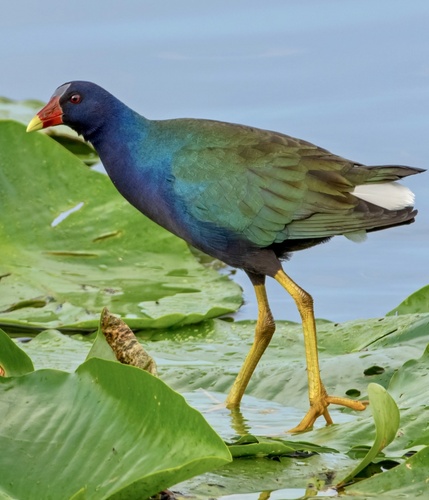 Purple Gallinule
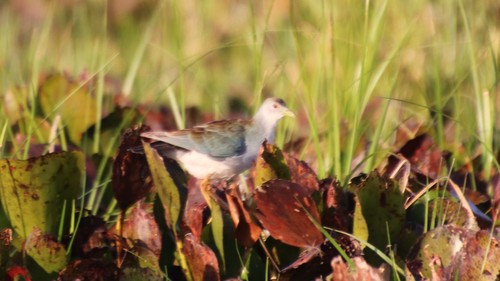 Azure Gallinule
In short
The most reliable field mark to separate Purple Gallinule from Azure Gallinule is overall plumage color in adults: Purple Gallinule is deep purple-blue with green and turquoise iridescence, while Azure Gallinule is much paler, with blue-gray underparts and olive-brown upperparts. Immature and juvenile birds are trickier, but Purple Gallinule immatures are brown-bronze with purple on the chest, whereas Azure Gallinule immatures are browner above with a buffy face and neck. Bill and shield color is also key: Purple Gallinule adults have a red-and-yellow bill with a pale blue shield, while Azure Gallinule adults have a pale greenish-yellow bill and shield. Size is a strong clue—Purple Gallinule is much larger and heavier. Leg color is helpful but varies with age. Flight views are rarely diagnostic, but leg color and dangling legs may be seen. Most confusion arises from dull-lit adult Purple Gallinules or immature birds.
Identification tips
- Adult body color: Purple Gallinule is deep purple-blue with green/turquoise iridescence; Azure Gallinule is pale blue-gray below and olive-brown above with some blue-green on the wings. This is the quickest separator in good light for adults.
- Bill and shield color (adults): Purple Gallinule has a red-and-yellow bill with a pale blue shield; Azure Gallinule has a pale greenish-yellow bill and shield. This mark is reliable at all seasons for adults.
- Leg and foot color: Both adults have yellow legs/feet, but Purple Gallinule's are brighter. Immature Purple Gallinule has brown-yellowish legs/feet; Azure Gallinule immatures have yellowish-orange legs/feet. Juvenile Purple Gallinule's legs are brown.
- Juvenile/immature plumage: Immature Purple Gallinule is brown-bronze above with purple on the chest and white undertail coverts; Azure Gallinule immature is browner above with a buffy face, neck, and breast, and a green shield. If you see purple on the chest, favor Purple Gallinule; if the face/neck is buffy and the shield green, favor Azure.
- Size and structure: Purple Gallinule is much larger and bulkier, with a heavier build and longer legs. Azure Gallinule is compact and delicate. Use this when both are present or if you have a good sense of scale.
- Flight views: Both species fly with legs dangling. No strong upperwing pattern differences are described, so rely on size, overall color, and leg color if visible.
- Face and underparts (adults): Purple Gallinule's face and underparts are purple-blue; Azure Gallinule's face, neck sides, and breast are pale blue-gray, with white lower underparts.
- Back and crown color: Purple Gallinule's back is iridescent green/blue; Azure Gallinule's is pale brownish olive, matching the crown and hindneck.
- Bill color in immatures: Immature Purple Gallinule has a pale bill and shield; Azure Gallinule immature has a green shield and pale bill.
- Undertail coverts: Juvenile Purple Gallinule shows white undertail coverts, which may be visible in some views; Azure Gallinule is less well described but does not mention this feature.
- Context and range: Outside South America, Purple Gallinule is the default. In South America, both occur, so rely on plumage and structure.
- Lighting pitfalls: In poor light, adult Purple Gallinule can look dull or brownish, resembling Azure Gallinule. Use bill/shield color and size as backup.
- Courtship/behavior: If you see display with outstretched neck and wings at right angles, it's likely Purple Gallinule, but this is rarely diagnostic in the field.
- Sex differences: Both species are similar between sexes; do not use sex as a separator.
- Seasonal movement: Azure Gallinule is more migratory within South America, but this is not a field mark unless you know local timing.
Size
Purple Gallinule is notably larger and heavier: adults average about 236 g (with males up to 257 g), and measure 26–37 cm in length with a 50–61 cm wingspan. Azure Gallinule is the smallest Porphyrio, at just 23–26 cm long and 92–111 g for males (females similar). In the field, Purple Gallinule appears bulkier and longer-legged, while Azure Gallinule is more delicate and compact. If you see both together, the size difference is obvious; alone, use structure and bill size as supporting clues.
Plumage
- Adults:
- Purple Gallinule: Striking purple-blue body with green and turquoise iridescence in good light; pale blue forehead shield, red-and-yellow bill, and bright yellow legs/feet. In poor light, can look dusky or brownish but shield and bill remain distinctive.
- Azure Gallinule: Much paler overall; pale brownish olive crown, hindneck, and back; upperwing coverts azure to greenish blue, flight feathers gray-blue; face, neck sides, and breast pale blue-gray, rest of underparts white. Bill and shield are pale greenish-yellow, legs/feet yellow.
- Immatures/Juveniles:
- Purple Gallinule: Brown-bronze above with purple on chest; pale bill and shield; legs/feet brown-yellowish (immature) or brown (juvenile); white undertail coverts.
- Azure Gallinule: Browner upperparts than adults, buffy face/neck/breast, green frontal shield, yellowish-orange legs/feet.
- Flight views:
- Both species show long, dangling legs in flight. No distinctive upperwing pattern is described for either species, so rely on overall color impression and leg color if visible.
Behaviour
Both species are marsh birds with similar habits: walking on floating vegetation using long toes, and flying short distances with legs trailing. Purple Gallinule is slightly more likely to be seen strutting or displaying with wings partly open, especially during courtship. Both are secretive but can be surprisingly bold when foraging. In flight, Purple Gallinule may appear heavier and less agile than the smaller Azure Gallinule.
Habitat
Both species inhabit marshes, lakes, and wetlands with dense emergent vegetation. Purple Gallinule is widespread in the Americas, including North, Central, and South America, and is a notable vagrant. Azure Gallinule is found in South America and Trinidad & Tobago, often moving seasonally with the wet season. If you are outside South America, Purple Gallinule is far more likely. In overlapping range, habitat is not a strong separator.