Purple Sunbird vs Black-throated Sunbird
Cinnyris asiaticus versus Aethopyga saturata
Play a quiz with Purple Sunbird and Black-throated Sunbird
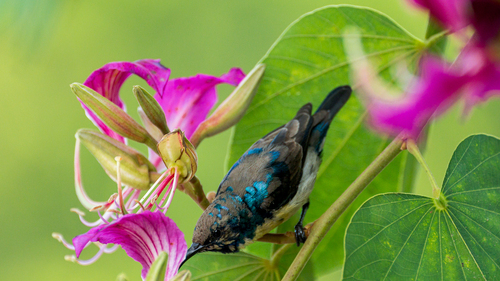
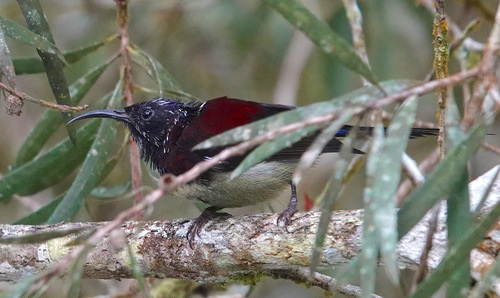
Purple Sunbird
Black-throated Sunbird
In short
The Purple Sunbird (Cinnyris asiaticus) and the Black-throated Sunbird (Aethopyga saturata) can be distinguished by their plumage and habitat preferences. The Purple Sunbird is typically found in open areas and gardens, while the Black-throated Sunbird prefers forested habitats. Males of both species are colorful, but their specific plumage patterns differ significantly.
Identification tips
- Habitat: Check the habitat; Purple Sunbirds are more common in open and urban areas, while Black-throated Sunbirds are found in forests. 2. Male Plumage: Look for the glossy purple-blue of the male Purple Sunbird versus the black throat and multicolored plumage of the male Black-throated Sunbird. 3. Female Plumage: Note the more uniform olive and yellowish tones of the female Purple Sunbird compared to the brighter yellow underparts of the female Black-throated Sunbird.
Size
Both species are small sunbirds, but the Purple Sunbird is slightly more compact compared to the more slender Black-throated Sunbird.
Plumage
Male Purple Sunbirds have a glossy purple-blue sheen, while male Black-throated Sunbirds feature a striking black throat and chest with a more varied color palette including red and green. Females of both species are less colorful, with the Purple Sunbird female being more uniformly olive above and yellowish below, whereas the Black-throated Sunbird female has a more distinct yellow underpart.
Behaviour
Both species exhibit typical sunbird behavior, such as hovering near flowers to feed on nectar. However, the Purple Sunbird is more likely to be seen in open and urban areas, while the Black-throated Sunbird is more often found in forested environments.
Habitat
Purple Sunbirds are commonly found in gardens, open woodlands, and urban areas. In contrast, Black-throated Sunbirds prefer subtropical or tropical moist lowland forests and montane forests.
Voice
Vocalizations are not a primary distinguishing feature in the field, as both species have typical sunbird calls, though the specifics of their calls may differ slightly.